
場所
ウィンブルドン・カレッジ
Wimbledon College
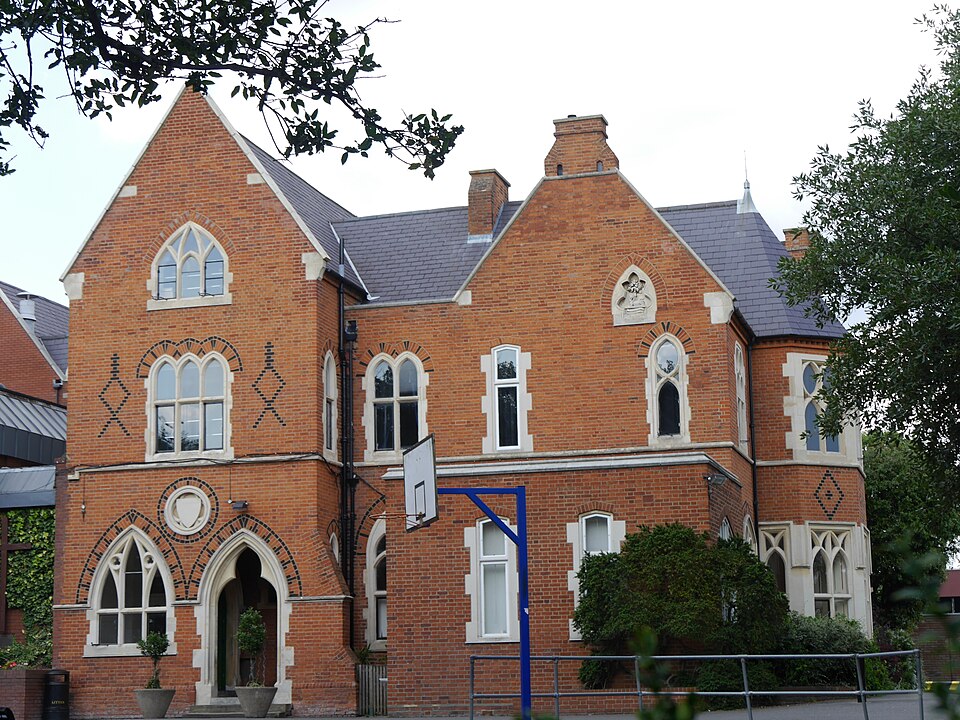
Wimbledon College is a government-maintained, voluntary-aided, Jesuit Catholic secondary school and sixth form for boys aged 11 to 19 in Wimbledon, London.
場所
Wimbledon College
Wimbledon College is a government-maintained, voluntary-aided, Jesuit Catholic secondary school and sixth form for boys aged 11 to 19 in Wimbledon, London.
この項目を含む事件ファイルで情報と関係を見てみましょう。
この項目を含む事件ファイルはまだありません。
この項目から調査する最初のコメントをお待ちしています。
Wimbledon College is a government-maintained, voluntary-aided, Jesuit Catholic secondary school and sixth form for boys aged 11 to 19 in Wimbledon, London.
Wimbledon College is a government-maintained, voluntary-aided, Jesuit Catholic secondary school and sixth form for boys aged 11 to 19 in Wimbledon, London.
The college was founded in 1892 "for improvement in living and learning for the greater glory of God and the common good." It is affiliated with the Sacred Heart Church and Donhead Preparatory School, its former feeder preparatory school. It is also affiliated with the Ursuline High School, the college's sister school, who have worked in partnership since 1986.
The school was founded on 18 January 1892, initially at the site of No. 3 Cranbrook Road. On its first day, only one student, Thomas Lloyd, was in attendance; his brother William had fallen ill. After the first academic year, six more students joined the Lloyd brothers. During this period the school moved twice, first to a property on Darlaston Road and then to a building adjoining the All England Lawn Tennis Courts. Finally, in 1893. the college acquired the former site of Wimbledon School on Edge Hill, aided by the financial backing of Edith Arendrup. Lessons began at this site on 26 June 1893; the college has not moved since.
In September 1898, the Wimbledon College Army Department was established, which trained young men for entrance into the Royal Military Academies at Sandhurst and Woolwich.
During the First World War, the college lost 129 former pupils, including Maurice Dease and Gerald Robert O'Sullivan, both of whom received the Victoria Cross. On 18 February 1922, the war memorial at the rear of the chapel and the memorial stained glass window at the front, behind the altar, were unveiled.
In 1921, John Manning, the prefect of studies, which was then the formal title for Wimbledon College's head master, introduced the house system with three houses (Fisher, More, and Campion), leading to an expansion of extracurricular activities. This was complemented with the development of a senior prefect system, with six boys managing the day-to-day discipline of the school. In 1929, eight acres of field beside Coombe Lane, in Raynes Park, was bought as a venue for the college's sporting activities; it has been in use for these purposes ever since.
In 1933, due to the growing number of pupils, the decision was made to buy Donhead Lodge, across the road from the college on Edge Hill, and establish a preparatory school there. The seventy-two pupils from Lower Preparatory, Preparatory, and Elements were taken from the college and settled at the newly instituted Wimbledon College Preparatory School (now Donhead).
The school expanded its facilities with a new wing (the St Lawrence wing) of classrooms, kitchens and toilets completed in the early 1950s; these are now predominantly used for English and science. The growth in demand for student places meant that the school quickly expanded, from n
出典: Wimbledon College (CC BY-SA)
構造化された情報、ユーザーの意見、AIが抽出した関係を区別して表示します。
John Sinnott was inaugurated as the prefect of studies in 1937; he was the first former student of the college to hold that office. Sinnott is widely seen as having pioneered the college and wider Catholic education in Britain during his thirteen years as prefect of studies, over which time he developed a careers bureau, a college orchestra, academic interhouse competitions and violin playing. Acting on concerns of fire hazards due to crowded corridors and underfunded laboratories in a 1938 inspection, and on the appetite from inspectors for his plans to expand the provision of geography lessons, Sinnott made plans to expand the college with new facilities; however, he was frustrated by the outbreak of the World War II, when tight restrictions were placed on the use of steel and timber.
During the Second World War, the functioning of the college was much more disrupted than in World War I. The college and Donhead both had cellars which, with minor adjustments, were approved by local air raid wardens. Sandbags were brought in and timber frames used to reinforce the ceilings. Since both schools were outside the evacuation area, school was allowed to proceed. Three weeks after the outbreak of war on 3 September 1939, the new school term began, albeit with a drop in attendance of one in five pupils. Because the games pitch was distant from the bomb shelters, games lessons were cancelled during the war and break was shortened. The college's swimming pool provided valuable water for the local fire brigade and, in the local community, the school acted as a first aid centre.
On the night of 18 February 1944, a bomb exploded on the Convent of the Sisters of Mary, situated on the Downs, a nearby road, killing five nuns and wounding several others. Windows and doors in the college were damaged and the roof of its swimming pool caved in; the pool was never recommissioned at that site due to the damage incurred.
The college lost fifty-eight former pupils as a result of the Second World War, including Eugene Esmonde, a recipient of the Victoria Cross. They are commemorated by a memorial above the door of the college's chapel.
Separately, during this time, Sinnott had concluded that the independent school model was not suitable, owing to the unaffordable fees required of Catholic families; in January 1942, he applied to Surrey County Council (in whose jurisdiction Wimbledon resided at the time) for deficiency aided school status, and this was granted in 1943. This allowed the college to be funded by the local education authority while retaining its religious character. Fees were abolished in March 1945. This marked the beginning of the process of the college becoming a voluntary aided grammar school, which was completed in July 1948.
In 1945, Richard Milward, a former pupil at the school, began a 40-year tenure as a history teacher (and later as the history master) at the college. A popular teacher and local historian, and president of the Wimbledon Society for six years, he was seen as a stalwart of the school.
Sinnott died in his early 50s and was replaced as prefect of studies by Ignatius St Lawrence in 1950.