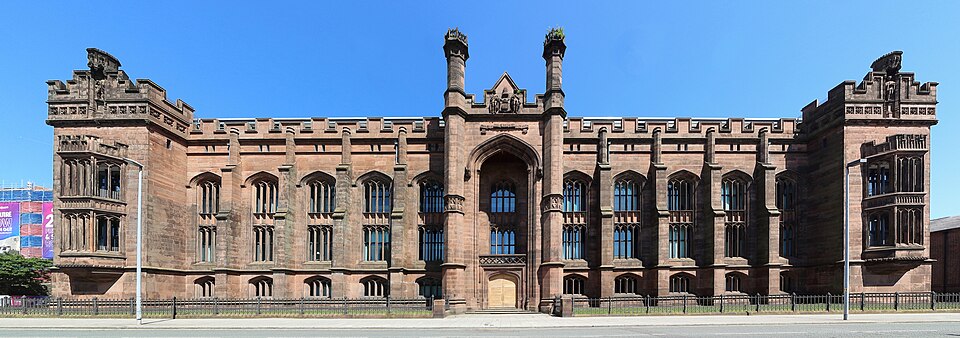
The first headmaster of the new, LEA-controlled Liverpool Collegiate School was Samuel Edward Brown, appointed in 1908, a Cambridge graduate who set out to secure academic success at a time when the mark of a great school was the number of pupils winning university scholarships. The Collegiate also started to earn an enviable reputation within the city and beyond, and pupil numbers rose from around 400 in 1908 to over 1000 by the early 1920s. Fuelled by the desire to prove itself more than a poor relation of Liverpool College, the School succeeded in attracting "first class graduates, many from Oxbridge, to teach at the Collegiate, in a depressingly urban setting in what was then an unfashionable Northern city", inspirational teachers who helped "to transform the school in a generation into one of the leading grammar schools in the country".
Yearly dramatic or musical productions were instigated, including the school tradition of staging Gilbert & Sullivan operettas which endured for half a century. A new school organ was installed by Rushworth and Dreaper in 1913. Annual School Camps began in 1914, and from the 1920s Games lessons were conducted at Holly Lodge playing fields in West Derby.
In 1929, following the death of the first headmaster, the post was taken up by Arnold MacKenzie Gibson. He embarked on a broadening of the school curriculum and wished to place as much emphasis on the 'average boy' as the high-achieving university candidate. Gibson put in place alternative routes by which boys could make progress up the school and tried to ensure that all pupils received a well-rounded education, believing the education of the whole person, for leisure as much as work, to be as important as subject specialisation. From the early 1930s more school trips were arranged including a summer school at Dunkirk, regular exchanges with pupils in France and Germany and the continuation of the customary summer camp on the Isle of Man.
A new school song, 'Paean Esmedunensis', with music by Gibson and words in Latin by his deputy, Victor Dunstan, was first performed at the Annual Prize Giving of 1931 and would last the lifetime of the Collegiate.
Yearly school plays, school concerts and exhibitions of work continued throughout the 1930s, and the headmaster was able to report rising academic achievement at successive Prize Giving ceremonies. Gibson was also urging the building of a new Collegiate building in West Derby and in 1936 the Liverpool Education Committee recommended to the City Council the purchase of land in Meadow Lane. Proposals were set aside, however, as the international situation became increasingly tense during the late 1930s. School visits to Belgium and, perhaps surprisingly, to Germany continued.