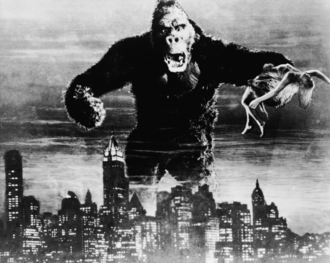
King Kong, also referred to simply as Kong, is a fictional monster, a giant gorilla who has appeared in various media since 1933. The character has become an international pop culture icon, appearing in several movies, comics, videogames and television shows. His first appearance was in the novelization of the 1933 film King Kong from RKO Pictures, with the film premiering a little over two months later.
King Kong, also referred to simply as Kong, is a fictional monster, a giant gorilla who has appeared in various media since 1933. The character has become an international pop culture icon, appearing in several movies, comics, videogames and television shows. His first appearance was in the novelization of the 1933 film King Kong from RKO Pictures, with the film premiering a little over two months later.
詳しい紹介を読む
King Kong, also referred to simply as Kong, is a fictional monster, a giant gorilla who has appeared in various media since 1933. The character has become an international pop culture icon, appearing in several movies, comics, videogames and television shows. His first appearance was in the novelization of the 1933 film King Kong from RKO Pictures, with the film premiering a little over two months later.
A sequel quickly followed that same year with The Son of Kong, featuring Little Kong. The Japanese film company Toho later produced King Kong vs. Godzilla (1962), featuring a giant Kong battling Toho's Godzilla, and King Kong Escapes (1967), a film loosely based on Rankin/Bass' The King Kong Show (1966–1969). In 1976, Dino De Laurentiis produced a modern remake of the original film directed by John Guillermin. A sequel, King Kong Lives, followed a decade later featuring a Lady Kong. Another remake of the original, set in 1933, was released in 2005 by filmmaker Peter Jackson.
Kong: Skull Island (2017), set in 1973, is part of Warner Bros. Pictures and Legendary Entertainment's Monsterverse, which began with a reboot of Godzilla in 2014. A sequel, Godzilla vs. Kong was released in 2021. It was followed by the film Godzilla x Kong: The New Empire in 2024, which featured more of Kong's kind.
King Kong has inspired a number of imitators, parodies, cartoons, books, comics, video games, theme park rides, and a stage play. The character has also crossed over into other franchises such as Godzilla, Planet of the Apes, Doc Savage, Tarzan, The Rocketeer, and the Justice League. His role in the different narratives varies, ranging from an egregious monster to a tragic antihero.
Overview
The King Kong character was conceived and created by American filmmaker Merian C. Cooper. In the original film, the character's name is Kong, a name given to him by the inhabitants of the fictional "Skull Island" in the Indian Ocean, where Kong lives along with other oversized animals, such as plesiosaurs, pterosaurs, and various dinosaurs. An American film crew, led by Carl Denham, captures Kong and takes him to New York City to be exhibited as the "Eighth Wonder of the World".
Kong escapes and climbs the Empire State Building, only to fall from the skyscraper after being attacked by weaponized biplanes. Denham comments, "It wasn't the aeroplanes, it was beauty killed the beast", for he climbs the building in the first place only in an attempt to protect Ann Darrow, an actress originally kidnapped by the natives of the island and offered up to Kong as a sacrifice (in the 1976 remake, her character is named "Dwan").
A pseudo-documentary about Skull Island that appears on the DVD for the 2005 remake (originally seen on the Sci-Fi Channel at the time of its theatrical release) gives Kong's scientific name as Megaprimatus kong ("Megaprimatus", deriving from the prefix "mega-" and the Latin words "primate" and "primatus", means "big primate" or "big supreme being") and states that his species may be related to Gigantopithecus, but that genus of giant ape is more closely related to orangutans than to gorillas.
Merian C. Cooper became fascinated by gorillas at the age of six. In 1899, he was given a book from his uncle called Explorations and Adventures in Equatorial Africa. The book, written in 1861, chronicled the adventures of Paul Du Chaillu in Africa and his various encounters with the natives and wildlife there. Cooper became fascinated with the stories involving the gorillas, in particular, Du Chaillu's depiction of a particular gorilla known for its "extraordinary size", that the natives described as "invincible" and the "King of the African Forest". When Du Chaillu and some natives encountered a gorilla later in the book he described it as a "hellish dream creature" that was "half man, half beast".
As an adult, Cooper became involved in the motion picture industry. While filming The Four Feathers in Africa, he came into contact with a family of baboons. This gave him the idea to make a picture about primates. A year later when he got to RKO, Cooper wanted to film a "terror gorilla picture". As the story was being fleshed out, Cooper decided to make his gorilla giant sized. Cooper stated that the idea of Kong fighting warplanes on top of a building came from him seeing a plane flying over the New York Insurance Building, then the tallest building in the world. He came up with the ending before the rest of the story as he stated: "Without any conscious effort of thought I immediately saw in my mind's eye a giant gorilla on top of the building". Cooper also was influenced by Douglas Burden's accounts of the Komodo dragon, and wanted to pit his terror gorilla against dinosaur-sized versions of these reptiles, stating to Burden: "I also had firmly in mind to giantize both the gorilla and your dragons to make them really huge. However I always believed in personalizing and focusing attention on one main character and from the very beginning I intended to make it the gigantic gorilla, no matter what else I surrounded him with". Around this time, Cooper began to refer to his project as a "giant terror gorilla picture" featuring "a gigantic semi-humanoid gorilla pitted against modern civilization".
When designing King Kong, Cooper wanted him to be a nightmarish gorilla monster. As he described Kong in a 1930 memo: "His hands and feet have the size and strength of steam shovels; his girth is that of a steam boiler. This is a monster with the strength of a hundred men. But more terrifying is the head—a nightmare head with bloodshot eyes and jagged teeth set under a thick mat of hair, a face half-beast half-human". Willis O'Brien created an oil painting depicting the giant gorilla menacing a jungle heroine and hunter for Cooper, but when it came time for O'Brien and Marcel Delgado to sculpt the animation model, Cooper decided to backpedal on the half-human look for the creature and became adamant that Kong be a gorilla. O'Brien on the o