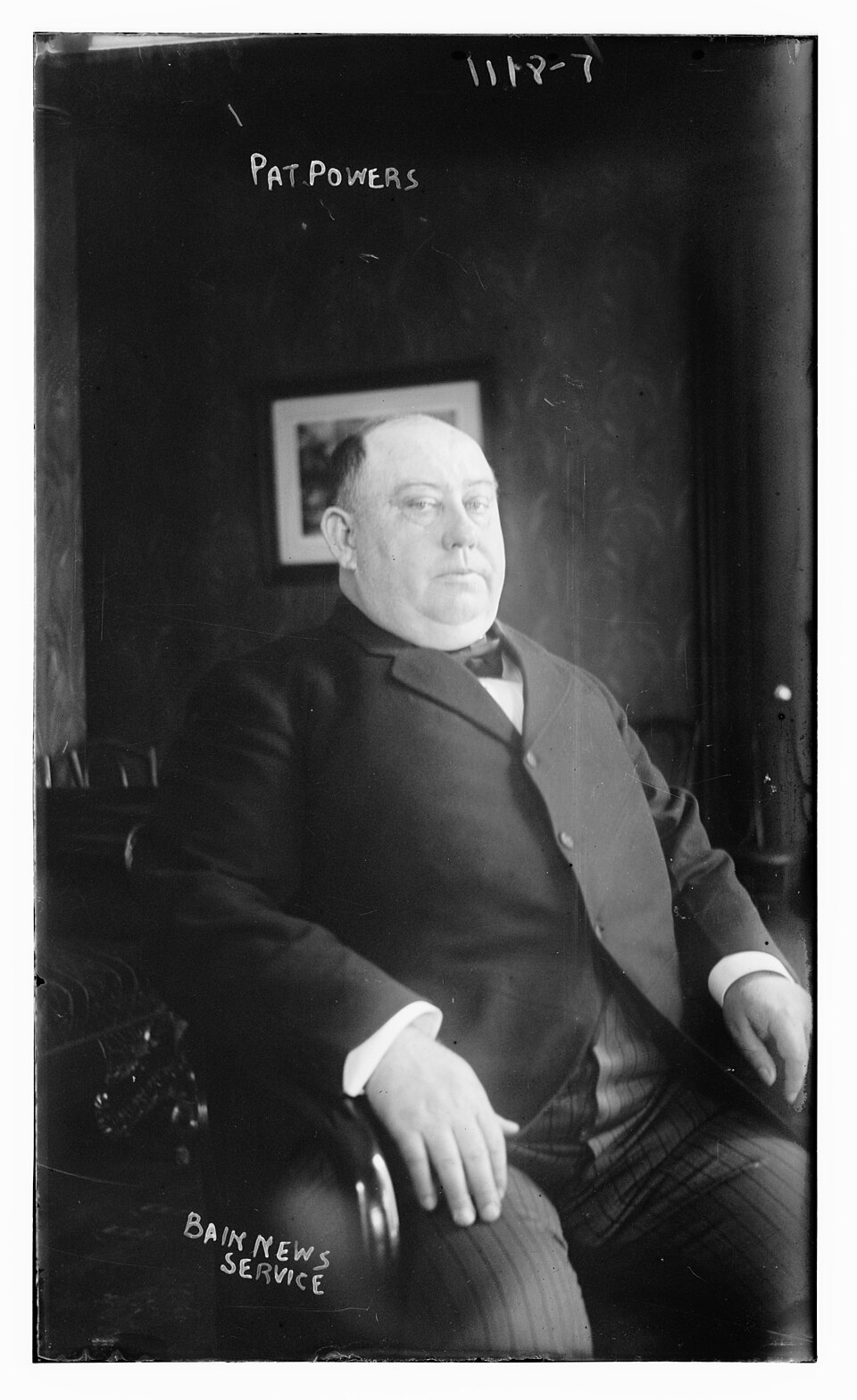
Patrick Anthony Powers was an Irish-American producer who was involved in the movie and animation industry from the 1910s to 1930s. He established Powers' Cinephone Moving Picture Company, also known as Powers Picture Plays. His firm, Celebrity Productions, was the first distributor of Walt Disney's Mickey Mouse cartoons (1928–1929). After one year, Disney split with Powers, who started the animation studio Iwerks Studio with Disney's lead animator, Ub Iwerks.
Patrick Anthony Powers was an Irish-American producer who was involved in the movie and animation industry from the 1910s to 1930s. He established Powers' Cinephone Moving Picture Company, also known as Powers Picture Plays. His firm, Celebrity Productions, was the first distributor of Walt Disney's Mickey Mouse cartoons (1928–1929). After one year, Disney split with Powers, who started the animation studio Iwerks Studio with Disney's lead animator, Ub Iwerks.
詳しい紹介を読む
Patrick Anthony Powers (October 8, 1869 – July 30, 1948) was an Irish-American producer who was involved in the movie and animation industry from the 1910s to 1930s. He established Powers' Cinephone Moving Picture Company, also known as Powers Picture Plays. His firm, Celebrity Productions, was the first distributor of Walt Disney's Mickey Mouse cartoons (1928–1929). After one year, Disney split with Powers, who started the animation studio Iwerks Studio with Disney's lead animator, Ub Iwerks.
Early career
Powers was born in Waterford, Ireland. According to the Buffalo Courier-Express obituary dated August 1, 1948, his sister, Mary Ellen Powers, lived in Buffalo for her entire life.
Terry Ramsaye, a movie pioneer like Pat Powers, spoke affectionately of his friend: "His first job was as a blacksmith's helper. He was impressed by the amount of labor it involved and immediately gave evidence of executive ability by organizing a union to raise his own pay. He had a flair for politics, too, and presently acquired a less strenuous post with the police department." Ramsaye recalled how entrepreneurial Powers was, quoting Powers's philosophy: "I would rather make 10 dollars in a fast trade than to earn a thousand." Ramsaye concluded, "Pat Powers got what he came over [from ] for -- action, success, and enough controversy to keep him interested."
The 1920s
In 1912, Powers had led his own filmmaking company, part of multiple mergers that created Universal Pictures. In 1920, studio president Carl Laemmle and vice president R. H. Cochrane bought out treasurer Powers. As reported by Motion Picture News, "P. A. Powers's other interests are demanding so much of his time that an option on his Universal stock has been given Messrs. Laemmle and Cochrane." Powers left Universal to resume independent production.
The Robertson-Cole production company was reorganized in 1922 as Film Booking Office of America (FBO), and Pat Powers, as one of the company's new American investors, was appointed managing director. The studio was located at the northeast corner of Gower Street and Melrose Avenue, near the future home of Columbia Pictures. Powers was "succeeded as managing director" by Maj. H. C. S. Thomson, "at the instigation of the capital represented in the corporation".
In 1924 Powers turned his attention to purchasing the assets of the defunct Triangle Film Corporation, including approximately 2000 story properties. In 1926, he took over the old William Selig studio and established the new distribution outfit Associated Exhibitors.
In 1928, Joseph P. Kennedy and RCA head David Sarnoff merged FBO and the Keith-Albee-Orpheum theater circuit to form RKO Radio Pictures.
Powers enters sound-film field
Inventor Lee De Forest, a pioneer in adding sound to motion pictures, was on the verge of bankruptcy, due to legal fees from a series of lawsuits against former associates Theodore Case and Freeman Harrison Owens. By the late 1920s De Forest was selling cut-rate sound equipment to second-run movie theaters wanting to convert to sound on the cheap.
Powers invested in what remained of De Forest's Phonofilm company in the spring of 1927. In June 1927, Powers made an unsuccessful takeover bid for the company, and subsequently sued De Forest for $25,000. In the aftermath of the failed takeover, Powers hired a former De Forest technician, William Garity, to replicate the Phonofilm sound recording system, which became Powers Cinephone. By this time, De Forest was in too weak a financial position to mount a legal challenge against Powers for patent infringement.
Powers opened a Cinephone studio for sound-film production in June 1929, on 40th Avenue in Long Island City, New York. His first productions were comedy and novelty shorts with actor-writer Harry Delf, and with burlesque comedians Billy Gilbert and Gene Schuler. The physical plant was very small for a movie studio; surviving Cinephone shorts restrict the camera movement to one cramped soundstage.
Walt Disney and Ub Iwerks
In 1928, Powers licensed the Cinephone process to Walt Disney so that Disney could make sound cartoons such as Mickey Mouse's Steamboat Willie (1928). Unable to find a distributor for the sound cartoons, Disney began releasing his cartoons through Powers's company Celebrity Productions (also known as Celebrity Pictures).
After one year of successful Mickey Mouse and Silly Symphonies cartoons, Walt Disney confronted Powers in 1930 about money due to Disney from the distribution deal. Powers responded by signing Disney's head animator Ub Iwerks to an exclusive deal to create his own animation studio. The Iwerks Studio was only mildly successful, with cartoon series such as Flip the Frog and Willie Whopper released through Metro-Goldwyn-Mayer, and the ComiColor cartoons released by Powers himself under his Celebrity Pictures banner. Powers withdrew his support from the Iwerks studio in 1936; Iwerks subsisted primarily through subcontracted work for other cartoon studio
Powers partnered with Joseph A. Schubert Sr. and sold phonographs from 1900 to 1907, when they formed the Buffalo Film Exchange, 13 Genesee St. which purchased films from producers and rented them to nickelodeons.
In 1910, Powers left Buffalo for New York City, where he founded the Powers Moving Picture Company, also frequently billed in advertisements and credited in his films as "Powers Picture Plays". Early examples of his studio's releases include The Woman Hater (1910) with Violet Heming, Pearl White, and Stuart Holmes; the comedy Lost in a Hotel (1911); the children's fantasy film An Old-Time Nightmare (1911); and the Western Red Star's Honor (1911).
In 1912, Powers's company merged with Carl Laemmle's Independent Moving Pictures Company (IMP) film company and others to create what eventually would become Universal Pictures. He served as treasurer of the Universal Film Manufacturing Company. Later, in 1916 and 1917, Powers introduced a cartoon series titled Fuller Pep, which was similar to Paul Terry's Farmer Al Falfa series. Nine cartoons were produced.