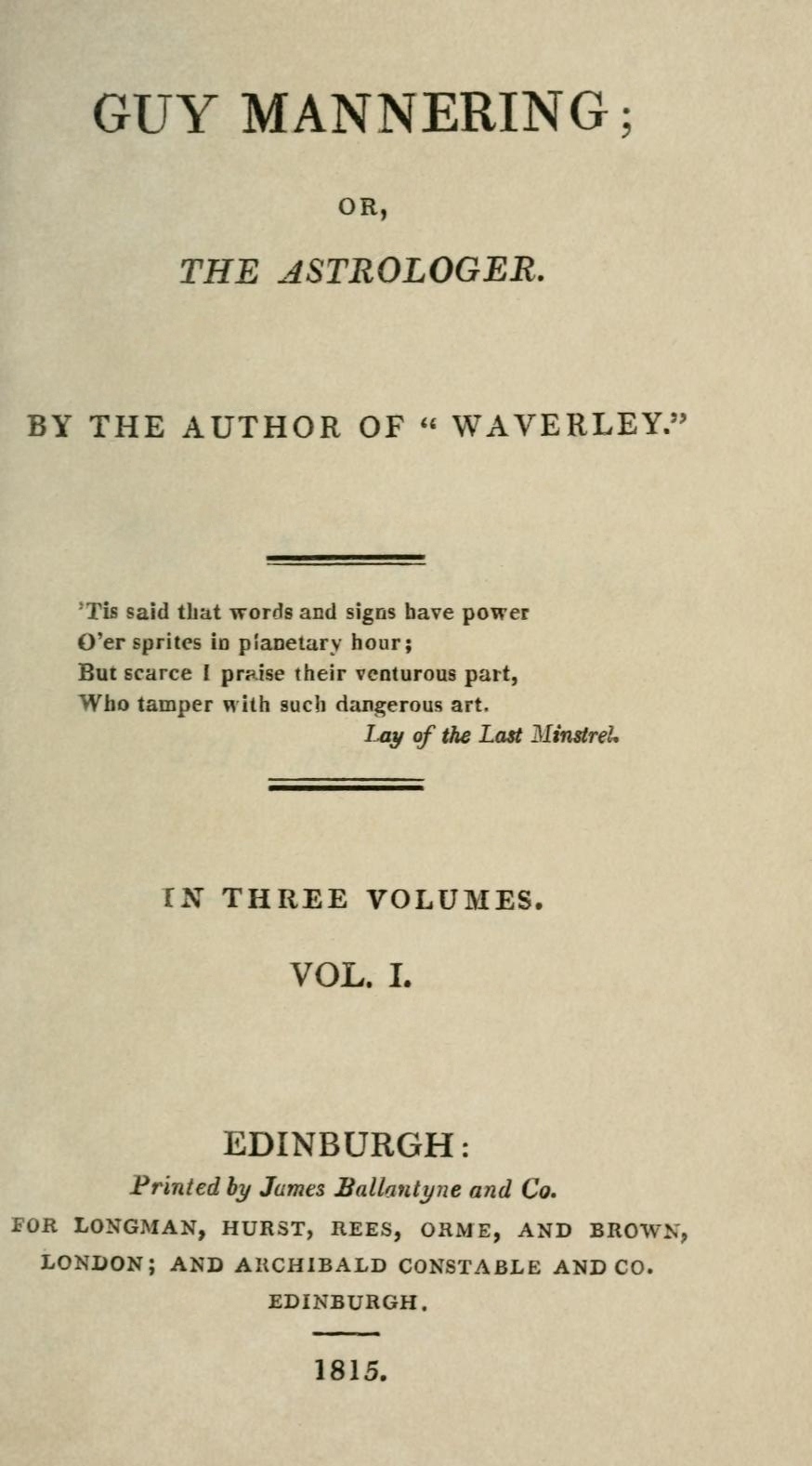
Guy Mannering; or, The Astrologer is the second of the Waverley novels by Walter Scott, published anonymously in 1815. According to an introduction that Scott wrote in 1829, he had originally intended to write a story of the supernatural, but changed his mind soon after starting. The book was a huge success, the first edition selling out on the first day of publication.
Guy Mannering; or, The Astrologer is the second of the Waverley novels by Walter Scott, published anonymously in 1815. According to an introduction that Scott wrote in 1829, he had originally intended to write a story of the supernatural, but changed his mind soon after starting. The book was a huge success, the first edition selling out on the first day of publication.
詳しい紹介を読む
Guy Mannering; or, The Astrologer is the second of the Waverley novels by Walter Scott, published anonymously in 1815. According to an introduction that Scott wrote in 1829, he had originally intended to write a story of the supernatural, but changed his mind soon after starting. The book was a huge success, the first edition selling out on the first day of publication.
Composition
Scott began the composition of Guy Mannering in the last days of 1814, immediately after completing his last long narrative poem The Lord of the Isles. Writing with remarkable speed, he finished it by mid-February 1815. In a letter dated 19 January 1815, Scott writes: "I want to shake myself free of Waverley, and accordingly have made a considerable exertion to finish an odd little tale within such time as will mystify the public... W. Erskine, and Ballantyne, are of opinion that it is much more interesting than Waverley."
Editions
Guy Mannering appeared in three volumes in Edinburgh, published by Archibald Constable and Co. The print run was 2000, and the selling price one guinea (£1.05). The London publishers were Longman, Hurst, Rees, Orme, and Brown, who had to wait some days before receiving their consignment of 1500 copies by sea, anticipated by copies sent down via the faster road route by Edinburgh publishers. As with all the Waverley novels before 1827, publication was anonymous. The first edition was followed by a further 5,000 copies in March and May, the second and third editions. There is no clear evidence for authorial involvement in these, or in any of the novel's subsequent appearances except for the 18mo Novels and Tales (1823) and the "Magnum" edition. Some of the small changes to the text in 1823 are attributable to Scott, but that edition was a textual dead end. At the beginning of 1828 he provided the novel with an introduction and notes, and revised the text, for the Magnum edition in which it appeared as Volumes 3 and 4 in August and September 1829.
The standard modern edition, by P. D. Garside, was published as Volume 2 of the Edinburgh Edition of the Waverley Novels in 1999: this is based on the first edition; the Magnum material appears in Volume 25a.
Plot background
Guy Mannering is set in the 1760s to 1780s, mostly in the Galloway area of southwest Scotland, but with episodes in Cumberland, Holland, and India. It tells the story of Henry "Harry" Bertram, the son of the Laird of Ellangowan, who is kidnapped at the age of five by smugglers after witnessing the murder of a customs officer. It follows the fortunes and adventures of Harry and his family in subsequent years, and the struggle over the inheritance of Ellangowan. The novel also depicts the lawlessness that existed at the time, when smugglers operated along the coast and thieves frequented the country roads.
Guy Mannering, after leaving Oxford, is travelling alone in southwestern Scotland, on the coast of the Solway Firth. After losing his way at nightfall, he is directed to Ellangowan, the home of Mr Godfrey Bertram. The friendly but incompetent Bertram welcomes him, although his wife is in labour with their first child. As they await news, Mannering meets Dominie Sampson, a learned but socially inept tutor, and Meg Merrilies, a wild-looking, strident Gypsy woman, who has come to tell the child's fortune. The young student, however, offers to do this from the stars, and predicts that three periods of the boy's life will be very hazardous. Not wishing to concern the parents, he leaves his predictions to be opened when the child is five years old. Mannering also meets smuggler Dirk Hatteraick, who captains vessels active off the wild coast by Ellangowan.
However, before his fifth birthday is over, little Harry Bertram disappears while in the care of an excise-man, Kennedy, who is murdered by smugglers. No trace can be found of the child, though Kennedy's body is found at the foot of a cliff. In her distress, his mother goes into labour once again, and after giving birth to a daughter, she dies.
Seventeen years elapse, and Mannering, now a Colonel, returns from India and visits Scotland once again. He arrives at Ellangowan in time to be present at the death of the now destitute Godfrey Bertram. The possessions and home of Bertram and his daughter Lucy are being sold. Mannering attempts to buy the estate, but is called back to England to attend to his own daughter who is reported to have a lover, so misses the sale. The Ellangowan estate is purchased at a reduced rate by the conniving Glossin, whose unscrupulous dealings have been one of the causes of the Bertrams' downfall. The estate is sold on the condition that if the male heir is found, the estate will return to the Bertrams.
Mannering's daughter Julia has in fact been entertaining the affections of Vanbeest Brown, a young cavalry officer from her father's regiment, though she does not admit this to her father. Brown is unsure of his parentage, having been raised in Holland, and told that though born in Scotland, he was rescued at a young age from smugglers. Colonel Mannering in fact believes that he killed Brown in a duel in India, a fact which weighs heavily on his conscience. (Out of concern that Mannering will disapprove of Brown's low status, Mannering's wife had led him to believe that Brown's affectionate visits were to her, not her daughter. Mannering's wife dies before the truth of the matter is explained.)
Mannering brings his daughter with him to Scotland, and rents a house called Woodbourne, not far from Ellangowan. He invites Lucy Bertram to be a companion for his daughter, and Dominie Sampson to be his librarian.
Brown follows Julia Mannering to Scotland, taking a roundabout route to explore some of the wilder parts of his birth country. He dines at an inn called Mump's Hall, where he meets a jolly farmer, Dandie Dinmont. Here he also meets Meg Merrilies, who seems to recognise him. The proprietress of Mump's Hall sends thugs to rob Dinmont on the road, and Brown arrives in time to help fend them