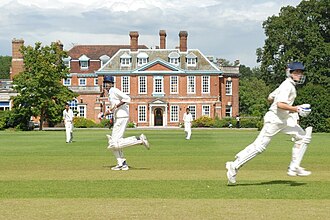
Haberdashers' Boys' School is a private school for boys aged 4–18 in Elstree, Hertfordshire, England. It is a member of the Headmastersʼ and Headmistressesʼ Conference.
Haberdashers' Boys' School (formerly Haberdashers' Aske's Boys' School) is a private school for boys aged 4–18 in Elstree, Hertfordshire, England. It is a member of the Headmastersʼ and Headmistressesʼ Conference.
Haberdashers' Boys' School is a private school for boys aged 4–18 in Elstree, Hertfordshire, England. It is a member of the Headmastersʼ and Headmistressesʼ Conference.
Read more about this topic
Haberdashers' Boys' School (formerly Haberdashers' Aske's Boys' School) is a private school for boys aged 4–18 in Elstree, Hertfordshire, England. It is a member of the Headmastersʼ and Headmistressesʼ Conference.
The school was founded in 1690 by a Royal Charter granted to the Worshipful Company of Haberdashers to establish a hospital for 20 boarders with £32,000 from the legacy of Robert Aske (equivalent to approximately £5m in 2019).
The school relocated from its original site in Hoxton in 1874, eventually (1961) moving to 104 acres of green belt countryside in Elstree.
It sits on the same site as the Haberdashers' Girls' School.
1690–1738
Following a bequest of approximately £20,000 made by the merchant Robert Aske to the Worshipful Company of Haberdashers on his death in 1689, an almshouse for twenty needy members of the Haberdashersʼ Company was established in 1690 just outside the City of London at Hoxton. Designed by Robert Hooke, the almshouse comprised a chapel and, at its centre, the school, which provided education for 20 sons of poor freemen between the ages of nine and fifteen. However, the chaplain, Thomas Wright, was then made master of Bunhill School and was thus unable to teach the boys at Askeʼs. In 1697, therefore, John Pridie was appointed to teach the boys English, the catechism, and basic grammar at a salary of £40 a month. Soon afterward, Pridie secured the right to admit pupils from paying parents, allowing him to increase the amount of money spent on the boys' education. However, this right did not last for long.
In 1701, the school instituted new rules that introduced a cap and gown as the school uniform. The school created the position of a master to teach arithmetic and writing. The school continued to cater to poor pupils, requiring any boy who inherited £100 or more to leave to make way for a less lucky individual. However, the school began to run into financial difficulties; by 1714, the school had reduced itself to only eight pupils. Hardship continued until 1738 when the Court of Assistants, the senior governing body of the Haberdashers' Company, decided that the favourable condition of the company justified restoring the school. At the same time, caps and gowns ceased to be the school uniform, and the school removed Latin from the curriculum.
1738–1825
In 1818, the Charities Commission announced that the school's buildings required repairs that were too expensive for the company's allotted allowance. However, errors in bookkeeping reveal that, whereas it was thought that the school was £7,000 in debt to the company, they were in fact £900 in credit. By 1820 the schoolmaster's basic salary was still fixed at £15. However, the master at this time, William Webb, received gratuities of £20 in both 1818 and 1819. By contrast, the chaplain, matron, and nurse received £50, £16, and £12 respectively, and each of the two maidservants received a salary of £8. The pupil body continued to comprise 20 poor sons of freedmen, and the curriculum consisted of the three Rs (reading, writing, and arithmetic) and the catechism.
1825–1874
In 1825, the school erected new buildings on the site. The schoolmaster at this time was himself a former pupil of the school and a liveryman of the company. The company increased the school's allowance by £4 and expanded the school's collection of books. Regular examinations were conducted, with prizes provided for exceptional performance.
In the early days of the school, the chaplain and the schoolmaster both taught but had separate roles. However, in 1830, the school chaplain was dismissed following scandalous behaviour with a servant-girl. The school was temporarily closed, and when it re-opened in 1831, J. L. Turner was elected to take both roles and given a salary of £700, from which he had to pay for all costs of the school's management. He was forbidden to take pupils from paying parents. The school replaced the former reading, writing, and arithmetic curriculum with Latin (having removed it in 1738), geography, grammar, accounting, and mathematics. By the end of the year, Turner revealed he had spent £748, which exceeded his salary. However, the company committee was satisfied that the significant improvement in the boys' education merited an increase in funding to £800 per year. At this point, the school conducted examinations on a biannual basis.
In 1849, F. W. Mortimer, headmaster of the City of London School, criticized some of the textbooks used and the teaching of Latin, which he thought would be better replaced by French. In 1858, Thomas Grose, who conducted the school's examinations, echoed Mortimer's earlier criticisms of the study of Latin and repeated his suggestion that the school should teach French instead. In addition, he also recommended the introduction of geometry, business studies, trigonometry, mechanics, and natural philosophy to the curriculum. The schoolmaster at this time, Mr. Carterfield, resisted these suggestions. However, growing dissatisfaction among the school's older pupils led to his resignation later that year. A. Jones became headmaster, as the title had become known. In 1868, inhabitants of the surrounding area petitioned the school to accept the sons of parishioners as pupils.
In 1874, though not directly related to this school, two new schools, one for boys and one for girls, were set up in Hatcham, South London. They were known as the Haberdashers' Hatcham Schools until 1991, when the two were combined as Haberdashers' Hatcham College, now a state-funded academy.
1874–1961
In 1874, the almshouse, which had housed the school since 1690, closed to give the developing school more space. The school was divided into two halves, one for boys and one, for the first time, for girls. Each half admitted 300 pupils, a significant increase on previous pupil numbers; £5,000 was spent on renovating the Hoxton buildings; and the chaplain, schoolmaster, matron, and almsmen were pensioned. The foundationers were moved to another boarding school.