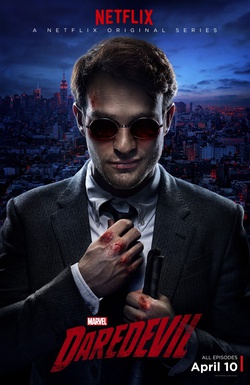
The first season of the American streaming television series Daredevil, which is based on the Marvel Comics character of the same name, follows the early days of Matt Murdock / Da…
The first season of the American streaming television series Daredevil, which is based on the Marvel Comics character of the same name, follows the early days of Matt Murdock / Daredevil, a lawyer-by-day who fights crime at night, juxtaposed with the rise of crime lord Wilson Fisk. It is set in the Marvel Cinematic Universe (MCU), sharing continuity with the films and other television series of t…
The first season of the American streaming television series Daredevil, which is based on the Marvel Comics character of the same name, follows the early days of Matt Murdock / Daredevil, a lawyer-by-day who fights crime at night, juxtaposed with the rise of crime lord Wilson Fisk. It is set in the Marvel Cinematic Universe (MCU), sharing continuity with the films and other television series of the franchise. The season was produced by Marvel Television in association with ABC Studios, DeKnight Productions and Goddard Textiles, with Steven S. DeKnight serving as showrunner, and series creator Drew Goddard acting as consultant.
Charlie Cox stars as Murdock, while Vincent D'Onofrio plays Fisk. They are joined by principal cast members Deborah Ann Woll, Elden Henson, Toby Leonard Moore, Vondie Curtis-Hall, Bob Gunton, Ayelet Zurer, and Rosario Dawson. Daredevil entered development in late 2013, with Goddard hired in December. DeKnight replaced him as showrunner and Cox was hired to star in May 2014. Filmed in New York City from July to December 2014, the season focuses on the darker, more mature elements of the source material. Stephanie Maslansky designed the costumes for the season, with the final red suit for Daredevil designed by Ryan Meinerding and the costume artists at Marvel Studios. The season features links and references to other MCU projects, including future Netflix series.
The first two episodes of the season premiered in Los Angeles on April 2, 2015, with the full season of 13 episodes released on Netflix on April 10 to an estimated high viewership. Critics praised the performances, particularly D'Onofrio's, and the darker tone and action sequences of the series compared to other properties set in the MCU. However, some of the pacing during the season and the final red Daredevil suit received criticism. The first season received three nominations at 67th Primetime Creative Arts Emmy Awards, for Outstanding Special Visual Effects from Shade VFX, Outstanding Sound Editing for a One-Hour Series, and for Outstanding Main Title Design. The series was renewed for a second season on April 21, 2015.
Development
In October 2013, Marvel and Disney announced that Marvel Television and ABC Studios would provide Netflix with live action series centered around Daredevil, Jessica Jones, Iron Fist, and Luke Cage, leading up to a miniseries based on the Defenders. Drew Goddard was hired to serve as executive producer and showrunner for Daredevil, with his production company Goddard Textiles producing the season, however, in May 2014 it was announced that Goddard had stepped down as showrunner in order to focus on directing a feature film based on Marvel's Sinister Six for Sony Pictures Entertainment. He was succeeded by Steven S. DeKnight and his production company DeKnight Productions. Goddard, who wrote the first two episodes, remained with the show as a consultant and executive producer. It was also revealed that the series would be titled Marvel's Daredevil. The first season consists of 13 hour-long episodes. Peter Friedlander, Allie Goss, Kris Henigman, Cindy Holland, Alan Fine, Stan Lee, Joe Quesada, Dan Buckley, Jim Chory, Loeb, Goddard, and DeKnight served as executive producers. Kati Johnston served as a producer.
Writing
The season does not directly adapt any one storyline from the comics, with DeKnight feeling that it was more important to focus on "nailing the spirit of the comics". Nonetheless, notable comics stories whose elements were adapted into the season include Frank Miller and John Romita Jr.'s 1993 miniseries Daredevil: The Man Without Fear, a retelling of the character's origin story. DeKnight stated that Netflix's support of "the creatives" coupled with Marvel's restrictions on their properties led to him pushing the source material as far as he could while remaining respectful of the characters and their history, and being surprised at "how willing everyone is to take a really fresh look and really push what we're doing." Vincent D'Onofrio likened the Netflix production more to a "13-hour film" than to a television series, noting that the format allowed for the time needed to tell the story and "be much more specific". Deborah Ann Woll explained that what she saw as one of the most important themes in the series was normal people having an impact in "seemingly insurmountable circumstances", with the focus not being on Daredevil's abilities or the characters' qualifications, but on their willingness to help people.
Though the season was much more violent than previous Marvel Cinematic Universe (MCU) works, DeKnight felt that sexual violence would be "too far", saying that "Daredevil wasn't asking for a lot of sexual situations, especially since Matt Murdock is not really in the position to get into a relationship, and it just didn't fit the story for that season. I think that'll change moving forward, but I never pushed any kind of sexual agenda on the show. I think once Daredevil was a hit and people were really responding positively, you can see the progression into more of an adult world in Jessica Jones."
Speaking about the way the season reveals the name Daredevil, DeKnight explained that several options had been brought up, such as "one of the versions in the comics where when he was a kid people used to taunt him with the name Daredevil", which did not fit in the world of the series, or having Ben Urich give the character the name, but the timing for that did not work due to Urich's death before the final Daredevil suit was introduced. It was decided that instead of having the name Daredevil said onscreen, it would be easier to introduce it through the media as a newspaper headline. On why this was not done for Wilson Fisk as Kingpin, DeKnight stated that he felt it would "get a little bit silly....[if] we went, 'Oh they called him Daredevil! Oh they called him Kingpin!'", and was unable to come up with another natural way for the name Kingpin to come up, so it was decided to leave t