TowerFall is an action indie video game created by Maddy Thorson through her company Maddy Makes Games, which would later become Canadian developer and publisher Extremely OK Game…
TowerFall is an action indie video game created by Maddy Thorson through her company Maddy Makes Games, which would later become Canadian developer and publisher Extremely OK Games. In the game, players control up to four archers in a multiplayer platform fighter.
TowerFall is an action indie video game created by Maddy Thorson through her company Maddy Makes Games, which would later become Canadian developer and publisher Extremely OK Games. In the game, players control up to four archers in a multiplayer platform fighter. It was released on the Ouya microconsole in June 2013 and was later ported to PlayStation 4, Xbox One, Linux, OS X, and Windows as TowerFall Ascension and to the Nintendo Switch under its original title of TowerFall.
TowerFall was Thorson's first commercial game. It followed from a June 2012 game jam single-player prototype. Thorson tested the game on her indie developer colleagues with whom she lived, and developed its capacity as a party game. Its mechanics were inspired by games of Thorson's youth, such as Bushido Blade and GoldenEye 007, and influenced by demo feedback at the Evolution Championship Series fighting game tournament. TowerFall was known as the standout title for the Ouya at the console's launch. In its first year, the game sold around 7,000 copies on Ouya, resulting in a gross revenue of about $105,000. When the Ouya exclusivity expired, Thorson signed another exclusivity agreement for the PlayStation 4, where Ascension received an expanded single-player mode, and new levels, weapons, and gameplay variants. A PlayStation Vita release followed in 2015, and Xbox One and Switch versions have been released as well. A standalone eight-player edition for Windows released in 2016.
Ascension was met with generally favorable reception. Critics recommended it as a party game reminiscent of Super Smash Bros. and praised its balance. However, some felt that its single-player mode was a low point, and lamented the lack of an online multiplayer mode.
Gameplay
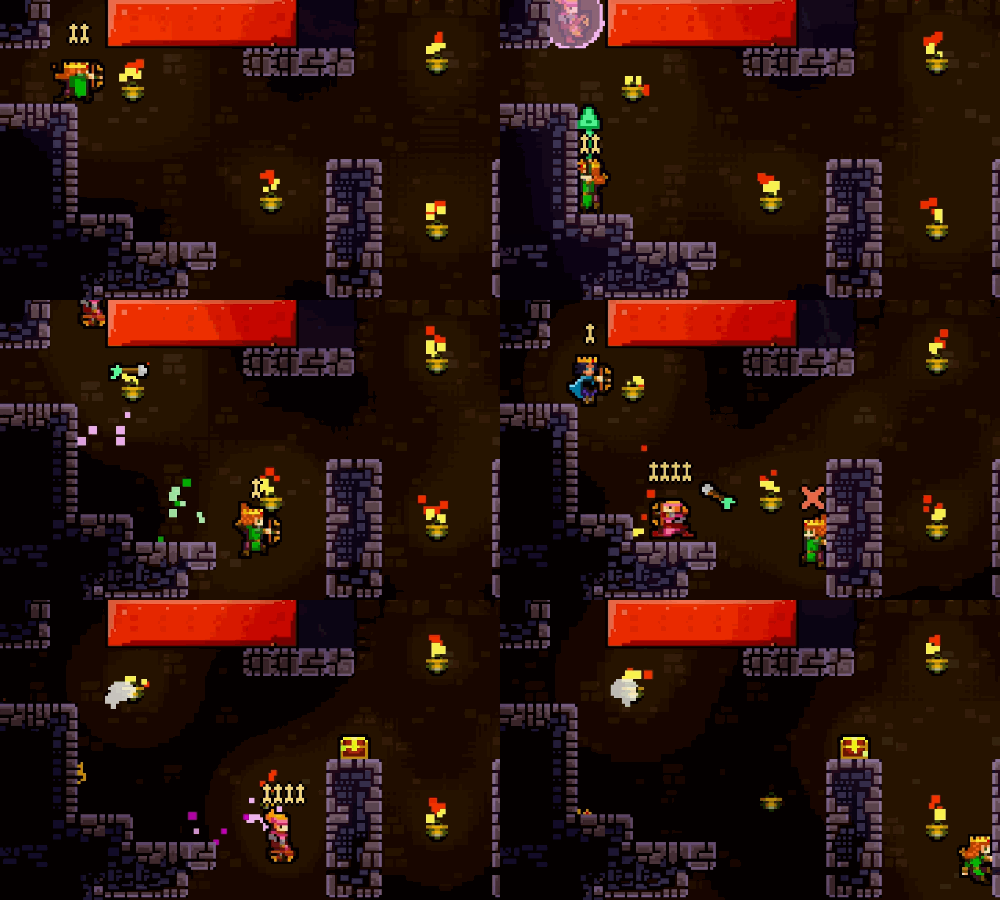
TowerFall is an archery combat arena game where players kill each other with arrows and head-stomps until only one player remains. It is also possible to play in cooperative mode. In multiplayer, up to four players fight in an arena using a limited supply of arrows. Players replenish their arrow supply from those shot about the arena. The players can also catch other players' arrows. "Treasure" power-ups give players shields, wings, and arrows with increased power. The game's rules can be customized and saved for future use. Kotaku's Chris Person described the gameplay as "[Super] Smash Bros. bred with games like Spelunky or Nidhogg".
There are four game modes. In single-player, the player must hit targets around the arena before a timer runs out. The developer compared this mode to "Break the Targets" in the Super Smash Bros. series. Ascension adds a remodeled version of the target levels as a Trials mode, which requires the players to use power-ups to break all targets within several seconds. Ascension also adds a Quest mode, where one or two players attempt to survive against enemy waves of increasing difficulty. As a single-player event, Quest functions as a score attack mode. The new Ascension improvements were also released for the Ouya version.
The Ouya release supports the Xbox 360 and PlayStation 3 controllers. Ascension uses the DualShock 4 controller's built-in speaker to play sound effects. The game does not have online multiplayer.
Development
The game was developed and produced by Maddy Thorson, who previously made Planet Punch and browser games. TowerFall was her first full commercial game. The idea came from a visit with Alec Holowka as they worked at a game jam, the 48-hour June 2012 Vancouver Full Indie Game Jam. The team iterated through a Legend of Zelda-inspired multiplayer mode that became a single-player platformer Flash game where the player was a "skilled archer out of an ancient legend". She intended to add multiple weapons, but chose to keep the first one—the bow and arrow—due to its feel. The arrow was designed to fire without charging and to bias towards targets so as to give the player "more leeway". Thorson also chose to limit the aim direction to the eight ordinal directions rather than affording complex 360 degree controls. She also added levels, items, a store, and a story based on ascending a tower. Along with in-game progress, players would gain new items and skills. Thorson originally intended to send the game to Adult Swim for "easy money", but changed her mind upon developing a multiplayer version after the jam.
Holowka credits the multiplayer's party game feel to the many hours of local multiplayer testing it received in Thorson's homes in Vancouver. Thorson lived with a developer she met through Game Maker's community, and the two eventually moved in with Holowka in "Indie House", a Vancouver house whose occupants are all indie developers. The close community of indie gamers and their interest in trying new game ideas was both a product and generator of their living arrangements. Though Holowka dropped back from the project shortly after the game jam, leaving the project to Thorson, he stepped in to demo the game at the 2013 Game Developers Conference at the last minute when Thorson's passport had expired. With an increase in press attention following an exhibition at PAX East, Thorson entered an agreement with Ouya's Kellee Santiago to release exclusively on the microconsole. Critics saw this as being the action the new console needed to compete with existing consoles, and Thorson felt the release for Ouya to be less "intimidating" than releasing for the PlayStation 3. The game also fit Ouya's emphasis on couch co-op gaming. Thorson originally did the artwork herself but was not satisfied with the results and hired MiniBoss to finish the graphics. Holowka composed the music, and Thorson hired Power Up Audio to make the sound effects.
Thorson said that the game started to come together about six months into its development. They tested the game on close friends once every few weeks, and the friends would ask Thorson when they could play it again. Thorson brought the game to the 2013 Evolution Championship Series fighting games tournament, where they