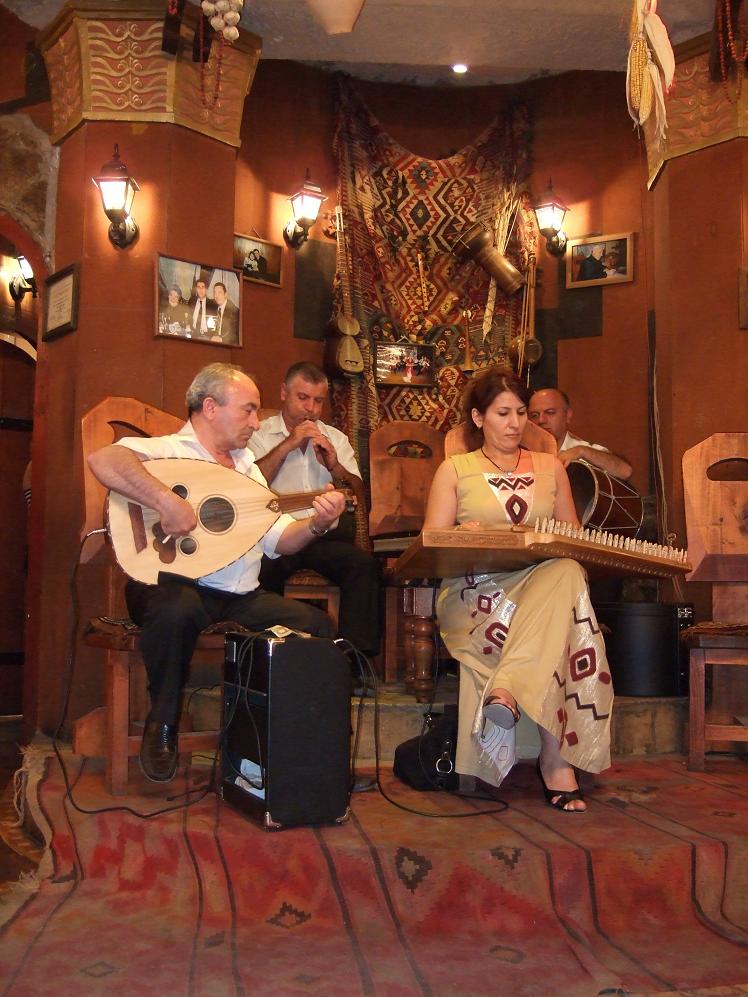
Armenian folk music is a genre of Armenian music. It usually uses the duduk, the kemenche, and the oud. It is very similar to folk music in the Caucasus and shares many similar songs and traditions with countries around Armenia, namely Georgia and Azerbaijan.
Armenian folk music is a genre of Armenian music. It usually uses the duduk, the kemenche, and the oud. It is very similar to folk music in the Caucasus and shares many similar songs and traditions with countries around Armenia, namely Georgia and Azerbaijan.
詳しい紹介を読む
Armenian folk music is a genre of Armenian music. It usually uses the duduk, the kemenche, and the oud. It is very similar to folk music in the Caucasus and shares many similar songs and traditions with countries around Armenia, namely Georgia and Azerbaijan.
The Importance of Armenian Folk Music For The Armenian Nation And Musical Culture
The original Armenian folk music forms the basis of national self-awareness and defines the socio-cultural identity of the Armenian people, along with other attributable components of the socio-cultural life of the Armenian ethnicity.
Being one of the oldest, having vividly expressed originality, melodic richness and compositional nobility, Armenian folk music has had a significant impact on the development of musical culture worldwide.
Origin Story
Armenian folk music dates back to ancient times. Its scientifically noticeable history has more than three millennia. This process already began in the 20th-18th centuries B.C.
In the territory of the Armenian highlands (geographical and cultural area, within the boundaries of which the ethnogenesis of the Armenian nation took place), many artifacts were found, which testify that the art of music flourished here in B.C. since at least the second millennium. Such artifacts are ancient musical instruments discovered by archaeologists, as well as various images of people playing music (including petroglyphs) and ancient written (mainly cuneiform) monuments that tell about certain events, ceremonies and actions that were accompanied by music.
The original features of Armenian folk music were formed in its bosom due to the constant cross-breeding of Balkan and Western Anatolian musical traditions with the musical traditions of such ancient cultures of the Middle East as Hittite, Aramaic, Assyro-Babylonian and Persian, as well as a result of its complete assimilation with the culture of the state Urartu, which was advanced for its time.
Development stages of Armenian folk music
Information about Armenian folk singers (rhapsodes), gusans, whose work, in turn, originates from the earlier musical tradition of novelists, folk singers who told stories of epic poems of ancient Armenia, reaches us from the depths of the centuries. In particular, ancient Armenian authors of the 5th century such as Agathanghegos, Pavstos Buzand, Movses Khorenatsi, Yeghishe and others report about Gusan songs.
At first, the servants in the temple of God Gisane were called gusans, and in the Hellenistic era, the participants of farcical and satirical representations. Gusans sang songs accompanied by playing musical instruments, especially at parties, weddings, and funerals. They also performed the songs of the wandering homeless (Gharibi), epic songs, mythical tales, etc.
Among the main (vocal, instrumental, mixed) genres and types of ancient Armenian folk music, according to the nature of their applied functions (religious and social significance), one can distinguish ritual, calendar, work, wedding, military, epic, dance, party, lyrical- love, lullaby, household, game, funeral and other categories of songs.
A special place in Armenian folk music is occupied by peasant songs, which include arable horovels, as well as the songs of Skitalians (travelers) belonging to the "Antun" (homeless) genre.
Many Armenian historians, writers, philosophers and music theorists, since ancient times to one degree or another, have been engaged in researching the aesthetic characteristics of Armenian folk and spiritual music of artists such as Mesrop Mashtots, Sahak Partev, Hovhannes Mandakuni, Stepanos Syunetsi (senior), Komitas Aghtetsi, Barsegh Tchon, Sahak Dzoraporetsi, Stepanos Syunetsi, Davit Anhaght, Davit Kerakan, Hakob Sanahnetsi, Grigor Narekatsi, Khachatur Taronatsi, Nerses Shnhorali, Hovhannes Imstaser, Hovhannes Yerznakatsi, Arakel Syunetsi, Hakob Krimetsi, Grigor Narekatsi, Frick, Hovhannes Tlkurantsi, Mkrtich Naghash, Minas Tokhatetsi, Petros Kapantsi, Baghdasar Dpir, Arakel Syunetsi, Mateos Dvugayetsi, Grigor Khlatetsi, Arakel Baghisetsi, Avetik Pakhtasaryan, Zenne Poghos, Khachatur Erzrumtsi, Mkhitar Sebastasi, Grigor Dpir Gapaskalyan (of four musicological treatises author) and others.
Such famous Armenian composers and folklorists of the 19th-20th centuries as Makar Yekmalyan, Spiridon Melikyan, Grigor Syunin, Nikoghayos Tigranyan, Kristapor Kara-Murza collected a large collection of samples of Armenian folk and spiritual music. However, the greatest merit in the coordination, study and deep aesthetic meaning of Armenian musical folklore belongs to Komitas, the founder of the National School of Scientific Folklore, he managed to collect, process and prepare for publication more than 2000 folk songs.
As a result of the tireless collective and scientific activity of Komitas, the ethnographer who created a real anthology of Armenian folk song and revealed the patterns of peasant musical thinking and musical speech, the questions of the antiquity of traditions, genre differentiation, genealogy and the crystallization of the means of artistic expression of secular ethnographic singing, at once and in the most convincing way, entered into the main problematology of Armenian monodic music. The latter very simply presented two branches: People-peasant and spiritual.
From the beginning, Armenian folk music was monodic, but enriched with various elements of polyphony (stretched tones, use of some types of antiphonal singing, etc.).
Komitas discovered the tetrachord structure of the fundamental sounds of Armenian folk music and the typical ways of connecting tetrachord-cells in it.
H. Kushnarev continued Komitas' musicological research in the field of Armenian folk music, who defined the basic diatonic sound system of Armenian music as a combination of three pure series of quarts (Mixolydian, Aeolian and Locrian), clarified the methods of forming chromatic sounds of Armenian folk music and gave a detailed description of the relationship of the tones arising in that examination base.
In general, music theory in Armenia has always been inextricably linked with musical aesthetics, so since