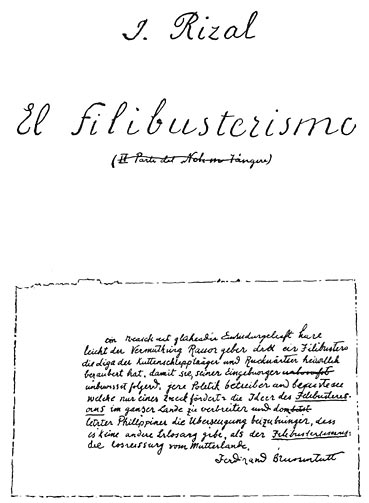
El Filibusterismo, also known by its alternative English title The Reign of Greed, is the second novel written by Philippine national hero José Rizal. It is the sequel to Noli Me Tángere and, like the first book, was written in Spanish. It was first published in 1891 in Ghent.
El Filibusterismo, also known by its alternative English title The Reign of Greed, is the second novel written by Philippine national hero José Rizal. It is the sequel to Noli Me Tángere and, like the first book, was written in Spanish. It was first published in 1891 in Ghent.
詳しい紹介を読む
El Filibusterismo (transl. The filibusterism; The Subversive or The Subversion, as in the Locsín English translation, are also possible translations), also known by its alternative English title The Reign of Greed, is the second novel written by Philippine national hero José Rizal. It is the sequel to Noli Me Tángere and, like the first book, was written in Spanish. It was first published in 1891 in Ghent.
The novel centers on the Noli-El Fili duology's main character Crisóstomo Ibarra, now returning for vengeance as "Simoun". The novel's dark theme departs dramatically from the previous novel's hopeful and romantic atmosphere, signifying Ibarra's resort to solving his country's issues through violent means, after his previous attempt in reforming the country's system made no effect and seemed impossible with the corrupt attitude of the Spaniards toward the Filipinos.
The novel, along with its predecessor, was banned in some parts of the Philippines as a result of their portrayals of the Spanish government's abuses and corruption. These novels, along with Rizal's involvement in organizations that aimed to address and reform the Spanish system and its issues, led to Rizal's exile to Dapitan and eventual execution. Both the novel and its predecessor, along with Rizal's last poem, are now considered Rizal's literary masterpieces.
Both of Rizal's novels had a profound effect on Philippine society in terms of views about national identity, the Catholic faith and its influence on the Filipino's choice, and the government's issues in corruption, abuse of power, and discrimination, and on a larger scale, the issues related to the effect of colonization on people's lives and the cause for independence. These novels later on indirectly became the inspiration to start the Philippine Revolution.
Throughout the Philippines, the reading of both the novel and its predecessor is now mandatory for high school students throughout the archipelago, although it is now read using English, Filipino, and the Philippines' regional languages.
In the events of the previous novel, Crisóstomo Ibarra, a reform-minded mestizo who tried to establish a modern school in his hometown of San Diego and marry his childhood sweetheart, was falsely accused of rebellion and presumed dead after a shootout following his escape from prison. Elías, his friend who was also a reformer, sacrificed his life to give Crisóstomo a chance to regain his treasure and flee the country, and hopefully continue their crusade for reforms from abroad. After a thirteen-year absence from the country, a more revolutionary Crisóstomo has returned, having taken the identity of Simoun, a mysterious wealthy jeweler whose objective is to drive the government to commit as much abuse as possible in order to drive people into revolution.
Simoun goes from town to town presumably to sell his jewels. Reaching San Diego, he detours to the Ibarras' forested land to retrieve more of his treasures buried in the mausoleum. There, his true identity as Crisóstomo Ibarra is discovered by a now-grown Basilio, who was also in the mausoleum visiting his mother's grave. In the years since the death of his mother, Basilio had been serving as Capitán Tiago's servant in exchange for being allowed to study, and is now an aspiring doctor on his last year at university as well as administrator and apparent heir to Capitán Tiago's wealth. Simoun reveals his motives to Basilio and offers him a place in his plans. Too secure of his place in the world, Basilio declines.
At Barrio Sagpang in the town of Tiani, Simoun stays at the house of the village's cabeza de barangay, Tales. Having suffered misfortune after misfortune in recent years, Kabesang Tales is unable to resist the temptation to steal Simoun's revolver and join the bandits. In Los Baños, Simoun joins his friend, the Captain-General, who is then taking a break from a hunting excursion. In a friendly game of cards with him and his cronies, Simoun raises the stakes higher and higher and half-jokingly secures blank orders for deportation, imprisonment, and summary execution from the Captain-General.
Later on, Simoun goes to Manila and meets Quiroga, a wealthy Chinese businessman and aspiring consul-general for the Qing dynasty. Knowing Quiroga is heavily in his debt, Simoun offers him a steep discount if the former stores his massive arsenal of rifles in Quiroga's warehouses, to be used presumably for extortion activities with Manila's elite. Despite his hatred of guns and weaponry, Quiroga reluctantly agrees to do the job and uses his bazaar as a front.
During the Quiapo Fair, a talking heads exhibit ostensibly organized by an American named Mr. Leeds but secretly commissioned by Simoun is drawing popular acclaim. Padre Bernardo Salví, now chaplain of the Convent of the Poor Clares, attends one of the performances. The exhibit is set in Ptolemaic Egypt but features a tale that closely resembled that of Crisóstomo Ibarra and María Clara, and their fate under Salví. The show ends with an ominous vow of revenge. Deeply overcome with guilt and fear, Salví recommends the show be banned, but not before Mr. Leeds sailed for Hong Kong.
Months pass and the night of Simoun's revolution comes. Simoun visits Basilio in Tiago's house and tries to convince him again to join his revolution. He reveals his plan for the attack: a cannon volley shall be fired, at which point Kabesang Tales, now a bandit identifying himself as Matanglawin, and Simoun, who managed to deceive and recruit a sizable rogue force among the government troops, will lead their forces into the city. The leaders of the Church, the University, scores of bureaucrats, the Captain-General himself, as well as the bulk of officers guarding them are all conveniently located in one place, the theater where a controversial and much-hyped performance of Les cloches de Corneville is taking place. While Simoun and Matanglawin direct their forces, Basilio and several others are to r