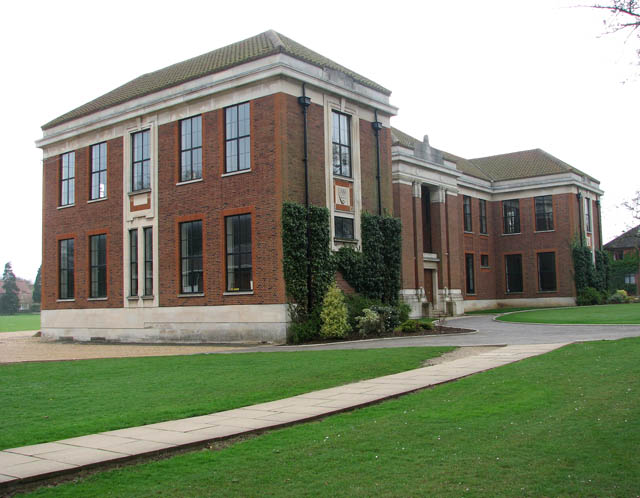
Gresham's School is a public school in Holt, Norfolk, England, one of the top twenty International Baccalaureate schools in England.
Read more about this topic
Gresham's School is a public school (English fee-charging boarding and day school) in Holt, Norfolk, England, one of the top twenty International Baccalaureate schools in England.
The school was founded in 1555 by Sir John Gresham as a free grammar school for forty boys, following King Henry VIII's dissolution of Beeston Priory. The founder left the school's endowments in the hands of the Worshipful Company of Fishmongers of the City of London, who are still the school's trustees.
In the 1890s, an increase in the rental income of property in the City of London led to a major expansion of the school, building on land that it already owned at the eastern edge of Holt, including several new boarding houses as well as new teaching buildings, library, and chapel.
Gresham's admitted girls from 1971 and is now fully co-educational. As well as its senior school, it operates a preparatory and a nursery and pre-prep school, the latter now in the Old School House, the historic home of the school. Altogether, the three schools teach about eight hundred children.
In September 2025, Tatler shortlisted Gresham's for its Tatler Schools Awards 2026 "Best Public School" title, together with Eton, Brighton, Canford, and Caterham. In October, it was announced that Gresham's had won the title.
The school
Gresham's School, Holt, was founded by Sir John Gresham, who obtained letters patent in 1555, during the reign of Queen Mary I. For its home he gave the school his manor house at Holt, which he had bought in 1546 from his elder brother Sir William Gresham.
The founding of Gresham's was connected to King Henry VIII's suppression of the Priory of Augustinian canons at Beeston Regis in June 1539. The Priory of St Mary in the Meadow, Beeston Regis, established in 1216, had operated a school which John Gresham and his brothers probably attended, but the school came to an end with the priory, leaving no provision for education in the neighbourhood of Holt.
The new school opened and was granted a Royal Charter in 1562. By the letters patent of 1555, the school was called in full 'The Free Grammar School of Sir John Gresham, knight, citizen and alderman of London'. The founder endowed Gresham's generously, placing its property in trust with the Worshipful Company of Fishmongers of the City of London, and full estate records dating from the school's foundation are held at the Guildhall Library. Sir John Gresham's endowments included his freehold property in Holt and Letheringsett, his wood and land called Prior's Grove, his manors of Pereers and Holt Hales, "with all and singular to the same belonging, situate in Holt, Sherington, Letheringsett, Bodham, Kellinge, Wayborne, Semlingham, Stodrye, Bantrye and West Wickham, in the said county of Norfolk", and also tenements called 'The White Hind' and 'The Peacock' in the parish of St Giles-without-Cripplegate, London. Close links with the Fishmongers' Company continue to the present.
By his Will of 1601, Leonard Smith, a fishmonger of London, left £120 and all his goods to establish a fellowship at Sidney Sussex College, Cambridge, and in 1604 'Mr Smith's Fellowship' was confirmed by the college, with the provision that "scholars from the Grammar School of Holt, in Norfolk" were to have preference.
The school library contains the Foundation Library, a collection of books and manuscripts provided at the school's establishment in 1555 and later.
On Christmas Day 1650, Thomas Cooper, a former usher of Gresham's, was hanged for his part in a Royalist rebellion on behalf of Charles II. His body was left hanging on a gibbet in the Holt Market Place.
For three hundred and fifty years, the school was based in what is now called the Old School House, or "OSH", the former manor house of Holt overlooking the Market Place in the town centre. In 1708, the school escaped a major fire which destroyed most of the rest of the mediaeval town of Holt. This resulted in most of the buildings now to be seen in the town centre belonging to the 18th century.
In 1729, the Fishmongers' Company presented the school with "...a valuable and useful library, not only of the best editions of the Classics and Lexicographers, but also with some books of Antiquities, Chronology, and Geography, together with a suitable pair of globes". By the 18th century, references to fish were hard to find in the court minutes of the Fishmongers' Company, and the company's main business had become managing its extensive property and administering its charities and trusts, such as the school at Holt and St Peter's Hospital, an almshouse at Newington in Surrey.
For the period 1704 to 1750, Charles Linnell analysed the 'Status of fathers of boys at Holt Grammar School' in his Gresham's School History and Register (1955): "Sons of gentlemen 10%, clergy 30%, professional men 5%, tradesmen 20%, plebeian 15%, unknown 20%".
One of the school's 18th-century heads was John Holmes, appointed at the age of twenty-seven, a prolific writer of educational textbooks, who led the school between 1730 and his death in 1760.
In the 19th century, boys were strictly required to attend services at the Holt parish church, and in November 1815 a boy called Charles Loynes was "expelled for non-attendance at church".
In 1823, the expenditure of the Fishmongers' Company on the school was £367, of which £158-10s-0d was for the master's salary, allowances and gratuities, £80 for the Usher's salary, board and lodging, £52-11s-6d for repairs, £22-12s-6d for taxes, £15-15s-6d for poor rates, £12-10s-0d for coals, £9-13s-4d for two-thirds of the cost of the school books, and £6-6s-0d for a School Feast which took place in June.
In 1836, the 'Wardens and Commonalty of the Art and Mystery of Fishmongers of the City of London' held an insurance policy for 'Other property or occupiers: Free Grammar School Holt Norfolk (Rev Benn. Pulleyn)' with the Sun Fire Office.
In his History of the Twelve Great Livery Companies of London (1836), William Herbert says of the school: