
條目
配音演員
dub actor
负责后期配音、混音处理的人
在包含此條目的事件檔案中探索資訊與關係。
還沒有包含此條目的事件檔案。
從此條目開始調查正在查找與此條目有關的作品或人物。
配音演員
正在尋找與它相連的內容。
等待第一則留言。
负责后期配音、混音处理的人
Dubbing is the process of adding to or replacing the recorded audio of a film or video during post-production. Dubbing commonly refers more narrowly to the process of replacing dialog, especially with a translation synchronized to the film's visuals.
Dubbing is also used to replace unclear dialogue, change lines, or add dialogue from characters off screen. When this is the case, it may be referred to as automated dialogue replacement or sometimes additional dialogue replacement (ADR).
In many countries, dubbing was adopted at least in part for political reasons. In authoritarian states such as Fascist Italy and Francoist Spain, dubbing could be used to enforce particular ideological agendas, excising negative references to the nation and its leaders and promoting standardized national languages at the expense of local dialects and minority languages. In post-Nazi Germany, dubbing was used to downplay events in the country's recent past, as in the case of the dub of Alfred Hitchcock's Notorious, where the Nazi organization upon which the film's plot centers was changed to a drug smuggling enterprise. The first post-WWII movie dub was Konstantin Zaslonov (1949) dubbed from Russian into the Czech language.
In Western Europe after World War II, dubbing was attractive to many film producers as it helped to enable co-production between companies in different countries, in turn allowing them to pool resources and benefit from financial support from multiple governments. The use of dubbing meant that multi-national casts could be assembled and were able to use their preferred language for their performances, with appropriate post-production dubs being carried out before distributing versions of the film.
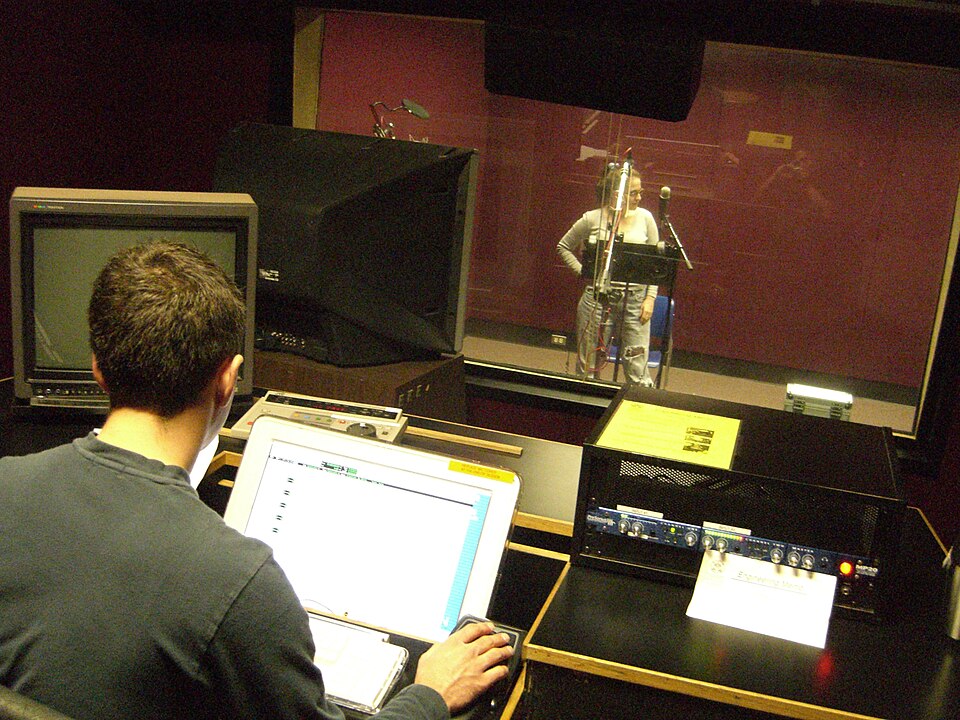
Automated dialogue replacement (ADR)is the process of re-recording dialogue by the original actor (or a replacement actor) in a sound booth after the filming process to improve audio quality (for example, if the microphones from on-set picked up ambient noise such as strong wind or passing traffic) or make changes to the initially scripted dialog.
In the early days of talkies, a loop of film would be cut and spliced together for each of the scenes that needed to be re-recorded, and then the loops would be loaded onto a projector one by one. For each scene, the loop would be played repeatedly while the voice actor performed the lines, trying to synchronize them to the filmed performance. This was known as "looping" or a "looping session". Loading and reloading the film loops while the talent and recording crew stood by was tedious. Later, videotape and then digital technology replaced the film loops, and the process became known as automated dialogue replacement (ADR).
In recent years speech synthesis programs and artificial intelligence have been used to artificially automatically dub content. In September 2025 YouTube officially launched an optional multi-language audio-dubbing feature following a two-year-long pilot program. Amazon Prime Video has tested AI-generated dubs in March 2025 and has released AI-dub versions of content such as English dubs of the Banana Fish anime and the Portuguese language show O Silêncio de Marcos Tremmer, though they have been criticized for their overall quality and potential job impact on voice actors. Development of the technology to be able to auto-dub live events has also taken place, though auto-dubs for live events are not currently widely in use.
A related but distinct approach, known as visual dubbing, uses machine learning to modify an actor's on-screen lip and facial movements in post-production to match dubbed target-language audio, rather than replacing the performer's voice. Early models such as Wav2Lip (2020) demonstrated that accurate lip synchronisation could be generated from arbitrary audio and video inputs across any speaker identity or language. The 2023 SAG-AFTRA TV/Theatrical contract permits adjusting lip and facial movements to match a foreign language as part of standard dubbing practices, without requiring additional performer consent, provided human voice actors perform the dubbed audio.
Localization is the practice of adapting a film or television series from one region of the world for another. In contrast to pure translation, localization encompasses adapting the content to suit the target audience. For example, culture-specific references may be replaced, and footage may be removed or added.
The new voice track is usually spoken by a voice actor (VA). In many countries, actors who regularly perform this duty remain little-known, with the exception of particular circles (such as Seiyuu the anime fandom) or when their voices have become synonymous with roles or actors whose voices they usually dub. In the United States, many of these voice artists may employ pseudonyms or go uncredited due to Screen Actors Guild (SAG) regulations or the desire to dissociate themselves from the role.
The dialogue writer's role is to make the translation sound natural in the target language, and to make the translation sound like a credible dialogue instead of merely a translated text.
來源:Dubbing (CC BY-SA)
結構化資訊、使用者意見與 AI 擷取的關係會分別標示。
In conventional film production, a production sound mixer records dialogue during filming. During post-production, a supervising sound editor, or ADR supervisor, reviews all of the dialogue in the film and decides which lines must be re-recorded. ADR is recorded during an ADR session, which takes place in a specialized sound studio. Multiple takes are recorded, and the most suitable take becomes the final version, or portions of various takes may be edited together.
As of 2020, the process includes various automated techniques, such as automatically displaying lines on-screen for the talent, automated cues, shifting the audio track for accurate synchronization, and time-fitting algorithms for stretching or compressing portions of a spoken line. There is software that can sort out spoken words from ambient sounds in the original filmed soundtrack, detect the peaks of the dialog, and automatically time-fit the new dubbed performance to the original to create accurate synchronization.