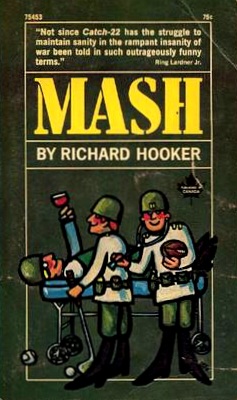
MASH: A Novel About Three Army Doctors is a 1968 novel written by Richard Hooker with the assistance of writer W. C. Heinz. It is notable as the foundation of the M*A*S*H franchise, which includes a 1970 feature film and a long-running TV series (1972–1983). The novel is about a fictional U.S. Mobile Army Surgical Hospital in South Korea during the Korean War.
MASH: A Novel About Three Army Doctors is a 1968 novel written by Richard Hooker with the assistance of writer W. C. Heinz. It is notable as the foundation of the M*A*S*H franchise, which includes a 1970 feature film and a long-running TV series (1972–1983). The novel is about a fictional U.S. Mobile Army Surgical Hospital in South Korea during the Korean War.
소개 자세히 읽기
MASH: A Novel About Three Army Doctors is a 1968 novel written by Richard Hooker (the pen name of former military surgeon H. Richard Hornberger) with the assistance of writer W. C. Heinz. It is notable as the foundation of the M*A*S*H franchise, which includes a 1970 feature film and a long-running TV series (1972–1983). The novel is about a fictional U.S. Mobile Army Surgical Hospital in South Korea during the Korean War.
Hooker followed the novel with two sequels. Additionally, a series of sequels, of a different and lighter tone, were credited to Hooker and William E. Butterworth, but actually written by Butterworth alone.
Plot
Lieutenant Colonel Henry Blake, commander of the 4077th Mobile Army Surgical Hospital, requests two new surgeons for his unit. Captains Duke Forrest and Hawkeye Pierce share a jeep to the post, in the process discovering that they share a taste for alcohol and similar views about many issues. Blake assigns them to the night shift, billeting them with Major Jonathan Hobson, a Midwestern preacher and surgeon.
Despite their dislike of authority and penchant for making wisecracks and pulling pranks, the new doctors exhibit exceptional surgical skills and commitment to their job, gaining the respect of their colleagues. They become annoyed by Maj. Hobson's religious fervor and insist that Blake have Maj. Hobson rebilleted. Friction mounts between the major and the new captains; when Major Hobson's prayers begin to annoy everyone, Col. Blake arranges to have him sent stateside.
Hornberger was born in 1924 and raised in Trenton, New Jersey. He attended Bowdoin College in Brunswick, Maine. After graduating from Cornell University Medical School, he was drafted into the Korean War and assigned to the 8055 Mobile Army Surgical Hospital (M.A.S.H. or MASH).
M.A.S.H. units, according to one doctor assigned to the unit, "weren't on the front lines, but they were close. They lived and worked in tents. It was hot in the summer and colder than cold in the winter." The operating room consisted of stretchers balanced on carpenters' sawhorses.
Many of the M.A.S.H. doctors were in their 20s, many with little advanced surgical training. During battle campaigns, units could see "as many as 1,000 casualties a day".
"What characterized the fighting in Korea", one of Hornberger's fellow officers recalled, "was that you would have a period of a week or 10 days when nothing much was happening, then there would be a push. When you had a push, there would suddenly be a mass of casualties that would just overwhelm us."
There were, another surgeon recalled, "'long periods when not much of anything happened' in an atmosphere of apparent safety—plenty of time to play ... When things were quiet we would sit around and read. Sometimes the nurses would have a little dance."
A colleague described Hornberger as "a very good surgeon with a tremendous sense of humor." As in the novel, Hornberger did label his tent "The Swamp". Hornberger was not fond of the TV adaptation of his novel, as he was politically conservative, in contrast to the tone of the show.
Hornberger's later assessment of his unit's behavior was: "A few flipped their lids, but most just raised hell in a variety of ways and degrees."
After the war ended, Hornberger worked in a VA hospital before returning to Maine to establish a surgical practice in Waterville. In 1956, he began attempting to put his memories into a book.
In the 1960s, a visit with a former M.A.S.H. colleague and his wife—a nurse at the unit—led to a session of drinking and storytelling. Hornberger later claimed the evening gave him new motivation to finish his manuscript.
A chance event brought Hornberger and Heinz together. "A doctor named J. Maxwell Chamberlain helped me write my novel The Surgeon and, previous to that, a Life cover piece about a lung operation," Heinz told American Heritage magazine. Hornberger, who had studied under Chamberlain, sent Heinz a letter suggesting that they collaborate. After Heinz's wife read the manuscript and enjoyed it, he agreed to contribute: "I cleaned it up, since it was full of those jokes that doctors like to make about the body. Then it took quite a while, maybe a year, back and forth. I eventually tied everything together. As much as it got tied together; there isn't a hell of a story line in MASH, just a succession of operations and techniques and humor. The only thing that holds it together is the characters and the familiarity that the reader comes to have with them."
Pierce and Forrest request a chest surgeon for the unit. When the new man, Captain John McIntyre, arrives, he displays exceptional skill, but resists their attempts to draw him into their social circle. During a recreational football game, Hawkeye suddenly remembers playing football against McIntyre in college and introduces McIntyre to everyone as Trapper John.
The Bachelor Officers Quarters (BOQ) tent occupied by the three surgeons, known as The Swamp, becomes a central gathering point. The surgeons enjoy the company of Father Mulcahy, the Catholic chaplain, although they are not strongly religious, but Duke (an avowed Protestant) wants to seek out a Protestant chaplain. A chaplain is found, but the "Swampmen" object to his habit of ghostwriting cheerful letters for soldiers without checking the seriousness of their wounds. After a patient dies the day after a letter saying "Everything is fine and I'll be home soon" is sent, the Swampmen lash him to a wooden cross and make him believe they intend to burn him alive.
Captain Waldowski, a dentist nicknamed "The Painless Pole", is prone to regular fits of depression. When he announces his decision to commit suicide, the Swampmen stage a "Last Supper", summon everyone to bid him farewell and then give him a sedative. While he is sedated, they hook him to a harness and drop him from a helicopter, ending the depression.
The Swampmen have frequent conflicts with Captain Frank Burns. Burns, even though he has never had s