
단체
Susquehanna University
Susquehanna University is a private liberal arts college in Selinsgrove, Pennsylvania, United States. Founded in 1858 as a Lutheran missionary institute, it became coeducational in 1873 and adopted its present name in 1895.
단체
Susquehanna University is a private liberal arts college in Selinsgrove, Pennsylvania, United States. Founded in 1858 as a Lutheran missionary institute, it became coeducational in 1873 and adopted its present name in 1895.
이 항목이 포함된 사건 파일에서 정보와 관계를 함께 살펴보세요.
이 항목이 포함된 사건 파일이 아직 없습니다.
이 항목으로 조사 시작하기Susquehanna University is a private liberal arts college in Selinsgrove, Pennsylvania, United States. Founded in 1858 as a Lutheran missionary institute, it became coeducational in 1873 and adopted its present name in 1895.
Susquehanna University is a private liberal arts college in Selinsgrove, Pennsylvania, United States. Founded in 1858 as a Lutheran missionary institute, it became coeducational in 1873 and adopted its present name in 1895.
Susquehanna enrolls approximately 2,200 students and is organized into four academic schools, including the AACSB-accredited Sigmund Weis School of Business.
The institution was founded by Benjamin Kurtz, its first president. Having already assisted in the founding of Gettysburg Seminary, Kurtz wanted to create another institution to serve American Lutheranism.
Kurtz's mission was to "educate men for the gospel ministry ... who cannot take a full course of training adapted to their age and circumstances." The Lutherans in Selinsgrove provided 50 students, pledged $22,000, and offered the provisional use of its church facilities. However, they stipulated that the institute be expanded to a junior college and that a sister college for women also be formed.
On September 1, 1858, the Missionary Institute of the Evangelical Lutheran Church and Susquehanna Female College were established and legally recognized 23 days later. It had two departments, the theology department and the classical department. In 1873, the sister college disbanded and the institute became co-educational.
The institute officially became known as Susquehanna University in 1895. Its name shows its location in the Susquehanna Valley, near the eponymous river for which the Susquehanna Synod of the Evangelical Lutheran Church in the United States was named.
The 20th century brought many changes. The institution had recently begun offering bachelor degrees and changed its name to reflect that. In 1903, the board approved Susquehanna’s colors, orange and maroon.
By the 1920s, student enrollment skyrocketed, accommodations were refurbished, the campus expanded, and academic departments and offerings were enhanced.
In 2018, Susquehanna expanded to offer a master of education.
Susquehanna University is devoted primarily to undergraduate education, though does offer a master of education in curriculum and instruction. The university is accredited by the Middle States Commission on Higher Education.
The institution offers 84 majors, 69 minors, and programs and allows students to design their own major, complete a double degree, or start undeclared. Susquehanna offers pre-professional programs in pre-law, pre-veterinary medicine and teaching, and coordinates degrees with several other universities. It has joint-degree programs with other institutions for engineering and a master of business administration.
Susquehanna has a student-to-faculty ratio of 12:1 with 95% of full-time faculty holding a doctorate or highest equivalent degree.
In 2026, an average of 93% of graduates were enrolled in graduate school or employed within six to twelve months of graduation.
Susquehanna University consists of four schools: School of the Arts, School of Humanities, School of Natural and Social Sciences, and the Sigmund Weis School of Business.
The GO Program, as part of a school policy adopted in 2009, requires all Susquehanna students go off-campus for cross-cultural learning. Students have a choice between GO Short programs of 2–3 weeks or semester-long GO Long programs. In 2013, the GO Program was awarded the Andrew Heiskell Award for Innovation in International Education
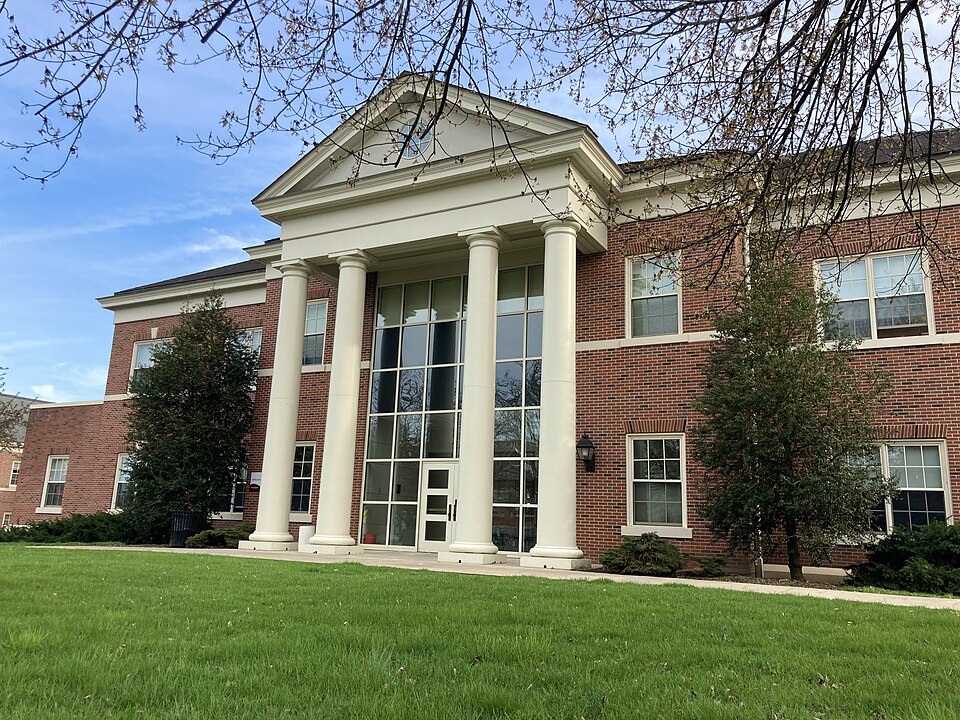
The Susquehanna University campus spans 297 acres (120 ha) in Selinsgrove, Pennsylvania. There are more than 50 buildings on campus, primarily in the style of Georgian architecture. The campus has four buildings that are Leadership in Energy and Environmental Design-certified (LEED) by the U.S. Green Building Council: two residence halls, the Natural Sciences Center, and the Admission House.
Students are guaranteed housing all four years, and nearly all students live on campus.
Selinsgrove Hall is a 3+1⁄2-story brick structure constructed in 1858 in the Italianate style. The roof features a wooden cupola and the structure was previously featured on the institution's logo. Seibert Hall is a 2+1⁄2-story brick structure constructed in 1902 in a restrained Colonial Revival style. Both Selinsgrove Hall and Seibert Hall, were listed on the National Register of Historic Places in 1979.
In 2017, the institution dedicated a $7 million space to welcome prospective students and families. According to the Susquehanna's website, Admission House was funded through contributions from the board of trustees. Unlike most other buildings on campus, the Admission House has a white facade instead of a naturally red-brick exterior. The 15,500-square-foot (1,440 m2) building was designed by architect Peter Bohlin of Bohlin Cywinski Jackson as a modern take on a barn.
The Natural Sciences Center is a $32-million academic building that houses Susquehanna’s biology, chemistry, earth and environmental science, neuroscience, ecology, health care studies, and pre-professional programs. It received Silver LEED certification. The 81,000-square-foot (7,500 m2) building was dedicated in 2010.
In 2018, Susquehanna University completed a 14-acre (5.7 ha) solar array with WGL Energy to supply 30 percent of the institution's electricity. At the time, it was the largest college- or university-sponsored solar array in Pennsylvania, and one of the largest solar projects in the Commonwealth. The 12,000-panel array is estimated to produce over 5,300 megawatt hours (MWh) of electricity per year.
Susquehanna University enrolls approximately 2,200 undergraduate students from 32 states and 30 countries,
Susquehanna University offers more than 150 student clubs and organizations, a variety of honor societies and professional organizations, and 13 Greek organizations, including four National Panhellenic Conference sororities, one National Pan-Hellenic Council sorority, one National Interfraternity Music Council fraternity for women, four Interfraternity Council fraternities, one National Pan-Hellenic Council fra
출처: Susquehanna University (CC BY-SA)
확인된 구조화 정보, 사용자 의견, AI가 찾은 관계를 구분해 표시해요.
아직 댓글이 없어요. 먼저 한마디 남겨 보세요.