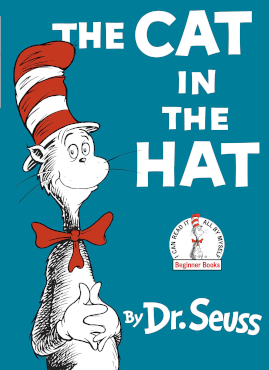
The Cat in the Hat is a 1957 children's book written and illustrated by American author Theodor "Dr. Seuss" Geisel. The story centers on a tall anthropomorphic cat who wears a red and white-striped top hat and a red bow tie. The Cat shows up at the house of Sally and her brother one rainy day when their mother is away. Despite the repeated objections of the children's fish, the Cat shows the children a few of his tricks in an attempt to entertain them. In the process, he and his companions, Thing One and Thing Two, take over the house.
The Cat in the Hat is a 1957 children's book written and illustrated by American author Theodor "Dr. Seuss" Geisel. The story centers on a tall anthropomorphic cat who wears a red and white-striped top hat and a red bow tie. The Cat shows up at the house of Sally and her brother one rainy day when their mother is away. Despite the repeated objections of the children's fish, the Cat shows the children a few of his tricks in an attempt to entertain them. In the process, he and his companions, Thing One and Thing Two, take over the house.
소개 자세히 읽기
The Cat in the Hat is a 1957 children's book written and illustrated by American author Theodor "Dr. Seuss" Geisel. The story centers on a tall anthropomorphic cat who wears a red and white-striped top hat and a red bow tie. The Cat shows up at the house of Sally and her brother one rainy day when their mother is away. Despite the repeated objections of the children's fish, the Cat shows the children a few of his tricks in an attempt to entertain them. In the process, he and his companions, Thing One and Thing Two, take over the house.
Geisel created the book in response to a debate in the United States about literacy in early childhood and the ineffectiveness of traditional primers such as those featuring Dick and Jane. Geisel was asked to write a more entertaining primer by William Spaulding, whom he had met during World War II and who was then director of the education division at Houghton Mifflin. However, because Geisel was already under contract with Random House, the two publishers agreed to a deal: Houghton Mifflin published the education edition, which was sold to schools, and Random House published the trade edition, which was sold in bookstores.
Geisel gave varying accounts of how he created The Cat in the Hat, but in the version he told most often, he was so frustrated with the word list from which he could choose words to write his story that he decided to scan the list and create a story based on the first two rhyming words he found. The words he found were cat and hat. The book was met with immediate critical and commercial success. Reviewers praised it as an exciting alternative to traditional primers. Three years after its debut, the book had already sold over a million copies, and in 2001, Publishers Weekly listed the book at number nine on its list of best-selling children's books of all time. The book's success led to the creation of Beginner Books, a publishing house centered on producing similar books for young children learning to read. In 1983, Geisel said, "It is the book I'm proudest of because it had something to do with the death of the Dick and Jane primers."
Since its publication, The Cat in the Hat has become one of Dr. Seuss's most famous books, with the Cat himself becoming his signature creation, later on becoming one of the mascots for Dr. Seuss Enterprises. The book was adapted into a 1971 animated television special, a 2003 live-action film, and an upcoming 2026 animated film, and the Cat has been included in many pieces of Dr. Seuss media.
Plot
An unnamed boy, who is the narrator of the book, sits with his sister Sally while home alone on a cold and rainy day, staring wistfully out the window. Then they hear a loud bump which is quickly followed by the arrival of the Cat in the Hat, a tall anthropomorphic cat wearing a red and white-striped top hat and a red bow tie, who proposes to entertain the children with some tricks that he knows. The children's pet fish refuses, insisting that the Cat should leave. The Cat then responds by balancing the fish on the tip of his umbrella. The game quickly becomes increasingly trickier, as the Cat balances himself on a ball and tries to balance many household items on his limbs until he falls on his head, dropping everything he was holding. The fish falls into a pot and admonishes him again, but the Cat in the Hat just proposes another game.
Background
Theodor Geisel, writing as Dr. Seuss, created The Cat in the Hat partly in response to the May 24, 1954, Life magazine article by John Hersey titled "Why Do Students Bog Down on First R? A Local Committee Sheds Light on a National Problem: Reading". In the article, Hersey was critical of school primers like those featuring Dick and Jane:
In the classroom boys and girls are confronted with books that have insipid illustrations depicting the slicked-up lives of other children... All feature abnormally courteous, unnaturally clean boys and girls.... In bookstores anyone can buy brighter, livelier books featuring strange and wonderful animals and children who behave naturally, i.e., sometimes misbehave... Given incentive from school boards, publishers could do as well with primers.
After detailing many issues contributing to the dilemma connected with student reading levels, Hersey asked toward the end of the article:
Why should [school primers] not have pictures that widen rather than narrow the associative richness the children give to the words they illustrate—drawings like those of the wonderfully imaginative geniuses among children's illustrators, Tenniel, Howard Pyle, "", Walt Disney?
The Cat brings in a big red box from outside, from which he releases two identical blue-haired creatures, or "Things" as he refers them to, in red suits called Thing One and Thing Two. The Things cause more trouble, such as flying kites in the house, knocking pictures off the wall and picking up the children's mother's new polka-dotted dress. All this comes to an end when the fish spots the children's mother out the window. In response, the boy catches the Things in a net and the Cat, apparently ashamed, stores them back in the big red box. He takes it out the front door as the fish and the children survey the mess he has made. But the Cat soon returns, riding a machine that picks everything up and cleans the house, delighting the fish and the children. The Cat then leaves just before their mother arrives, and the fish and the children are back where they started at the beginning of the story. As she steps in, the mother asks the children what they did while she was out, but the children are hesitant to answer. The story ends with the narrator asking the reader, "What would you do if your mother asked you?"
This article caught the attention of William Spaulding, who had met Geisel during the war and who was then the director of Houghton Mifflin's education division. Spaulding had also read the best-selling 1955 book Why Johnny Can't Read by Rudolf Flesch. Flesch, like Hersey, criticized pr