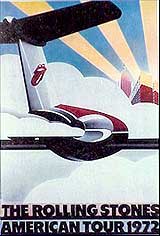
The Rolling Stones American Tour 1972, also known as the "Stones Touring Party", shortened to S.T.P., was a much-publicized and much-written-about concert tour of the United States and Canada in June and July 1972 by the Rolling Stones. Constituting the band's first performances in the United States following the Altamont Free Concert in December 1969, critic Dave Marsh would later write that the tour was "part of rock and roll legend" and one of the "benchmarks of an era."
The Rolling Stones American Tour 1972, also known as the "Stones Touring Party", shortened to S.T.P., was a much-publicized and much-written-about concert tour of the United States and Canada in June and July 1972 by the Rolling Stones. Constituting the band's first performances in the United States following the Altamont Free Concert in December 1969, critic Dave Marsh would later write that the tour was "part of rock and roll legend" and one of the "benchmarks of an era."
소개 자세히 읽기
The Rolling Stones American Tour 1972, also known as the "Stones Touring Party", shortened to S.T.P., was a much-publicized and much-written-about concert tour of the United States and Canada in June and July 1972 by the Rolling Stones. Constituting the band's first performances in the United States following the Altamont Free Concert in December 1969, critic Dave Marsh would later write that the tour was "part of rock and roll legend" and one of the "benchmarks of an era."
Naming
The official name of the tour was 'American Tour 1972'. The tour is also known as the "Stones Touring Party", shortened to S.T.P., derived from the laminates handed out by the management to crew, family, friends and press, granting access to the various areas at the concert venues and hotels. In 2015 Jose Cuervo in association with the Rolling Stones launched a brand of tequila with a marketing campaign based on one of the nicknames of the American Tour being the "Cocaine and Tequila Sunrise tour".
Coverage
Several writers were assigned to cover the tour. Truman Capote was commissioned to write a travelogue for Rolling Stone. Accompanied by prominent New York socialites Lee Radziwill and Peter Beard, Capote did not mesh well with the group; he and his entourage abandoned the tour in New Orleans, before resurfacing for the final shows at Madison Square Garden. Having struggled with writer's block since the publication of In Cold Blood in 1966, he failed to complete his feature, tentatively titled "It Will Soon Be Here." Rolling Stone ultimately recouped its stake by assigning Andy Warhol to interview Capote about the tour in 1973. In the interview, Capote alleged that tour doctor Laurence Badgley (a 1968 graduate of the Yale School of Medicine who was later retained by Led Zeppelin for their
The tour in part supported the group's Exile on Main St. album, which had been released on 12 May, a few weeks before the tour began. It was also part of a triennial pattern of touring America that the group maintained from 1969 through 1981.
On the first show of the tour, 3 June in Vancouver, British Columbia, 31 policemen were treated for injuries when more than 2,000 fans attempted to crash the Pacific Coliseum.
In San Diego on 13 June, there were 60 arrests and 15 people injured during disturbances. In Tucson, Arizona, on 14 June, an attempt by 300 youths to storm the gates led to police using tear gas. On 16 June, after the Denver shows, in a hotel suite, Stephen Stills and Keith Richards drew knives in an argument. While in Chicago for three appearances on 19 and 20 June, the group stayed at Hugh Hefner's original Playboy Mansion in the Gold Coast district. Eighty-one people were arrested at the two sellout Houston shows on 25 June, mostly for marijuana possession and other minor drug offences. There were 61 arrests in the large crowd at RFK Stadium in Washington, D.C., on the Fourth of July.
On 13 July police had to block 2,000 ticket-less fans from trying to gain access to the show in Detroit. On 17 July at the Montreal Forum a bomb blew up in the Stones' equipment van, and replacement gear had to be flown in; then it was discovered that 3,000 forged tickets had been sold; fans rioted and there was a late start to the concert. The next day, 18 July, the Stones' entourage got into a fight with photographer Andy Dickerman in Rhode Island, and Jagger and Richards landed in jail, imperiling that night's show at the Boston Garden. Boston Mayor Kevin White, fearful of a riot if the show were to be cancelled, intervened to bail the musicians out; the show went on, albeit with another late start. Dickerman would later file a £22,230 lawsuit against the band.
The tour ended with four shows over three consecutive nights at New York City's Madison Square Garden, the first night of which saw 10 arrests and two policemen injured, and the last leading to confrontations between the crowd outside Madison Square Garden and the police. The last show on 26 July, Jagger's 29th birthday, had balloons and confetti falling from Madison Square Garden's ceiling and Jagger blowing the candles off a huge cake. Pies were also wheeled in, leading to a pie fight between the Rolling Stones and the audience.
Following the final performance, a party was held in Jagger's honor by Ahmet Ertegun at the St. Regis New York. Guests included Bob Dylan, Woody Allen, Andy Warhol, the Capote entourage, and Zsa Zsa Gabor, while the Count Basie Orchestra provided musical entertainment. At the event, Dylan characterized the tour as "encompassing" and "the beginning of cosmic consciousness."
Rock critic Robert Christgau reported that the mood of the shows was friendly, with Jagger "undercut[ting] his fabled demonism by playing the clown, the village idiot, the marionette."
1977 North American tour) had a "super-Lolita complex" and initiated the statutory rape of a high school student (also filmed by Robert Frank) on the band's business jet during a flight to Washington, D.C.
Terry Southern, a close friend of Keith Richards since the late 1960s, wrote about the tour for Saturday Review in what proved to be one of his last major journalistic assignments. Southern and Beard developed a friendship on the tour and collaborated intermittently on The End of the Game (an unfilmed screenplay) for over two decades.
Robert Greenfield's S.T.P.: A Journey Through America with the Rolling Stones (derived from his tour reportage for Rolling Stone) was published in 1974. Greenfield had already covered the band's 1971 British Tour for Rolling Stone and was granted unlimited access to the band's affairs. Although Greenfield was initially assigned as the magazine's sole correspondent for the tour before a last-minute deal was reached with Capote, he was permitted to continue in his assignment, paralleling Hunter S. Thompson and Timothy Crouse's two-pronged coverage of the contemporaneous 1972 United States presidential election for the magazine.