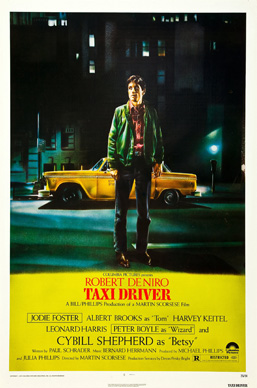
Taxi Driver is a 1976 American neo-noir, psychological drama film directed by Martin Scorsese and written by Paul Schrader. Set in New York City in a time of urban decay following the Vietnam War, it stars Robert De Niro as taxi driver Travis Bickle, whose mental state deteriorates as he works nights in the city, eventually having a mental breakdown and becoming a vigilante. The film also features Jodie Foster, Cybill Shepherd, Harvey Keitel, Peter Boyle, Leonard Harris and Albert Brooks.
Taxi Driver is a 1976 American neo-noir, psychological drama film directed by Martin Scorsese and written by Paul Schrader. Set in New York City in a time of urban decay following the Vietnam War, it stars Robert De Niro as taxi driver Travis Bickle, whose mental state deteriorates as he works nights in the city, eventually having a mental breakdown and becoming a vigilante. The film also features Jodie Foster, Cybill Shepherd, Harvey Keitel, Peter Boyle, Leonard Harris and Albert Brooks.
소개 자세히 읽기
Taxi Driver is a 1976 American neo-noir, psychological drama film directed by Martin Scorsese and written by Paul Schrader. Set in New York City in a time of urban decay following the Vietnam War, it stars Robert De Niro as taxi driver Travis Bickle, whose mental state deteriorates as he works nights in the city, eventually having a mental breakdown and becoming a vigilante. The film also features Jodie Foster, Cybill Shepherd, Harvey Keitel, Peter Boyle, Leonard Harris and Albert Brooks (in his first feature film role).
Filming began in summer 1975, with actors taking pay cuts to ensure that the project could be completed on its low budget of $1.9 million ($11.4 million in 2025). For the score, Bernard Herrmann composed what would be his final score. The music was finished mere hours before his death, and the film is dedicated to him.
Theatrically released by Columbia Pictures on February 8, 1976, the film was critically and commercially successful despite generating controversy for both its graphic violence in the film's climax, and for the casting of 12-year-old Foster as a child prostitute. The film received numerous accolades, including the Palme d'Or at the 1976 Cannes Film Festival and four nominations at the 49th Academy Awards, including Best Picture, Best Actor (for De Niro) and Best Supporting Actress (for Foster).
Although Taxi Driver generated further controversy for inspiring John Hinckley Jr.'s attempted assassination of President Ronald Reagan in 1981, the film has remained popular. It is considered one of the greatest films ever made, and one of the most culturally significant and inspirational of its time. In 2022, Sight & Sound named it the 29th-best film ever in its decennial critics' poll, and the 12th-greatest film of all time on its directors' poll, tied with Barry Lyndon. In 1994, the film was designated as "culturally, historically, or aesthetically" significant by the U.S. Library of Congress and was selected for preservation in the National Film Registry.
In New York City, former Marine and Vietnam War veteran Travis Bickle takes a job as a night-shift taxi driver to cope with his chronic insomnia and loneliness, frequently visiting adult movie theaters on his breaks, and keeping a diary in which he consciously attempts to include aphorisms such as "you're only as healthy as you feel". He becomes disgusted with the crime and urban decay that he witnesses regularly in the city and dreams about getting "the scum off the streets", recording these dreams in his diary. His narration throughout the film is largely conveyed through voice-over excerpts from his diary, which reveal his deteriorating mental state and deepening alienation from society.
Travis becomes infatuated with Betsy, a campaign worker for Senator Charles Palantine, who is running for president. Travis enters the campaign office where she works and asks her to join him for coffee, to which she agrees. Betsy agrees to go on a second date with him, during which he takes her to an adult movie theater, which she leaves immediately. He attempts to reconcile with her, but fails. The rejection further deepens his isolation and contributes to his increasingly erratic behavior. Enraged, he storms into the campaign office where she works and berates her before being kicked out of the office.
Experiencing an existential crisis and seeing various acts of prostitution throughout the city, Travis confides in a fellow taxi driver, nicknamed Wizard, about his violent thoughts. However, Wizard dismisses them and assures him that he will be fine. Despite this reassurance, Travis remains emotionally unmoored, unable to articulate the depth of his psychological distress. To find an outlet for his rage, Travis follows an intense physical training regimen. He gets in contact with black market gun dealer Easy Andy and buys four handguns. At home, Travis practices drawing his new weapons, going as far as creating a quick-draw firearm hidden in one of the sleeves in his coat. He begins attending Palantine's rallies to scope out his security. He also writes a threatening letter to Palantine, further indicating his intent to act against him. One night, Travis shoots a man attempting to rob a convenience store run by his friend, leaving before the cops arrive as the convenience store owner proceeds to beat the non-responsive robber.
In his trips around the city, Travis regularly encounters Iris, a 12-year-old child prostitute. Tricking her pimp and abusive lover Sport into thinking that he wants to solicit her, Travis meets with her in private and tries to persuade her to stop prostituting herself.
Travis shaves his hair into a mohawk and attends a public rally where he plans to assassinate Palantine. However, Secret Service agents see Travis putting his hand inside his jacket and approach him, which escalates to a chase. Travis escapes pursuit and makes it back to his home undetected.
That evening, Travis drives to the brothel where Iris works to kill Sport. He enters the building and shoots Sport and one of Iris's clients, a mafioso. Travis is shot several times but manages to kill the two men. He fights with the bouncer, whom he manages to stab through the hand with his knife and kill with a gunshot to the head. Travis attempts to die by suicide, but has no bullets. Severely injured, he slumps on a couch next to a sobbing Iris. As the police respond to the scene, a delirious Travis mimics shooting himself in the head with his bloody finger.
Travis goes into a coma due to his injuries, but he is hailed by the press as a heroic vigilante who saved Iris and is not prosecuted for the homicides. He also receives a handwritten letter from Iris's parents in Pittsburgh, who thank him for saving their daughter, revealing that she's safe and attending school once more.
After recovering, Travis returns to work, where he encounters Betsy as a fare. Betsy tells him that she followed his story in the newspapers. Travis drops her off at he