
항목
범죄 문학
crime literature
가공의 범죄를 다룬 문학 장르
항목
crime literature
가공의 범죄를 다룬 문학 장르
이 항목이 포함된 사건 파일에서 정보와 관계를 함께 살펴보세요.
이 항목이 포함된 사건 파일이 아직 없습니다.
이 항목으로 조사 시작하기아직 댓글이 없어요. 먼저 한마디 남겨 보세요.
가공의 범죄를 다룬 문학 장르
Crime fiction, detective story, murder mystery, crime novel, mystery novel, and police novel are terms used to describe narratives or fiction that centre on criminal acts and especially on the investigation, either by an amateur or a professional detective, of a crime, often a murder. Most crime drama focuses on criminal investigation and does not feature the courtroom. Suspense and mystery are key elements that are nearly ubiquitous to the genre.
It is usually distinguished from mainstream fiction and other genres such as historical fiction and science fiction, but the boundaries are indistinct. Crime fiction has several subgenres, including detective fiction (such as the whodunit), courtroom drama, hard-boiled fiction, and legal thrillers.
Proto-science and crime fictions have been composed across history, and in this category can be placed texts as varied as the Epic of Gilgamesh from Mesopotamia, the Book of Tobit, Urashima Tarō from ancient Japan, the One Thousand and One Nights (Arabian Nights), and more.
One example of a story in this genre is the medieval Arabic tale of "The Three Apples", one of the tales narrated by Scheherazade in the Arabian Nights. In this tale, a fisherman discovers a heavy locked chest along the Tigris River, and he sells it to the Abbasid Caliph, Harun al-Rashid, who then has the chest broken open, only to find inside it the dead body of a young woman who was cut into pieces. Harun orders his vizier, Ja'far ibn Yahya, to solve the crime and find the murderer within three days, or be executed if he fails his assignment. The story has been described as a "whodunit" murder mystery with multiple plot twists. The story has detective fiction elements.
Two other Arabian Nights stories, "The Merchant and the Thief" and "Ali Khwaja", contain two of the earliest fictional detectives, who uncover clues and present evidence to catch or convict a criminal, with the story unfolding in normal chronology and the criminal already being known to the audience. The latter involves a climax where titular detective protagonist Ali Khwaja presents evidence from expert witnesses in a court. "The Hunchback's Tale" is another early courtroom drama, presented as a suspenseful comedy.
The earliest known modern crime fiction is E. T. A. Hoffmann's 1819 novella "Mademoiselle de Scudéri". Also, Thomas Skinner Surr's anonymous Richmond is from 1827; another early full-length short story in the genre is The Rector of Veilbye by Danish author Steen Steensen Blicher, published in 1829. A further example of crime detection can be found in Letitia Elizabeth Landon's story The Knife, published in 1832, although here the truth remains in doubt at the end. Another early crime novel is "The Murder of Engine Maker Roolfsen" by Norwegian author Maurits Hansen, published in 1839.
Better known are the earlier dark works of Edgar Allan Poe. His brilliant and eccentric detective C. Auguste Dupin, a forerunner of Arthur Conan Doyle's Sherlock Holmes, appeared in works such as "The Murders in the Rue Morgue" (1841), "The Mystery of Marie Rogêt" (1842), and "The Purloined Letter" (1844). With his Dupin stories, Poe provided the framework for the classic detective story. The detective's unnamed companion is the narrator of the stories and a prototype for the character of Dr. Watson in later Sherlock Holmes stories.
출처: Crime fiction (CC BY-SA)
확인된 구조화 정보, 사용자 의견, AI가 찾은 관계를 구분해 표시해요.
The evolution of locked-room mysteries was one of the landmarks in the history of crime fiction. The Sherlock Holmes mysteries of Doyle's are said to have been singularly responsible for the huge popularity of this genre. A precursor was Paul Féval, whose series Les Habits Noirs (1862–67) features Scotland Yard detectives and criminal conspiracies. The best-selling crime novel of the 19th century was Fergus Hume's The Mystery of a Hansom Cab (1886), set in Melbourne, Australia.
The evolution of the print mass media in the United Kingdom and the United States in the latter half of the 19th century was crucial in popularising crime fiction and related genres. Literary 'variety' magazines, such as Strand, McClure's, and Harper's, quickly became central to the overall structure and function of popular fiction in society, providing a mass-produced medium that offered cheap, illustrated publications that were essentially disposable.
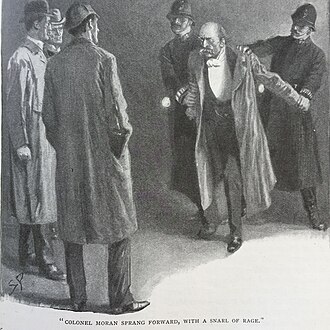
Like the works of many other important fiction writers of his day—e.g. Wilkie Collins and Charles Dickens—Arthur Conan Doyle's Sherlock Holmes stories first appeared in serial form in the monthly Strand in the United Kingdom. The series quickly attracted a wide and passionate following on both sides of the Atlantic, and when Doyle killed off Holmes in "The Final Problem", the public outcry was so great, and the publishing offers for more stories so attractive, that he was reluctantly forced to resurrect him.
In Italy, early translations of English and American stories and local works were published in cheap yellow covers, thus the genre was baptized with the term libri gialli or yellow books. The genre was outlawed by the Fascists during WWII, but exploded in popularity after the war, especially influenced by the American hard-boiled school of crime fiction. A group of mainstream Italian writers emerged, who used the detective format to create an antidetective or postmodern novel in which the detectives are imperfect, the crimes are usually unsolved, and clues are left for the reader to decipher. Famous writers include Leonardo Sciascia, Umberto Eco, and Carlo Emilio Gadda.
In Spain, The Nail and Other Tales of Mystery and Crime was published by Pedro Antonio de Alarcón in 1853. Crime fiction in Spain (also curtailed in Francoist Spain) took on some special characteristics that reflected the culture of the