
작품1999
버추어 테니스
Virtua Tennis
1999년 비디오 게임
작품1999
Virtua Tennis
1999년 비디오 게임
이 항목이 포함된 사건 파일에서 정보와 관계를 함께 살펴보세요.
이 항목이 포함된 사건 파일이 아직 없습니다.
이 항목으로 조사 시작하기아직 댓글이 없어요. 먼저 한마디 남겨 보세요.
1999년 비디오 게임
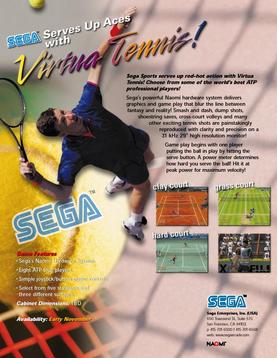
Virtua Tennis, known in Japan as Power Smash (パワースマッシュ, Pawā Sumasshu), is a 1999 tennis video game developed by Sega AM3 and published by Sega. Originally released for arcades on the Sega NAOMI hardware, it was ported to the Dreamcast in 2000 and later to Microsoft Windows, Game Boy Advance and N-Gage. The home versions expanded the arcade game with a World Circuit career mode in which players compete in matches and complete training minigames to improve their ranking.
The Dreamcast version received widespread critical acclaim and was nominated for Console Sports Game of the Year, Console Game of the Year and overall Game of the Year at the 4th Annual Interactive Achievement Awards. The game was followed by Virtua Tennis 2 in 2001 and became the first entry in the Virtua Tennis series.
The player must win five matches played on different surfaces and venues to win a tournament. If the player performs well enough, he is challenged by Master, one of the game's bosses.
This is a single match in which the options are customizable.
The match can be played as singles or doubles with up to four human players (two for singles). The duration can be varied between one game and one set. Other options include the court that the match is played on and the skill of the opponent(s).
Users have to win matches and complete training exercises in order to progress and unlock new ones. The user enters with a rank of 300th, which improves as matches are won. These matches are unlocked by completing easier matches or training exercises. The focus of the training exercises are to be fun, rather than realistic. Each exercise has three levels, with the difficulty increasing progressively. By completing the hardest difficulty with a certain amount of time left or points scored, an outfit is unlocked, which players can wear in all modes.
Virtua Tennis was developed by Sega AM3. The producer, Mie Kumagai, wanted to create a game that appealed to broad demographics of players, taking note of the large number of one-on-one fighting games that proliferated throughout Japanese arcades during the 1990s. She also wished to replicate the critical and commercial achievements of Sega AM2's soccer title Virtua Striker, which was directed by Satoshi Mifune and was a hit among a wide range of age groups.
Kumagai began planning a game that could serve as a both a fun, casual experience and competitive, hardcore experience for people to play with friends and family in arcades and at home. Her initial proposal, a basketball game was rejected, while her alternative proposal, a tennis game, was accepted. However, the potential for the project's success was still met with a large amount of skepticism within Sega. After Kumagai acquired a programmer, they made a trip to a tennis school for research, and began designing a unique paddle controller. By twisting this paddle, the user could switch between forehand and backhand shots, but after months of in-house experimentation it proved too difficult to operate. Taking advice from Mifune, the team simplified the controls to a more traditional joystick and buttons. User reception at location testing and in Sega's offices proved to be very positive and development thereafter was smooth. Sega executives feared the game's original Japanese title, Power Smash, would not translate well to overseas audiences. For its North American and European localizations, the name adopted the familiar Virtua label and was changed to .
The Dreamcast version received "universal acclaim", the Game Boy Advance version received "favorable" reviews, and the PC version received "average" reviews, while the N-Gage version received "generally unfavorable reviews", according to the review aggregation website Metacritic. Blake Fischer of NextGen called the Dreamcast version "The best four-player game in a long time, and an excellent single- and two-player diversion. Don't avoid this because it's not football – you'll get more playtime out of it than you think." In Japan, Famitsu gave the same console version a score of 33 out of 40.
John Thompson of AllGame gave the same arcade version four-and-a-half stars out of five, saying: "With an excellent engine, beautiful graphics and sounds, and an intuitive, deep gameplay system, is one of the best arcade games in recent memory. Sega dominated arcades of the late '90s, and with excellent titles such as this, it's easy to see why." Bryan Melville, however, gave the version four stars, calling it "a game that will go down as one of the best arcade ports on the 128-bit system." Edge gave the same Dreamcast version eight out of ten, saying: "Were it not for the irritation caused by the almost unbeatable players in later stages and the inability to play more than a single set per match, Virtua Tennis would have been a near-perfect sports game." The D-Pad Destroyer of GamePro called the same console version "one of the most purely fun sports games in a long time, up there with Sega Bass Fishing in the Games You're Embarrassed To Enjoy category. If you're a sports fan, go get it." Four-Eyed Dragon said of the version: "Even with sluggish controls and so-so visuals, Virtua Tennis st
출처: Virtua Tennis (video game) (CC BY-SA)
확인된 구조화 정보, 사용자 의견, AI가 찾은 관계를 구분해 표시해요.
In Europe, Sega released the game on 8 September 2000, the same day that the company reduced the recommended retail price of the Dreamcast to £149.99. Sega Europe included the game among the major software releases intended to support the console's second year on the market. Sega UK head of marketing Alison Turner promoted the game's accessibility, multiple play modes, realsitic courts and World Circuit features. Despite this, The Guardian described the marketing as invisible.