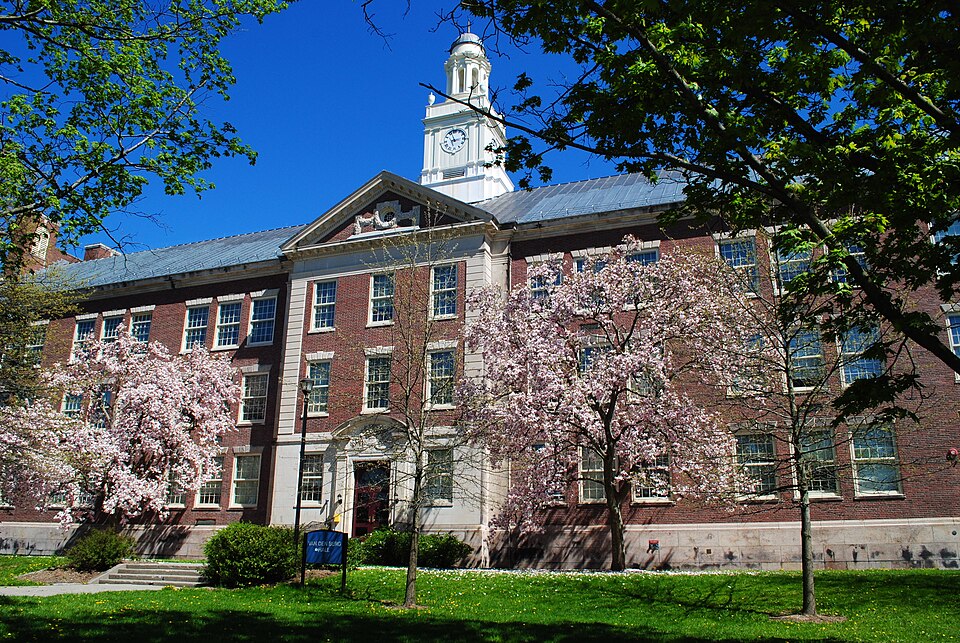
The university's origins can be traced back to the New Paltz Classical School, which originally opened in 1828. After changing its name to the New Paltz Academy in 1833, the school was decimated by a fire in 1884, after which the school offered their land to the state government of New York contingent upon the establishment of a normal school.
In 1885, one year after the fire, the New Paltz Normal and Training School, or New Paltz Normal School, was established to prepare teachers to practice their professions in the public schools of New York. It was granted the ability to award baccalaureate degrees in 1938, after which it was renamed as the State Teachers College at New Paltz; the inaugural class of 112 students graduated in 1942. In 1947, a graduate program in education was established.
When the State University of New York was established by legislative act in 1948, the Teachers College at New Paltz was one of 30 colleges associated under SUNY's umbrella. An art education program was added in 1951. The school experienced another name change in 1959, becoming the State University College of Education at New Paltz. One year later, in 1960, the college was authorized to confer liberal arts degrees. Just one year after that, in 1961, the school updated its name yet again, to the State University of New York College of Arts and Science at New Paltz.
The college's general education program (including then-vanguard introductory surveys of African and Asian cultures) was eliminated in 1971; a distribution requirement was re-instituted in 1993. A program in African American studies was established in 1968. Three years later, the experimental studies program (reorganized as the innovative studies program in 1975) began. It encompassed then-unusual disciplines including video art (under Paul Ryan), dance therapy, clowning, camping, and ecodesign. Instructors in the program were hired by students and compensated through student activity fees. A 4-acre (1.6 ha) environmental studies site operated by students and community members under the aegis of the program at the southern periphery of the campus included geodesic domes, windmills, kilns, a solar-powered house funded by the Department of Energy, and more inchoate variants of sustainable architecture. Upon ascending to the college presidency in 1980, Alice Chandler characterized the edifices as "shacks and hovels" and abolished the program in the early 1980s, demolishing most of the site in the process.
The Legislative Gazette, a journalism and political science internship in which students live and work in Albany and produce a weekly newspaper about state politics, was established in 1978.
On December 29, 1991, the campus was the scene of a widely reported PCB incident that contaminated four dormitories (Bliss, Gage, Capen and Scudder halls), as well as the Coykendall Science Building and Parker Theatre. Under the direction of the county and state health departments, the university began a massive, thorough cleanup effort. As an additional precaution, 29 other buildings were thoroughly tested and, if necessary, cleaned. The clean-up process lasted until May 1995. Since 1994, PCBs have not been used on the SUNY New Paltz campus.