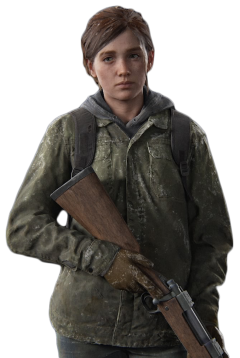
Ellie is a character in the video game series The Last of Us by Naughty Dog. She is portrayed by Ashley Johnson through performance capture in the games, and by Bella Ramsey in the television adaptation. In the first game, The Last of Us (2013), Joel Miller is tasked with escorting a 14-year-old Ellie across a post-apocalyptic United States in an attempt to create a cure for an infection to which Ellie is immune. While players briefly assume control of Ellie, the artificial intelligence primarily controls her actions. Ellie reappeared as the playable character in the downloadable content prequ
Ellie is a character in the video game series The Last of Us by Naughty Dog. She is portrayed by Ashley Johnson through performance capture in the games, and by Bella Ramsey in the television adaptation. In the first game, The Last of Us (2013), Joel Miller is tasked with escorting a 14-year-old Ellie across a post-apocalyptic United States in an attempt to create a cure for an infection to which Ellie is immune. While players briefly assume control of Ellie, the artificial intelligence primarily controls her actions. Ellie reappeared as the playable character in the downloadable content prequ
소개 자세히 읽기
Ellie is a character in the video game series The Last of Us by Naughty Dog. She is portrayed by Ashley Johnson through performance capture in the games, and by Bella Ramsey in the television adaptation. In the first game, The Last of Us (2013), Joel Miller is tasked with escorting a 14-year-old Ellie across a post-apocalyptic United States in an attempt to create a cure for an infection to which Ellie is immune. While players briefly assume control of Ellie, the artificial intelligence primarily controls her actions. Ellie reappeared as the playable character in the downloadable content prequel The Last of Us: Left Behind, in which she spends time with her friend Riley. In The Last of Us Part II (2020), players control a 19-year-old Ellie as she seeks revenge on Abby.
Ellie was created by Neil Druckmann and Bruce Straley, the directors of The Last of Us. Inspired by a mute character proposed for Uncharted 2: Among Thieves, they created her as a strong female character who has a close relationship with Joel. Throughout the first game's development, the relationship between Ellie and Joel was the focus. Johnson inspired aspects of Ellie's personality, prompting Druckmann to make her more active in fighting enemies. Following comparisons to the likeness of Canadian actor Elliot Page, Naughty Dog redesigned Ellie's appearance to better reflect Johnson's personality and make her younger. For Part II, Johnson considered her own experiences with anxiety and researched the effects of post-traumatic stress disorder.
The character has been well received by critics, with Ellie's relationship with Joel most frequently the subject of praise. The strength and complexity of her character, and its subversion of the damsel in distress stereotype, have also been commended. A scene in which Ellie and Riley kiss in Left Behind drew social commentary and was commended as a leap for LGBT representation in video games. Johnson's performance in Part II was praised for her depiction of vulnerability and suffering. The character and performance received numerous awards and nominations, and have placed favorably in polls and lists. Ramsey's performance in the television series has been similarly praised.
Creation
The concept for Ellie began with an unused idea for Uncharted 2: Among Thieves (2009). Neil Druckmann and Bruce Straley, directors of The Last of Us (2013), conceived a sequence with a mute female character who would accompany Uncharted protagonist Nathan Drake; Druckmann felt this would create a "beautiful" relationship through gameplay alone. An early alternative name for the character was Lily; Druckmann chose Ellie as he had considered the name for his daughter. Druckmann, who wrote The Last of Us, designed Ellie as a counterpart to Joel, the main playable character. She was also intended to demonstrate that a character bond could be created entirely through gameplay. Druckmann described the game as a coming of age story for Ellie, in which she adopts the qualities of a survivor.
Casting
Ashley Johnson was cast as Ellie in The Last of Us shortly after her auditions; the development team felt that she fit the role, particularly when acting alongside Troy Baker, who portrayed Joel. Johnson made important contributions to Ellie's character development. She convinced Druckmann to give Ellie a more independent personality, and to make her more successful in combat. As Ellie, Johnson's performances were mostly recorded using motion capture technology which produced approximately 85% of the game's animations. The remaining audio elements were recorded later in a studio. Johnson was sometimes uncomfortable while performing "disturbing" scenes. However, she was excited to play a rare example of a strong female video game character. For The Last of Us Part II (2020), Johnson considered her own experiences with anxiety, and researched the effects of post-traumatic stress disorder (PTSD) with Druckmann.
Appearance
The team felt that establishing Ellie's appearance was critical. They determined that she needed to appear young enough to make her relationship with Joel—who is in his 40s—believable, but old enough to be credible as a resourceful teenager capable of surviving. The team also considered Ellie important for marketing; Druckmann said that, when asked to move the image of Ellie from the front of the game's packaging to the back, "everyone at Naughty Dog just flat-out refused".
Following the announcement of The Last of Us, comparisons were made between Ellie and actor Elliot Page. Page claimed that Naughty Dog had "ripped off" his likeness and that it was "not appreciated", as he was acting in another game, Beyond: Two Souls (2013). According to Straley, Naughty Dog had no knowledge of Page's involvement in Beyond, which was announced several months after The Last of Us. Kotaku observed that some players would likely confuse the characters. Straley said that, following the comparisons, Naughty Dog revised Ellie's appearance because "we want our characters to stand on their own two feet". Druckmann and Straley said the change was made to better reflect Johnson's personality and make her younger. It was revealed in a trailer in May 2012.
Writing
The Last of Us: Left Behind (2014) was written to specifically focus on the relationship between Ellie and Riley, and to recount the events that defined their later personalities. Druckmann was also i
For Part II, Ellie's look underwent years of iteration; the team wanted a logical transition from the first game while maintaining a "practical yet personal" outfit. Lead character artist Ashley Swidowski designed Ellie's eyes to demonstrate a somberness; in the first game, Ellie had wider eyes to reflect her childlike nature. Ellie's moth tattoo was designed by the California-based artist Natalie Hall after the team struggled to settle on a design. Hall drew the tattoo on a developer's arm so the team could visualize it. Druckmann felt that moths' obsession with light mirrored Ellie's obsession in the game, and served as a reminder of Joel.