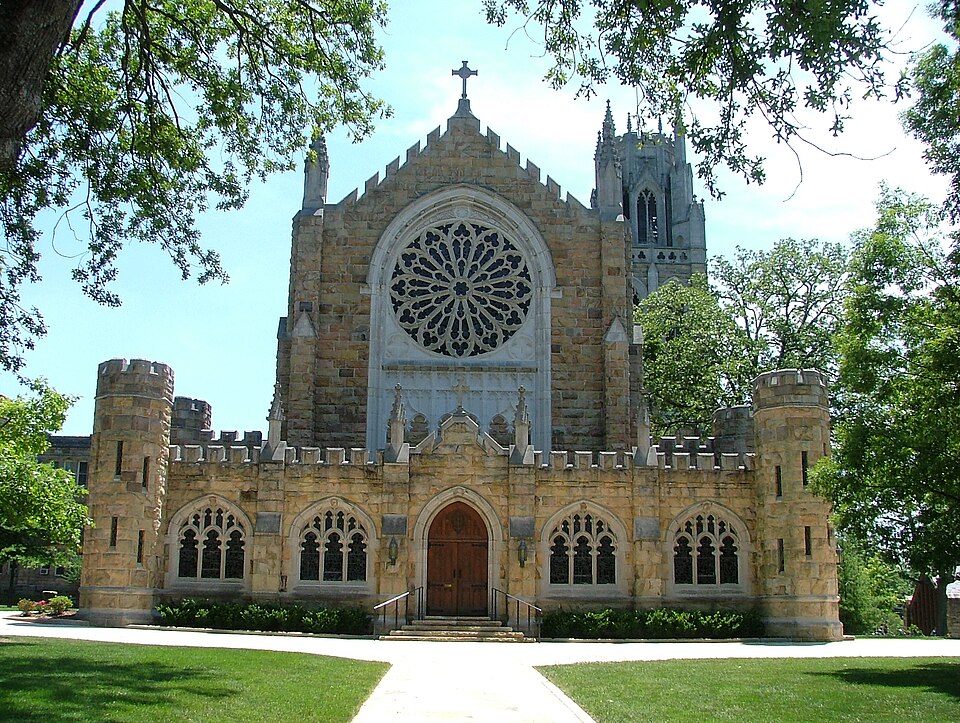
The University of the South, familiarly known as Sewanee, is a private Episcopal liberal arts college in Sewanee, Tennessee, United States. It is owned by 28 southern dioceses of the Episcopal Church, and its School of Theology is an official seminary of the church. The campus consists of 13,000 acres (53 km2) of scenic mountain property atop the Cumberland Plateau, with the developed portion occupying about 1,000 acres (4.0 km2).
The University of the South, familiarly known as Sewanee, is a private Episcopal liberal arts college in Sewanee, Tennessee, United States. It is owned by 28 southern dioceses of the Episcopal Church, and its School of Theology is an official seminary of the church. The campus consists of 13,000 acres (53 km2) of scenic mountain property atop the Cumberland Plateau, with the developed portion occupying about 1,000 acres (4.0 km2).
소개 자세히 읽기
The University of the South, familiarly known as Sewanee (), is a private Episcopal liberal arts college in Sewanee, Tennessee, United States. It is owned by 28 southern dioceses of the Episcopal Church, and its School of Theology is an official seminary of the church. The campus (officially called "The Domain" or, affectionately, "The Mountain") consists of 13,000 acres (53 km2) of scenic mountain property atop the Cumberland Plateau, with the developed portion occupying about 1,000 acres (4.0 km2).
2004 name change
For the period 2004 to about 2016, the institution combined its two historical names in all university publications that were not official documents and styled itself as "Sewanee: The University of the South". Version three of the university's style guide, a document reflecting the official policies of the university with respect to its public image following the name change, stated in part:
First, it must be understood that the official and legal name of this institution is "The University of the South". In the past, though, unorganized use of this official name and the university's familiar name, Sewanee, has been confusing to those unfamiliar with the institution. In addition, college guides and Web sites that have become so crucial in young people's college searches may list the institution under as many as four different entries—beginning with "The", "University", "South", or "Sewanee".
To avoid confusion and to honor the history and character of the institution, a consistent reference to the name of the institution is critical. So, for extended audiences unfamiliar with the institution, the naming convention "Sewanee: The University of the South" should be used on a first reference. Subsequent references may be to "Sewanee" or "the University".
Beginning in the 1830s, Bishop James Otey of Tennessee led an effort to found an Episcopal seminary in the Deep South. Following the Mexican War, the Episcopal Church saw tremendous growth in the region; and a real need for an institution "to train natives, for natives" – as Otey put it – arose. Up to that point, only the Virginia Theological Seminary in Alexandria, Virginia, existed south of the Mason-Dixon Line, and other denominations were already establishing schools in the region. The location was chosen primarily because of the proximity to the major railway hub of Chattanooga, Tennessee, and the existing railroad spur up the mountain, the "Mountain Goat", which ran from 1858 until April 1985. Bishop Leonidas Polk commented that, due to the access to railroads, one could reach any point in the South from Sewanee within thirty-six to forty-eight hours.
On July 4, 1857, delegates from ten Southern dioceses of the Episcopal Church in the United States—Alabama, Arkansas, Florida, Georgia, Louisiana, Mississippi, North Carolina, South Carolina, Tennessee, and Texas—were led up Monteagle Mountain by Polk for the founding of their denominational college for the region. The goal was to create a Southern university free of Northern influences. As Otey put it: the new university will "materially aid the South to resist and repel a fanatical domination which seeks to rule over us." The majority of the land for the university was donated by the Sewanee Mining Company on the condition that a university "be put in operation within ten years". The company's early profits were derived from the labor of mainly African-American convict leasing. John Armfield, co-founder of Franklin & Armfield, "the largest slave trading firm" in the United States, was the largest single donor involved in the founding of the university.
The six-ton marble cornerstone, laid on October 10th, 1860, and consecrated by Polk, was blown up in 1863 by Union soldiers; many of the pieces were collected and kept as keepsakes by the soldiers. A few were donated back to the university, and a large fragment was eventually installed in a wall of All Saints' Chapel. Several figures later prominent in the Confederacy, notably Polk, Bishop Stephen Elliott, Jr., and Bishop James Hervey Otey, were founders of the university. Generals Edmund Kirby Smith, Josiah Gorgas, and Francis A. Shoup were prominent in the university's postbellum revival.
Because of the damage and disruptions during the Civil War, construction came to a temporary halt. Polk died in action during the Atlanta campaign. He is remembered through his portrait Sword Over the Gown, painted by Eliphalet F. Andrews in 1900. After the original was vandalized in 1998, a copy by Connie Erickson was unveiled on June 1, 2003.
In 1866, building was resumed, and this date is sometimes used as the re-founding of the university and the year from which it has maintained continuous operations, though official materials and anniversary celebrations still use 1857. The university's first convocation was held on September 18, 1868, with nine students and four faculty members present. Presiding was Charles Todd Quintard, vice-chancellor (chief academic officer) of the university, second Bishop of Tennessee and "Chaplain of the Confederacy". He attended the first Lambeth Conference (1868) in England and received financial support from clergy and laity of the Church of England for rebuilding the school. Quintard is known as the "Re-Founder" of the University of the South.
During World War II, the University of the South was one of 131 tertiary institutions nationally that took part in the V-12 Navy College Training Program, which offered students a path to a Navy commission.
A minor scandal ensued, with more conservative commentators insinuating that the change was intended to "distance" the university from its historic association with Southern culture. "Some alumni were also angered by a report commissioned by the university last year [2004] by a marketing firm from Chicago that said that the word 'South' often had negative connotations for students around the country; the weaker the connection between the South and the university's name, the bett
변화의 기록
4
관계가 언제 생기고 바뀌었는지 날짜순으로 모았습니다. 소식 글과 출처에 적힌 날짜를 기준으로 합니다.
끝남
Sewanee: The University of the South 멤버사우스이스턴 콘퍼런스
끝남
Sewanee: The University of the South 속한 시리즈사우스이스턴 콘퍼런스
생김
Sewanee: The University of the South 멤버사우스이스턴 콘퍼런스
생김
Sewanee: The University of the South 속한 시리즈사우스이스턴 콘퍼런스