
캐릭터
후안 리코
Juan Rico
소설 스타십 트루퍼스의 주인공
캐릭터
Juan Rico
소설 스타십 트루퍼스의 주인공
이 항목이 포함된 사건 파일에서 정보와 관계를 함께 살펴보세요.
이 항목이 포함된 사건 파일이 아직 없습니다.
이 항목으로 조사 시작하기아직 댓글이 없어요. 먼저 한마디 남겨 보세요.
소설 스타십 트루퍼스의 주인공
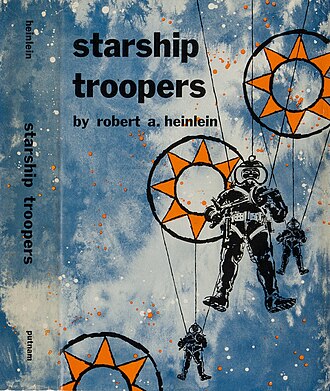
Starship Troopers is a military science fiction novel by American writer Robert A. Heinlein. Written in a few weeks in reaction to the US suspending nuclear tests, the story was first published as a two-part serial in The Magazine of Fantasy & Science Fiction as Starship Soldier, and published as a book by G. P. Putnam's Sons on November 5, 1959.
The story is set in a future society ruled by a human interstellar government called the Terran Federation, dominated by a military elite. Under the Terran Federation, only veterans of a primarily military Federal Service enjoy full citizenship, including the right to vote. The first-person narrative follows Juan "Johnny" Rico, a young man of Filipino descent, through his military service in the Mobile Infantry. He progresses from recruit to officer against the backdrop of an interstellar war between humans and an alien species known as "Arachnids" or "Bugs". Interspersed with the primary plot are classroom scenes in which Rico and others discuss philosophical and moral issues, including aspects of suffrage, civic virtue, juvenile delinquency, and war; these discussions have been described as expounding Heinlein's own political views. Identified with a tradition of militarism in US science fiction, the novel draws parallels between the conflict between humans and the Bugs, and the Cold War. It is also a coming-of-age novel, which criticizes the US society of the 1950s, arguing that a lack of discipline had led to a moral decline, and advocating corporal and capital punishment.
Starship Troopers brought to an end Heinlein's series of juvenile novels. It won the Hugo Award for Best Novel in 1960, and was praised by reviewers for its scenes of training and combat and its visualization of a future military. It also became enormously controversial because of the political views it seemed to support. Reviewers were strongly critical of the book's intentional glorification of the military, an aspect described as propaganda and likened to recruitment. The novel's militarism, and the fact that government service – most often military service – was a prerequisite to the right to vote, led to it being frequently described as fascist. Others disagree, arguing that Heinlein was only exploring the idea of limiting the right to vote to a certain group of people. Heinlein's depiction of gender has also been questioned, while reviewers have said that the terms used to describe the aliens were akin to racial epithets.
Starship Troopers had wide influence both within and outside science fiction. Ken MacLeod stated that "the political strand in [science fiction] can be described as a dialogue with Heinlein". Science fiction critic Darko Suvin wrote that it is the "ancestral text of US science fiction militarism" and that it shaped the debate about the role of the military in society for many years. The novel is credited with popularizing the idea of powered armor, which became a recurring feature in science fiction books and films, as well as an object of scientific research. Heinlein's depiction of a futuristic military was also influential. Later science fiction books, such as Joe Haldeman's 1974 anti-war novel The Forever War, have been described as reactions to Starship Troopers. The story was adapted several times, including in a 1997 film version directed by Paul Verhoeven that satirized what the director saw as the fascist aspects of the novel.
Robert Heinlein was among the best-selling science fiction authors of the 1940s and 1950s, along with Isaac Asimov and Arthur C. Clarke; they were known as the "big three" that dominated US science fiction. In contrast to the others, Heinlein firmly endorsed the anti-communist sentiment of the Cold War era in his writing. Heinlein served in the US Navy for five years after graduating from the United States Naval Academy in 1929. His experience in the military profoundly influenced his fiction. At some point between 1958 and 1959, Heinlein put aside the novel that would become Stranger in a Strange Land and wrote . His motivation arose partially from his anger at US President Dwight Eisenhower's decision to suspend US nuclear tests, and the Soviet tests that occurred soon afterward. Writing in his 1980 volume Expanded Universe, Heinlein would say that the publication of a newspaper advertisement placed by the National Committee for a Sane Nuclear Policy on April 5, 1958, calling for a unilateral suspension of nuclear weapons testing by the United States sparked his desire to write Starship Troopers. Heinlein and his wife Virginia created the "Patrick Henry League" in an attempt to create support for the US nuclear testing program. Heinlein stated that he used the novel to clarify his military and political views.
Set approximately 700 years in the future, the book depicts an Earth ruled by a world government run by military veterans. The society is depicted as affluent, and futuristic technology shown as coexi
출처: Starship Troopers (CC BY-SA)
확인된 구조화 정보, 사용자 의견, AI가 찾은 관계를 구분해 표시해요.
Like many of Heinlein's books, Starship Troopers was completed in a few weeks. It was originally written as a juvenile novel for New York publishing house Scribner; Heinlein had previously had success with this format, having written several such novels published by that publisher. The manuscript was rejected, prompting Heinlein to end his association with that publisher completely, and to resume writing books with adult themes. Scholars have suggested that Scribner's rejection was based on ideological objections to the content of the novel, particularly in its treatment of military conflict.
The Magazine of Fantasy & Science Fiction first published Starship Troopers in October and November 1959 as a two-part serial titled Starship Soldier. A senior editor at Putnam's, Peter Israel, purchased the manuscript and approved revisions that made it more marketable to adults. Asked whether it was aimed at children or adults, he said at a sales conference "Let's let the readers decide who likes it." The novel was eventually published by G. P. Putnam's Sons.