
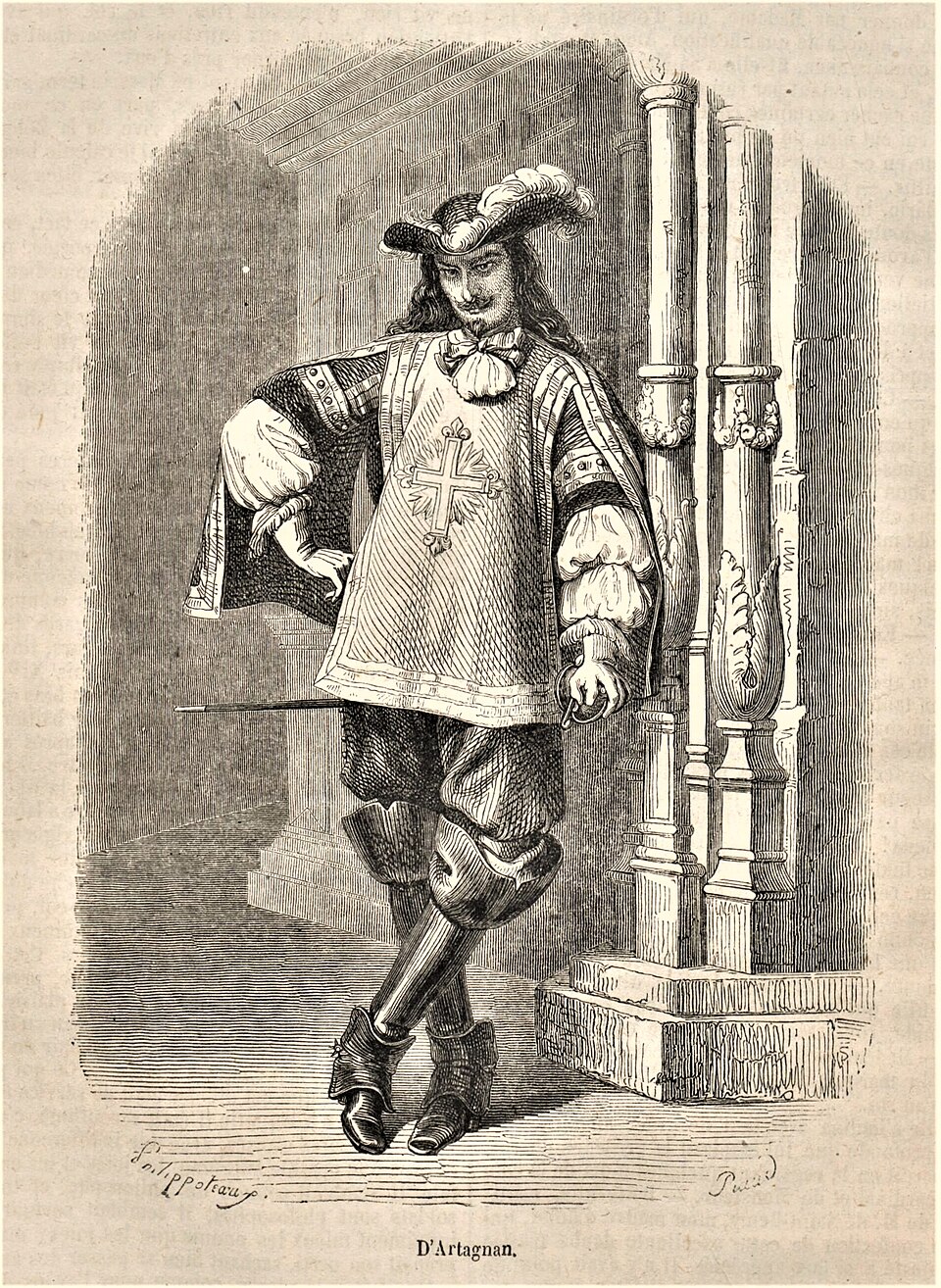
캐릭터
다르타냥
D'Artagnan
알렉상드르 뒤마의 소설 삼총사 등장인물
캐릭터
D'Artagnan
알렉상드르 뒤마의 소설 삼총사 등장인물
이 항목이 포함된 사건 파일에서 정보와 관계를 함께 살펴보세요.
이 항목이 포함된 사건 파일이 아직 없습니다.
이 항목으로 조사 시작하기아직 댓글이 없어요. 먼저 한마디 남겨 보세요.
Charles de Batz de Castelmore (French pronunciation: [ʃaʁl də bats də kastɛlmɔʁ]), also known as d'Artagnan and later Count d'Artagnan (c. 1611 – 25 June 1673), was a French soldier who served Louis XIV as captain of the Musketeers of the Guard. He died at the siege of Maastricht in the Franco-Dutch War. A fictionalised account of his life by Gatien de Courtilz de Sandras formed the basis for the d'Artagnan Romances of Alexandre Dumas, most famously including The Three Musketeers (1844). The heavily fictionalised version of d'Artagnan featured in Dumas' works and their subsequent screen adaptations is now far more widely known than the real historical figure.
D'Artagnan was born at the Château de Castelmore near Lupiac in south-western France. His father, Bertrand de Batz lord of Castelmore, was the son of a newly ennobled merchant, Arnaud de Batz, who purchased the Château de Castelmore. Charles de Batz went to Paris in the 1630s, using the name of his mother Françoise de Montesquiou d'Artagnan. D'Artagnan found a way to enter into the Musketeers in 1632 through the support of his uncle, Henri de Montesquiou d'Artagnan or perhaps thanks to the influence of Henri's friend, Monsieur de Tréville. D’Artagnan joined the guards in the mid-1630s and served under Captain des Essarts. The regiment saw much action in the early 1640s, taking part in sieges at Arras alongside another literary famous comrade in arms Cyrano de Bergerac, at Aire-sur-la-Lys, La Bassée and Bapaume in 1640–41 and Collioure and Perpignan in 1642. Whether or not d’Artagnan was personally involved is unclear, but it is likely he took part in some, if not all, of these sieges. While in the Musketeers, d'Artagnan sought the protection of the influential Cardinal Mazarin, France's principal minister from 1643. In 1646, the Musketeers company was dissolved, but d'Artagnan continued to serve his protector Mazarin.
D'Artagnan had a career in espionage for Cardinal Mazarin, in the years after the first Fronde. Owing to d'Artagnan's faithful service during this period, Louis XIV entrusted him with many secret and delicate situations that required complete discretion. He followed Mazarin during his exile in 1651 in the face of the hostility of the aristocracy. In 1652, d'Artagnan was promoted to lieutenant in the Gardes Françaises, and fought at the Battle of Stenay in 1654, as well as in sieges at Landrecies and Saint-Ghislaine, then to captain in 1655. In 1658, he became a second lieutenant in the newly reformed Musketeers. This was a promotion, as the Musketeers were far more prestigious than the Gardes-Françaises.
The French historian Odile Bordaz believes that d'Artagnan was buried in St Peter and Paul Church in Wolder, a district of Maastricht, the Netherlands. Wolder was Louis XIV's headquarters during the Maastricht siege and he attended mass in the local church every day. In contrast, the archaeologist Wim Dijkman, curator of the historical collections of the city of Maastricht at Centre Céramique, says that there is no historical or archaeological evidence for the claim.
On March 25, 2026, during restoration work at the St Peter and Paul Church, subsiding floor tiles around the altar revealed a skeleton buried directly beneath, a site historically reserved for notable figures. Near the remains were a French coin dated around 1660 and fragments of a lead musket ball. DNA from the teeth was sent to a German laboratory to compare with descendants' genetic material, while other bones were studied in Deventer to assess age and biological sex.
On 5 March 1659, d'Artagnan married Anne-Charlotte Boyer de Chanlecy (1624–1683), lady of Sainte-Croix, and widow of Jean-Elenor de Damas. She was the daughter of Charles Boyer, lord of Chanlecy and Sainte-Croix, and Claude de Rymon, lady of la Rochette. The couple soon separated, d'Artagnan pursuing his military career while his wife left Paris to live on her lands at Sainte-Croix, where she died on 31 December, 1683.
They had two sons, both of whom entered the military: Louis de Batz de Castelmore, who was born in 1660, took the title of count d’Artagnan and died at Château de Castelmore in December 1709, and Louis de Batz de Castelmore, who was born 4 July 1661 in Chalon-sur-Saône, was a knight, later known as count d’Artagnan, baron of Sainte-Croix, lord of Chanlecy and Castelmore, and became maréchal de camp. He married Marie Anne Amé (1670–1714) on 21 May
출처: Charles de Batz de Castelmore d'Artagnan (CC BY-SA)
확인된 구조화 정보, 사용자 의견, AI가 찾은 관계를 구분해 표시해요.
D'Artagnan was famous for his connection with the arrest of Nicolas Fouquet. Fouquet was Louis XIV's finance commissioner and aspired to take the place of Mazarin as the king's advisor. Fouquet was also a lover of grand architecture and employed the greatest architects and artisans in the building of his Chateau of Vaux-le-Vicomte. On 17 August 1661, he celebrated the completion with a most extravagant feast, at which every guest was given a horse. The king, however, felt upstaged by the grandeur of the home and event and, suspecting that such magnificence could only be explained through Fouquet's pilfering the royal treasury, three weeks later had d'Artagnan arrest Fouquet. To prevent his escape by bribery, d'Artagnan was assigned to guard him for four years until Fouquet was sentenced to life imprisonment.
In 1667, d'Artagnan was promoted to captain-lieutenant of the Musketeers, the effective commander as the nominal captain was the king. As befitted his rank and position, he could be identified by his striking burgundy, white, and black livery—the colours of the commanding officer of the Musketeers. Another of d'Artagnan's assignments was the governorship of Lille, which was won in battle by France in 1667. D'Artagnan was an unpopular governor and longed to return to battle. He found his chance when Louis XIV went to war with the Dutch Republic in the Franco-Dutch War. After being recalled to service, d'Artagnan was killed in battle on 25 June 1673 at the siege of Maastricht, when some believe that a musket ball tore into his throat.