
장소
Cranleigh School
영국의 초등학교
장소
영국의 초등학교
이 항목이 포함된 사건 파일에서 정보와 관계를 함께 살펴보세요.
이 항목이 포함된 사건 파일이 아직 없습니다.
이 항목으로 조사 시작하기아직 댓글이 없어요. 먼저 한마디 남겨 보세요.
영국의 초등학교
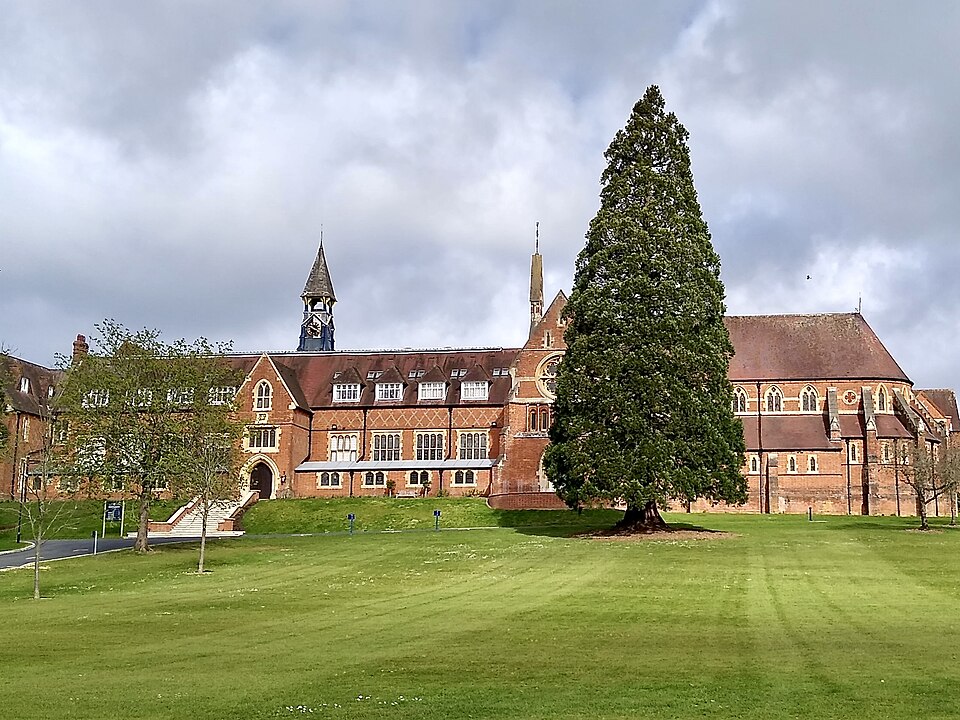
Cranleigh School is an independent, co-educational, boarding and day school for pupils aged 13–19 in South East England. Opened in 1865, it remains on its original campus, around 1 mile (1.6 kilometres) north of the centre of Cranleigh, Surrey. In March 2025, the school, together with the associated prep school, educated a total of 961 pupils between the ages of 7 and 19, of whom 575 were boarders. The current Head is Samantha Price. The school has international campuses in the United Arab Emirates and China.
The earliest proposals for the school were put forward in 1862 by George Cubitt, the MP for West Surrey, and John Sapte, the local parish priest. Henry Woodyer was commissioned to design the buildings and the foundation stone was laid in 1863. Cranleigh School opened to male pupils on 29 September 1865, although the original quad was not finished until 1867. The chapel and dining hall were completed two years later. These original buildings, all designed by Woodyer, were Grade II listed in July 1993.
From an initial total of around 150 boys in 1866, numbers in the school reached 280 by 1892. A joint application with St Catherine's School, Bramley, for a royal charter was made in 1897. The charter was granted the following year, establishing the Corporation of the Cranleigh and Bramley Schools. A major expansion of the school campus began in the early 1910s, with the purchase of additional land and the opening of new science laboratories. Two buildings designed by Edwin Cooper were completed in 1929, providing additional dormitories and a purpose-built auditorium. The first day girls began studying at Cranleigh School in 1971, and the first female boarders were admitted to the sixth form three years later. The school became fully coeducational in 1999.
The earliest proposals for a boarding school at Cranleigh, were put forward in 1862 by George Cubitt, the MP for West Surrey, and John Sapte, the local parish priest. A committee of 16 met that November at the Abbot's Hospital in Guildford to develop a prospectus for the new institution. The name "Surrey County School" was chosen and an eight-acre (3.2 ha) site was identified, which Cubitt agreed to purchase. The overriding aim was to provide "a sound and thorough public school education, on the principles of the Church of England, for the sons of farmers and others throughout the agricultural districts of Surrey." The motto, Latin: Ex cultu robur, lit. 'From culture strength', was chosen by Edward White Benson, a member of the founding committee and later the archbishop of Canterbury.
Merriman continued as headmaster until 1892, during which period the number of pupils increased to over 300. Under his leadership, a new library building was opened in 1874, and six years later, partly in response to an outbreak of scarlet fever, a sanatorium was constructed, funded by Cubitt. Merriman retired to take up the living of Freshwater on the Isle of Wight and was succeeded by George Allen, also a graduate of St John's College, Cambridge, and a former teacher at Wellington and Dulwich Colleges.
During the late 1890s, changes were made to governing structure of the school. The founders had originally chosen the name "Surrey County School", but in 1897, it was amended to "Cranleigh School (Surrey County)" to reflect common usage. A joint application with St Catherine's School, Bramley, was made to secure a royal charter, which was granted on 8 June 1898. Under its terms, the Corporation of the Cranleigh and Bramley Schools was established to assume ownership of the land on which the two institutions were built. Running of the schools continued as before, with operational powers delegated to separate boards of governors. John Honey, a historian of 19th-century education, writes that "by the end of the Victorian period, Cranleigh had gained acceptance among what were perhaps the top fifty public schools [in the country]".
The number of pupils at Cranleigh School declined throughout George Allen's tenure as headmaster, decreasing from 280 in the Summer Term of 1892 to 173 in October 1908. Allen blamed inadequate science facilities and teaching, which he had been unable to improve owing to the fall in income from fees. He resigned in July 1908 to become parish priest of Send near Woking.
Charles Tyler, a graduate of Pembroke College, Cambridge, who had previously taught at Charterhouse and Rossall Schools, was appointed headmaster in December 1908 and took up the post the following month. He proposed a programme of improvement for the school buildings and facilities, with the aim of reversing the decline in student numbers. The expenditure of £600 (equivalent to £6
출처: Cranleigh School (CC BY-SA)
확인된 구조화 정보, 사용자 의견, AI가 찾은 관계를 구분해 표시해요.
An appeal for funds was made in April 1863, with an initial target of £7000 (equivalent to £760,000 in 2025) to provide a school for 100 pupils. By the summer, half of this total had been raised, enabling the committee to commission Henry Woodyer to design the new buildings. The foundation stone was laid by Charles Longley, archbishop of Canterbury, on 25 November 1863, and Joseph Merriman, a fellow of St John's College, Cambridge, was appointed the first headmaster in early 1865. Robert Quick, who had previously taught at the Royal Grammar School, Guildford, and Hurstpierpoint College, was chosen as Merriman's deputy.
The school opened to students on 29 September 1865, although the formal opening ceremony did not take place until 12 October. By that date, only the south and east sides of the quad had been completed, which provided a school hall and two classrooms on the ground floor, with dormitories and accommodation for teachers on the first and second floors. Two further classrooms were in temporary use as the dining hall and chapel. Of the 25 pupils who had enrolled in advance, only 18 attended on the first day, but by the summer of 1866, the numbers had increased to 150. The remaining sides of the quad were completed the following year, and the chapel and dining hall were added in 1869.