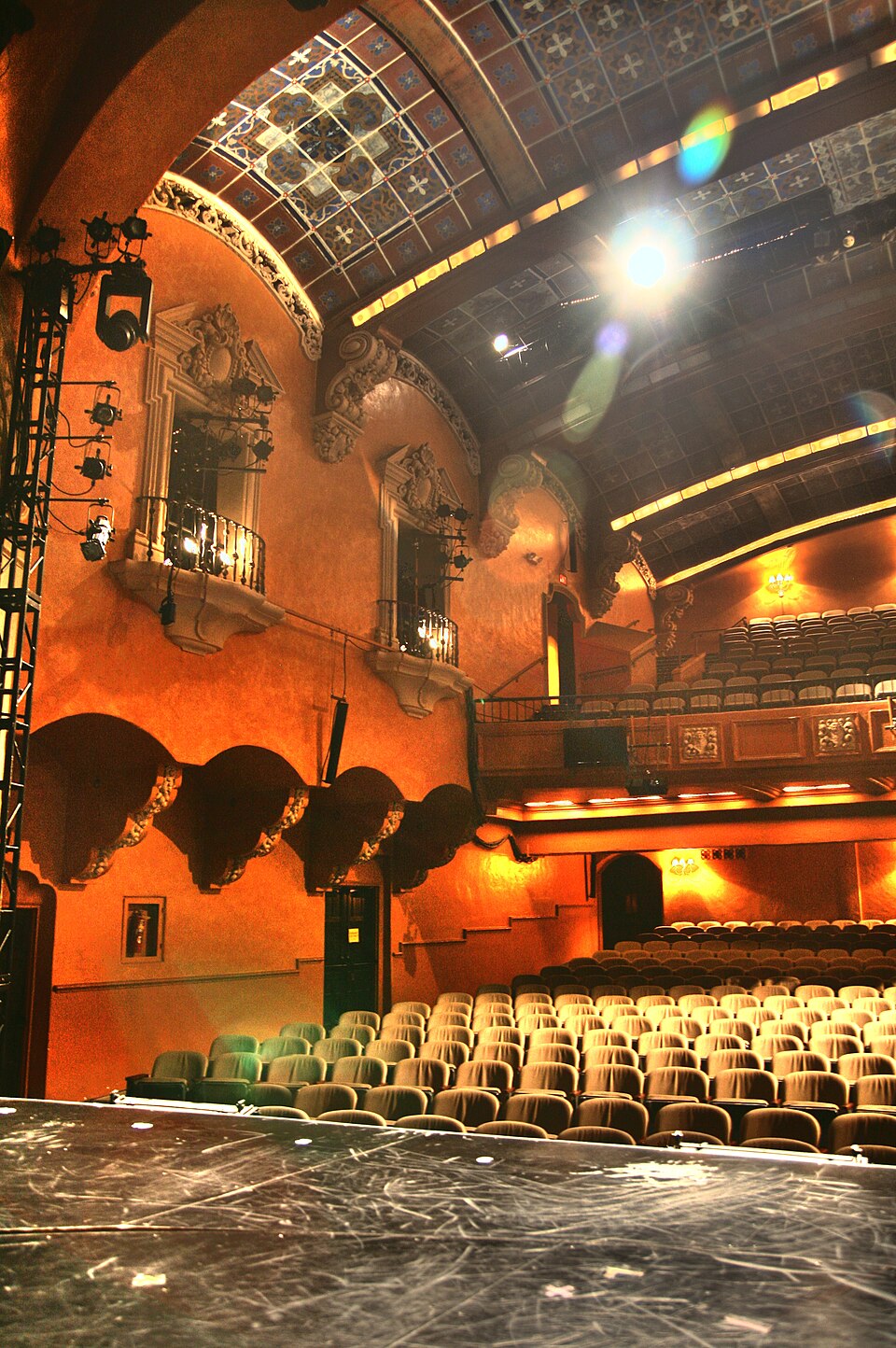
Beginning around 1912, the period known as the Little Theatre Movement developed in cities and towns across the United States. The artistic community that founded the Pasadena Playhouse was started in 1916 when actor-director Gilmor Brown began producing a series of plays at a renovated burlesque theatre with his troupe "The Gilmor Brown Players". Brown established the Community Playhouse Association of Pasadena in 1917 that would later become the Pasadena Playhouse Association, which necessitated a new venue for productions.
The community theatre organization quickly grew and in May 1924, the citizens of Pasadena raised funds to build a new theatre in the city center at 39 South El Molino Avenue. Completed in 1925, the theatre was designed in a Spanish Colonial Revival style by Pasadena artist and architect Elmer Grey, with a fire curtain painted by Pasadena artist Alson S. Clark.
Its non-professional, community beginnings and the tremendous amount of local support for the project led George Bernard Shaw to dub Pasadena "the Athens of the West", likening the enterprise to the ancient Festival Dionysia.
The building that was designed by Grey and built by the Winter Construction Co. drew the attention of the nation, bringing Southern California world premieres by authors such as Eugene O'Neill, William Saroyan, Noël Coward, F. Scott Fitzgerald and Tennessee Williams, as well as many English language premieres of significant European dramas. The Playhouse was recognized by the Legislature as the State Theatre of California in 1937.
The Pasadena Playhouse School of Theatre Arts was established in 1927 initially offering course credit via the University of California. Later known as the Pasadena Playhouse College of Theatre Arts, it eventually became an accredited college in 1936, offering BFA and MFA degrees. The college trained notable talents such as Raymond Burr, Victor Mature, Ernest Borgnine, Eleanor Parker, Charles Bronson, Ray Vasquez, Gene Hackman, Dustin Hoffman, Sally Struthers, Jamie Farr, Mako, Robert Rockwell, and others. During the school years, the Playhouse was very active, having as many as five independent stages in operation at any given time, giving 306–322 performances annually on the main stage alone. In order to provide housing for the many students, older homes along El Molino Avenue were modified to become dormitories.
The varied staging capabilities offered by its five venues led the Playhouse to become one of the first companies in California to experiment with new theatrical forms such as theatre-in-the-round. The Playhouse also built and operated one of the first television stations in Southern California. In addition to training the Air Force to use television and radio equipment, the Pasadena Playhouse supplied the majority of Southern California's early TV stations with the first trained technicians in the business.