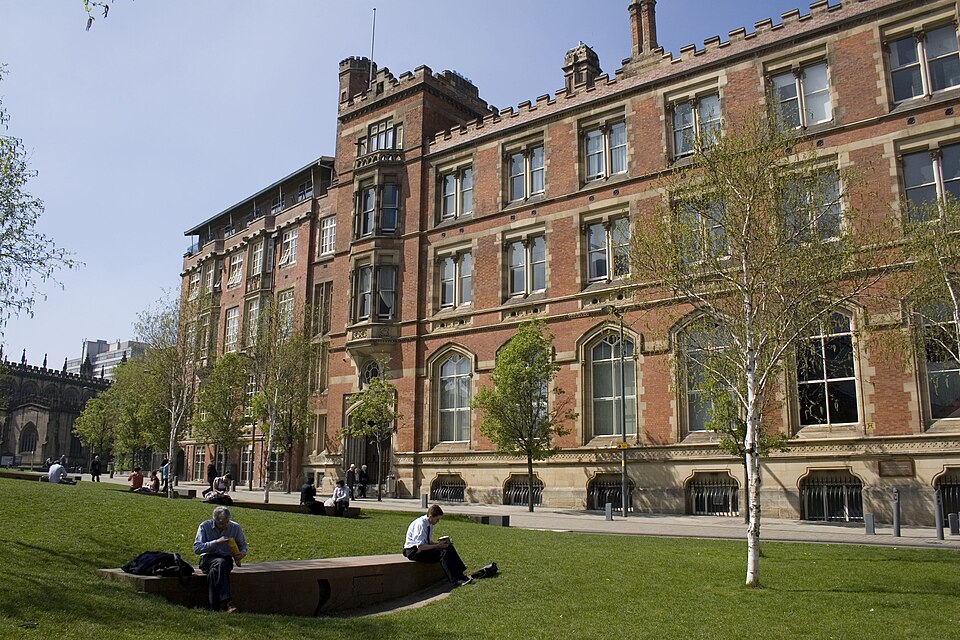
The Manchester Grammar School (MGS) is a highly selective private day school for boys aged 7–18 in Manchester, England, which was founded in 1515 by Hugh Oldham. It is the largest private day school for boys in the United Kingdom and has been described as "one of Britain's most prestigious independent day schools", known for its strong academic focus; having educated politicians, leading journalists, diplomats, Nobel laureates, poets, as well as Academy Award and BAFTA award-winning actors and directors.
The Manchester Grammar School (MGS) is a highly selective private day school for boys aged 7–18 in Manchester, England, which was founded in 1515 by Hugh Oldham. It is the largest private day school for boys in the United Kingdom and has been described as "one of Britain's most prestigious independent day schools", known for its strong academic focus; having educated politicians, leading journalists, diplomats, Nobel laureates, poets, as well as Academy Award and BAFTA award-winning actors and directors.
소개 자세히 읽기
The Manchester Grammar School (MGS) is a highly selective private day school for boys aged 7–18 in Manchester, England, which was founded in 1515 by Hugh Oldham (then Bishop of Exeter). It is the largest private day school for boys in the United Kingdom and has been described as "one of Britain's most prestigious independent day schools", known for its strong academic focus; having educated politicians, leading journalists, diplomats, Nobel laureates, poets, as well as Academy Award and BAFTA award-winning actors and directors.
Originally named 'The Manchester Free Grammar School for Lancashire Boys', The Manchester Grammar School was founded by Hugh Oldham in 1515 adjacent to Manchester Parish Church as a free grammar school and as the first school in Manchester. The school grounds slowly expanded for over 400 years until 1931, when the school successfully raised a sum to move its premises from a now over-crowded site in the centre of Manchester to its much larger present site at Rusholme. In accordance with its founder's wishes, MGS remains a predominantly academic school and belongs to the Headmasters' and Headmistresses' Conference.
In the post-war period, MGS was a direct-grant grammar school. It chose to become an independent school in 1976 after the Labour government abolished the Direct Grant System. Fees for 2023–2024 were £15,180 per annum.
Foundation
The founder, Hugh Oldham, a Manchester-born man, attended Exeter College, Oxford and Queens' College, Cambridge, after having been tutored in the house of Thomas Stanley, 1st Earl of Derby. Historical accounts suggest that he was not a particularly learned man, but was in Royal service, being a favoured protégé of Margaret Beaufort, Countess of Richmond and Derby, mother of Henry VII, and became recognised for his administrative abilities. He was appointed Bishop of Exeter in 1505. His great wealth came from his water-powered corn mills on the River Irk near Manchester, which were subsequently used to fund the school's endowment.
On 2 July 1515 he signed an endowment trust deed establishing the Manchester Free Grammar School for Lancashire Boys. A site was purchased in September 1516 and construction took place between April 1517 and August 1518. The combined cost was £218.13s.5d, largely given by Oldham, but with the help of his and the Bexwyke (Beswick) family who had provided an earlier endowment for a school within the parish church. A more elaborate deed in 1525 set the detailed rules for the school until the late 19th century.
The original deed promoted "Godliness and good learning" and established that any boy showing sufficient academic ability, regardless of background, might attend, free of charge. The school was situated between Manchester Cathedral, then a collegiate church, and the church's domestic quarters, subsequently Chetham's School of Music.
Later, Oldham's great friend Richard Foxe, the Bishop of Winchester, wished to found a monastery. Oldham, however, convinced him instead to found Corpus Christi College in Oxford and contributed 6,000 marks of silver (£4,000). Oldham also had a hand in the founding of Brasenose College, Oxford.
The original foundation provided a school house in the curtilage of Manchester's Parish Church and two graduates (the 'High Master' and the 'Usher') to teach Latin and later Greek, to any children who presented themselves. The school was intended to prepare pupils for university and eventually the Church or the legal profession. Typically, pupils would have stayed for 8 to 10 years before leaving for university. There was often enough money to fund bursaries or exhibitions for pupils.
In 1654, the world's first free public library was formed next door to MGS in what had been the church's living quarters. This was facilitated by a bequest from a wealthy businessman (and ex-pupil) Humphrey Chetham, which also served to create a bluecoat orphanage there, schooling 40 poor boys.
By the 18th century, there are thought to have been between 50 and 100 boys in the grammar school at any one time, three or four of whom each year were awarded exhibitions to Oxford and Cambridge. An extra room had been built onto the school house for boys who needed instruction in English before they started Latin, and another master was employed to teach them.
The 1515 building was replaced on the same site in 1776. This was on two levels, an Upper School for the Latin and Greek pupils, a Lower School for the English pupils. Boarding-houses were added and many of the Upper School pupils were boarders from surrounding counties. When De Quincy came as a boarder in 1800, classes were held at roughly 7.00am to 9.00, 9.30 to 12.00 and 3.00pm to 5.00.
By 1808 consideration was being given to moving from the site, as it was becoming insalubrious, but this proved impossible as the deed could not be changed except by Act of Parliament.
Going from the Old Church to Long Millgate ... one is in an almost undisguised working men's quarter, for even the shops and beerhouses hardly take the trouble to exhibit a trifling degree of cleanliness ... [The Irk, immediately beside the school,] is a narrow, coal black, foul smelling stream full of debris and refuse.
A commercial school, in parallel with the classical school, and more suited to Manchester's business climate, was established in the 1830s. By this time the school was getting richer on the proceeds of the mills which provided its funding and had a growing surplus on account. Its 'feoffees' (or governors) were mostly landed gentry from outside Manchester and they were heavily criticised for running the school to suit the needs of their offspring rather than as originally intended, the poor of Manchester. This led to a long running suit at the Court of Chancery, which eventually promoted the commercial side at the expense of the classical side of the school.
The area around the school continued to change. During the 1840s, Victoria Railway Station was completed opposite the schoo