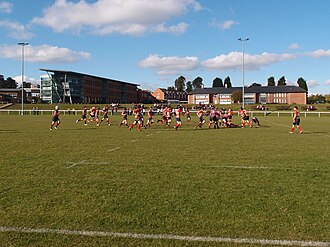
Northampton School for Boys (NSB) is an 11–18 boys secondary school in Northampton, England. It was founded as Northampton Grammar School in 1541 by Thomas Chipsey, Mayor of Northampton. Years 7 to 11 are boys-only, while sixth form classes are mixed. The school generally ranks among the best-performing in the county.
Northampton School for Boys (NSB) is an 11–18 boys secondary school in Northampton, England. It was founded as Northampton Grammar School in 1541 by Thomas Chipsey, Mayor of Northampton. Years 7 to 11 are boys-only, while sixth form classes are mixed. The school generally ranks among the best-performing in the county.
소개 자세히 읽기
Northampton School for Boys (NSB) is an 11–18 boys secondary school in Northampton, England. It was founded as Northampton Grammar School in 1541 by Thomas Chipsey, Mayor of Northampton. Years 7 to 11 are boys-only, while sixth form classes are mixed. The school generally ranks among the best-performing in the county.
Establishment
The school was founded in 1541 as the town's free boys grammar school on the site of the Lamb Inn on Bridge Street. Founded by mayor Thomas Chipsey, his fellow trustees included:
Laurence Manley, Mayor from 1546-37, 1547–48, and 1557, also MP for Northampton in 1529 and 1553
Edward Manley, Mayor from 1559–60, 1566–67, and 1574–75, also MP for Northampton in 1558
William Brightwell
Lawrence Washington, ancestor of George Washington, mayor in 1532 and 1545.
In 1557, the school moved to St. Gregory's church, which was adapted for its use. The School remained on this site until 1864, when it moved to the Corn Exchange in the Market Square. In 1870, additional premises were opened in Abington Square to educate a further 200 pupils. Due to its popularity, the school moved again in 1911, to new buildings constructed on the present site at Billing Road when it was known as the Town and County School.
Second World War
The boys of Willesden County School in north-west London (now Capital City Academy) and Kilburn Grammar School were evacuated to the school. The girls were evacuated to Northampton High School, England.
Grant maintained
In 1992, the school became Grant Maintained, later becoming a Foundation school. It was led for several years by Bruce Liddington, who brought the school out of a period of poor performance. It prospered as a prominent and over-subscribed school. From 1994, the school's GCSE results improved year upon year, and became the only school nationally to achieve an 11-year period of continual improvement. Liddington's success in leading the school through a turnaround earned him a knighthood and made him sought after in education strategy. Liddington would later be disgraced and resign from a chain of academy schools when he oversaw a culture of extravagant expense claims, irregularities, and trips to prestige venues funded by public money, which the Times Educational Supplement compared to corruption in US education. He was followed as headmaster by Michael Griffiths. Since 2014 Richard Bernard (Ex-OFSTED inspector) has taken over the role of headmaster.
During the 1990s, the school allowed the admission of girls into the Sixth Form. In 2007, up to a quarter of the Sixth Form could be girls, however it is now fully mixed with girls slightly outnumbering boys in the Sixth Form.
New buildings
In the summer of 1999 the school completed a new complex, Cripps Hall, named in honour of Sir Humphrey Cripps, philanthropist and Cambridge-educated former pupil of the school. It includes a theatre used for school productions and concerts as well as public performances. The building is home to the School's Expressive Arts and Modern Foreign Languages departments, as well as the theatre, drama workshop and Lounge.
During 2004, Northampton switched back to the two-tier system, once again making Northampton School for Boys a secondary school; consequently, the school had to admit pupils from the age of eleven. To cope with the increased numbers, the school for two years occupied a second campus ("Northampton School for Boys West") at the former Cliftonville Middle School—separated from the main site by St Andrew's Hospital—for the new year sevens and eights. With the completion of the RIBA award-winning new building, all pupils were located back on the main site.
Academy status
In 2010, Northampton School for Boys became an academy.
Academic and personal attainment
The school has achieved recognition for its success, particularly in the areas of sport and music. Six music groups from the school achieved places in the 2009 finals of the National Festival of Music for Youth. Out of these, the Jazz Big Band won the tournament, and two other groups finished as runners-up in their categories. In November 2007 the Schools 'Jazz Vocal Group' was invited to perform at the Music for Youth Proms at the Royal Albert Hall. In December 2005 NSB was named The Daily Telegraph State School of the Year for its achievements in sport.
Gifted pupils
The school was selected to be an ambassador school for the NAGTY due to its gifted and talented programme, which was hailed as a model system by DfES.
Sport
In terms of sport, the school has had a number of its former students go into professional rugby, but many have achieved international recognition in a range of sports. Particular strengths are rugby, football, cricket, basketball, cross country, athletics and rowing, but there are also competitive fixtures in hockey, swimming, badminton and netball. Saturday fixtures are still a part of NSB life, unlike most state schools.
On 20 May 2013, the Under 13 (year 8) age group won the English School's Football Association National Cup 4-3 AET, defeating Walkwood CE Middle School, Redditch, at Chesterfield F.C.'s Proact Stadium. This marked the first Football National Cup triumph for the school, and the second final.
On 16 March 2016, the Under 15 (year 10) age group won the football National Cup, securing a 2-1 victory over football specialist school Thomas Telford School, at the Madejski Stadium, Reading.
School buildings
The centre of the school is occupied by the 1911 Building, which over the years has been extended to include an extension to the library and which is now attached to the science and technology blocks and the new (2006) building. In the summer of 1999 the school completed the Cripps Hall, named in honour of Sir Humphrey Cripps, a former pupil of the school. It includes a theatre used for school productions and concerts as well as public performances. The building is home to the School's Expressive Arts and Modern Foreign Languages departments.
Beginning in 2005, the school has had a refurbishment and building programme, called Project 465 (the school was to be 465 years old when finished, but because of building delays i