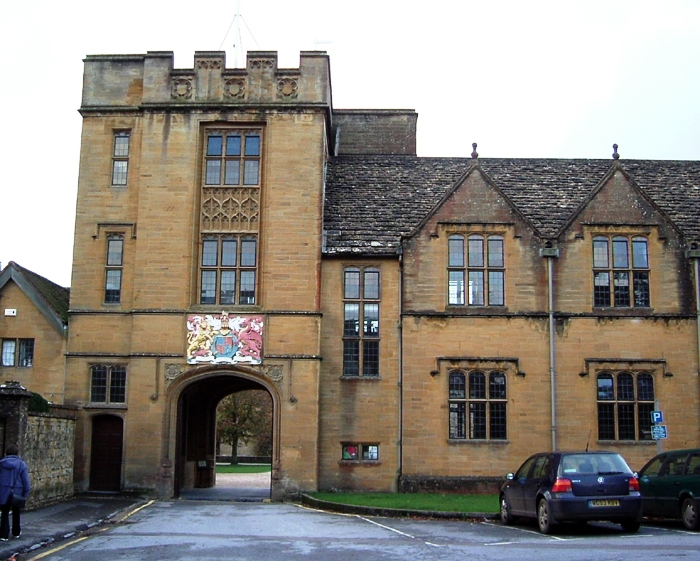
Sherborne School, also known as "Sherborne Boys", is a boarding school with day places for boys aged 13 to 18 located beside Sherborne Abbey in the Dorset town of Sherborne. The school has been in continuous operation on the same site for over 1,300 years. It was founded in AD 705 by St Aldhelm and, following the dissolution of the monasteries, re-founded in 1550 by Edward VI, making it one of the oldest schools in the United Kingdom. Sherborne is one of the twelve founding member public schools of the Headmasters' and Headmistresses' Conference in 1869 and is a member of the Eton Group and Bo
Sherborne School, also known as "Sherborne Boys", is a boarding school with day places for boys aged 13 to 18 located beside Sherborne Abbey in the Dorset town of Sherborne. The school has been in continuous operation on the same site for over 1,300 years. It was founded in AD 705 by St Aldhelm and, following the dissolution of the monasteries, re-founded in 1550 by Edward VI, making it one of the oldest schools in the United Kingdom. Sherborne is one of the twelve founding member public schools of the Headmasters' and Headmistresses' Conference in 1869 and is a member of the Eton Group and Bo
소개 자세히 읽기
Sherborne School, also known as "Sherborne Boys", is a boarding school with day places for boys aged 13 to 18 located beside Sherborne Abbey in the Dorset town of Sherborne. The school has been in continuous operation on the same site for over 1,300 years. It was founded in AD 705 by St Aldhelm and, following the dissolution of the monasteries, re-founded in 1550 by Edward VI, making it one of the oldest schools in the United Kingdom. Sherborne is one of the twelve founding member public schools of the Headmasters' and Headmistresses' Conference in 1869 and is a member of the Eton Group and Boarding Schools Association.
Sherborne educates about 540 boys, aged 13 to 18, and three quarters of its 2021 A level results were A or A* grades. Many of the school buildings are on the National Heritage List for England, including seven listed as grade I, four listed as grade II*, and 19 listed as grade II; the Courts' south side is a scheduled monument.
The school also has a branch located in Doha, Qatar which was built following the Emir of Qatar Tamim bin Hamad Al Thani's time at the school.
705–1539
Sherborne was founded as a cathedral school when, in 705 AD, King Ine of Wessex instructed Aldhelm, a churchman and distinguished scholar, to found a cathedral and college of clergy at Sherborne to relieve pressure from the growing see of Winchester. It is one of the oldest schools in the United Kingdom.
Anglo-Saxon masonry survives in the Beckett Room, below the school library, a reminder that Sherborne continues to occupy part of the Saxon Cathedral to which it owes its foundation. Alfred the Great, King of the Anglo-Saxons, is said to have been an early pupil of the school, a tradition supported by the seat of West Saxon government having moved to Sherborne in 860 (after Winchester was sacked by the Danes) when Alfred was about 11 years old. That Alfred's son, later Bishop of Sherborne, was also educated at a cathedral school (in Winchester following its recovery by Wessex) is regarded as additional presumptive evidence in support of the claim. Aldhelm was the first Bishop of Sherborne, and the school remained under the direction of Sherborne's bishops until 1122, when its supervision passed to the abbot of the Benedictine monastery which had been established at Sherborne by Wulfsige III in 998. The school continued under monastic direction until the dissolution of the monasteries by Henry VIII in 1539.
1539–1550
While the dissolution of the Benedictine Monastery of Sherborne in 1539 had an impact on administration and finances, Sherborne School remained in continuous operation, as evidenced by extant documents including the abbey churchwardens' accounts for 1542, which record a rent received from the school, and conclusively from a note on the certificate for Dorset under the Chantries Act, dated 14 January 1548, which records the school at Sherborne as continuatur quousque [long continued].
1550–present
On 29 March 1550 a formal instruction was issued by Edward VI to re-found Sherborne School – the first of his whole foundation – together with a good endowment of lands that the school might ever endure. A beautifully engrossed royal charter was sealed on 13 May 1550, under which the school was to have a headmaster and usher for the education of boys, and a board of twenty governors under a warden. A further note of continuity was struck when the last headmaster of Sherborne under the old foundation, William Gibson, was appointed as the first headmaster under the new foundation.
The school continues to occupy the site of the former monastery; the school chapel (12th century, modified in the 15th, 19th, and 20th centuries), library (13th century, 15th-century roof and windows), and the Abbot's House (c. 1480), occupied by the headmaster and the senior staff, are all former monastic buildings. The outlines of the monastic cloister, and curious first-floor Abbot's Chapel, are visible on the walls beyond the Abbot's House.
When Edward VI re-founded Sherborne, he granted the school an endowment of valuable lands which belonged to abolished chantries in the churches of Martock, Gillingham, Lytchett Matravers, Ilminster and the Free Chapel of Thornton in the parish of Marnhull. The lands with which the chantries were endowed are predominantly in Dorset, specifically in the manors of:
On 24 October 1851 Edward Digby, 2nd Earl Digby, owner of nearby Sherborne Castle, gave to the governors of the school a plot of land, measuring just under 1+1⁄2 acres (0.6 hectares), including the remaining old monastic buildings, though these had been converted for use as a silk mill c1740. This more than doubled the size of the school site and contributed hugely to the school's development thereafter. The old monastic buildings were restored and converted into a chapel, dormitories, big schoolroom, and classrooms in 1853, and over time the quadrangle, as can be seen today, was gradually formed.
In 1873, the governors bought a further 8 acres (3 hectares) or so from Lord Digby's trustees, allowing the creation of additional facilities and further prospects for the school. The old Abbey Silk Mill (not to be confused with the silk mill in the old monastic buildings) was converted into a workshop, concert room, museum, armoury, and laboratories, and a swimming bath was dug nearby, followed by the building of the fives courts the following year. The sanatorium in was completed in 1887, and the next big construction project was the Carrington Building in 1910, incorporating and replacing (in part) the old Abbey Silk Mill, to be used as new laboratories and classrooms. A new workshop was completed ten years later, forming what is now the Devitt Court. Over the years many more construction projects were completed, including the sports centre in 1974, the largest most recently being the Music School in 2010.
On 1 June 1950 King George VI and Queen Elizabeth visited Sherborne School and took part in the celebrations marking the four hundredth anniversary of the