
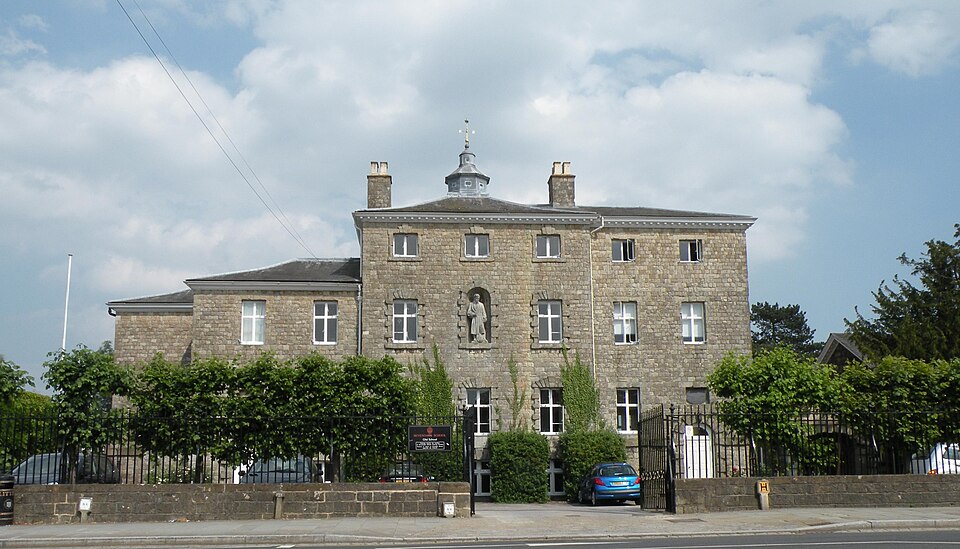
장소
Sevenoaks School
Sevenoaks School is a private school. It is co-educational, a private boarding and day school, located in Sevenoaks, Kent, England.
장소
Sevenoaks School is a private school. It is co-educational, a private boarding and day school, located in Sevenoaks, Kent, England.
이 항목이 포함된 사건 파일에서 정보와 관계를 함께 살펴보세요.
이 항목이 포함된 사건 파일이 아직 없습니다.
이 항목으로 조사 시작하기아직 댓글이 없어요. 먼저 한마디 남겨 보세요.
Sevenoaks School is a private school. It is co-educational, a private boarding and day school, located in Sevenoaks, Kent, England.
Sevenoaks School is a private school. It is co-educational, a private boarding and day school, located in Sevenoaks, Kent, England.
Established in 1432, it is the second oldest non-denominational school in the United Kingdom, only behind Oswestry (1407). It is among the UK's leading schools, and has annual boarding fees in excess of £53,500, making it one of the most expensive schools in the country. It is a registered charity.
As of 2025, it is among the top 5 International Baccalaureate schools in the United Kingdom, and top 15 in the world.
Around 1,200 day pupils and boarders attend, ranging in age from 11 to 18 years. There are approximately equal numbers of boys and girls. In 2006 it became the first major UK school to switch entirely from A level exams to the International Baccalaureate.
출처: Sevenoaks School (CC BY-SA)
확인된 구조화 정보, 사용자 의견, AI가 찾은 관계를 구분해 표시해요.
Founded as a grammar school by William Sevenoke in 1432 as a part of his last will and testament, the school was intended to give a classical education to boys in the area on free of charge and free of church constrictions. Sevenoke's will also provided for almshouses for poor men and women. Sevenoaks School is one of the oldest lay foundations in England. Sevenoke was Mayor of London and, as a friend of Henry V, may have been influenced by the MP for Shropshire and King's pleader, David Holbache, who founded Oswestry in 1407. According to William Lambarde and Richard Johnson (Nine Worthies of London), Sevenoke was a foundling, whose decision to establish the school and almshouses may have been inspired by his early history.
In 1560, in response to a petition by Ralph Bosville and Sevenoaks parishioners, Elizabeth I issued letters patent incorporating the school, giving it the right to use her name, and changing its governance. A seal was issued bearing Bosville's initials and the motto Servire Deo Regnari Est. Ralph Bosville was Clerk of the Court of Wards and Liveries, a JP and owner of the Manor of Bradbourne near Sevenoaks, and under the conditions of the letters patent, he and his heirs were to serve on the governing body as long as they lived in Kent. He has been described as the school's 'second founder'. Supporting the letters patent, statues and ordinances were issued in 1574 and a private act of Parliament, the Sevenoaks School Act 1597 (39 Eliz. 1. c. 13 Pr.) passed in February 1598. The school also received a number of bequests during the sixteenth century and during this period was brought to wider attention by William Lambarde's A Perambulation of Kent (1576).
The school is thought to have been initially housed in small buildings near the present site, before an official school house was built. Rebuilding took place in 1631, under the supervision of Thomas Pett. It was again rebuilt in 1724, to the designs of Lord Burlington, a friend of the headmaster of the time, Elijah Fenton. Building work was completed in 1732. During this period the Master and scholars were housed outside the town.
The school remained small until the late 19th century. School records show that between 1716 and 1748, under the headmastership of the Revd Simpson, school numbers dropped from 'a great many scholars' to only four boys. Simpson resigned and was replaced by Edward Holme, a distant relative of Sir Richard Burton. By 1778 there were around 60 pupils, and the same is indicated in the School Inquiry Commission of 1868.
In 1884 the governors appointed Daniel Birkett as headmaster. It was Birkett's vision to elevate the school's status to that of a First Grade Classical School. He started this revolution, reducing the number of free places to the townfolk and expanding boarding. When he resigned in the 1890s the school had over 100 boys. Birkett's revolution was continued by George Heslop who increased the size to a peak of 134 boys, although numbers dropped towards the end of the First World War (during which 350 Old Sennockians enlisted). Geoffrey Garrod followed Heslop in 1919. In the same year, the headmaster's wife, Mrs Garrod, started a new school for younger boys; Sevenoaks Prep School started with six pupils in the school Cottage Block. An element of selection entered the admissions process in the early 1920s.
James Higgs-Walker succeeded Garrod in 1924. Higgs-Walker introduced day houses, expanded school sports and extracurricular activities and expanded the school with the help of the school's benefactor, Charles Plumptre Johnson, who was a governor from 1913 to 1923 and chairman from 1923 to his death in 1938. Johnson donated many gifts to the school with his brother, Edward: *The Flagpole, 1924, *Thornhill, 1924 (Johnson's House), *Johnson's Hall, 1936 (Now Johnson's Library), *The Sanitorium, 1938, *Park Grange and the surrounding estate, 1946.
Higgs-Walker led the school until 1956 when he was succeeded by Kim Taylor. During Taylor's headship the school became more prominent nationally through Taylor's introduction of a number of innovative teaching methodologies, "Mr. Taylor, the Headmaster, has built so successfully on the work of his predecessor that in the ten years he has been at Sevenoaks it has changed from an old-established minor public school ... into an experimental outpost of the Headmasters' Conference."
The school was a pioneer in the introduction of 'The New Maths', an approach to teaching the subject which made it less abstract, and more engaging for pupils. The school adopted the textbooks and examination regime of the School Mathematics Project (SMP) which had been pioneered at a number of other private schools.
The final period of every Wednesday was set aside for the sixth form to attend lectures, usually with a current affairs theme. Speakers have included public figures such as trade union leaders Ray Buckton (ASLEF) and Hugh Scanlon (AEU), boxer Henry Cooper, philosopher A. J. Ayer and astronomer Patrick Moore.
In 1968, Taylor was succeeded by Michael Hinton who was himself succeeded by Alan Tammadge in 1971.
In 1976, the school first admitted girls and moved from being