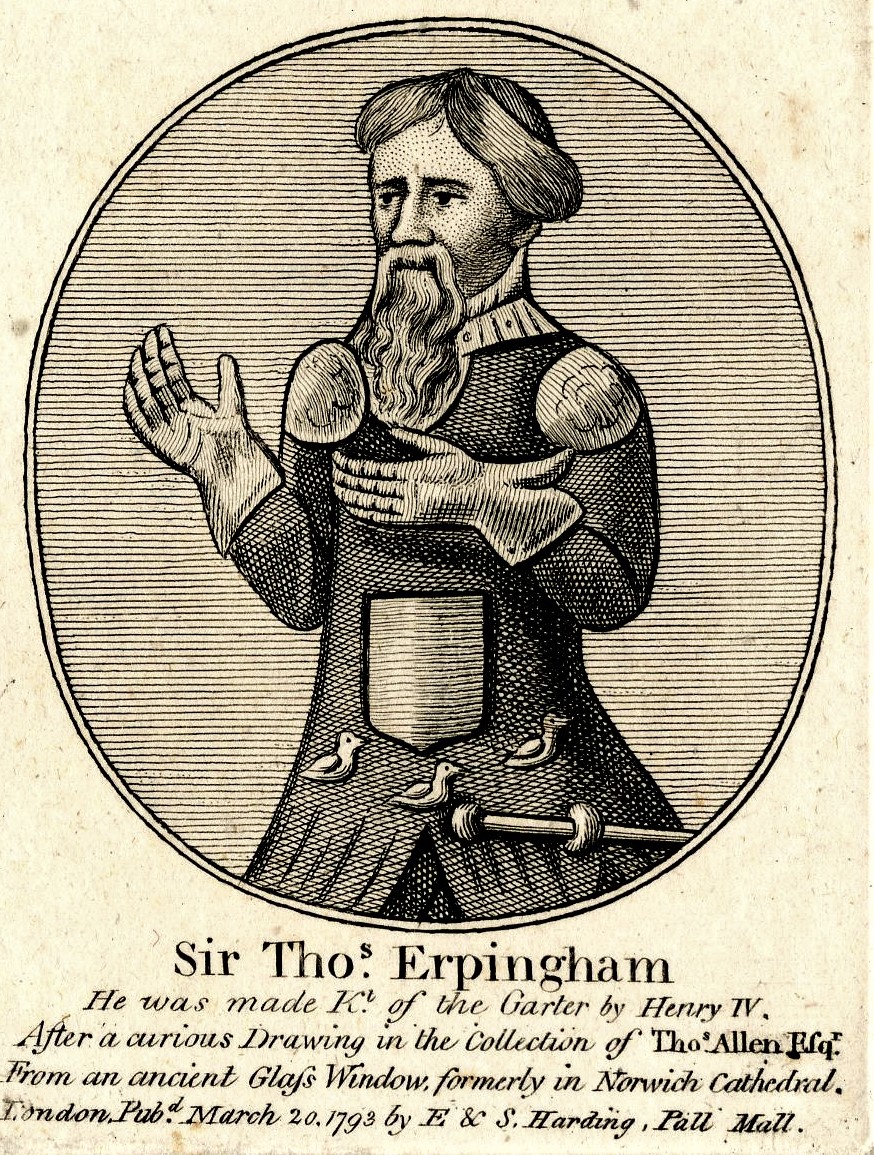
Sir Thomas Erpingham was an English soldier and administrator who loyally served three generations of the House of Lancaster, including Henry IV and Henry V, and whose military career spanned four decades. After the Lancastrian usurpation of the English throne in 1399, his career in their service was transformed as he rose to national prominence, and through his access to royal patronage he acquired great wealth and influence.
Sir Thomas Erpingham was an English soldier and administrator who loyally served three generations of the House of Lancaster, including Henry IV and Henry V, and whose military career spanned four decades. After the Lancastrian usurpation of the English throne in 1399, his career in their service was transformed as he rose to national prominence, and through his access to royal patronage he acquired great wealth and influence.
阅读详细介绍
Sir Thomas Erpingham (c. 1357 – 27 June 1428) was an English soldier and administrator who loyally served three generations of the House of Lancaster, including Henry IV and Henry V, and whose military career spanned four decades. After the Lancastrian usurpation of the English throne in 1399, his career in their service was transformed as he rose to national prominence, and through his access to royal patronage he acquired great wealth and influence.
Erpingham was born in the English county of Norfolk, and knighted when a young man. During the reign of Richard II he served under the King's uncle John of Gaunt, Duke of Lancaster, in Spain and Scotland, and was with Gaunt's son Henry Bolingbroke on crusades in Lithuania, Prussia and the Holy Land. Erpingham accompanied Bolingbroke into exile in October 1398, and was with him when he landed at Ravenspur in July 1399 to reclaim his inheritance as Duke of Lancaster, after his lands had been forfeited by Richard. Bolingbroke rewarded Erpingham by appointing him as constable of Dover Castle and warden of the Cinque Ports, and after ascending the throne as Henry IV he made him chamberlain of the royal household. Erpingham later helped to suppress the Epiphany Rising and was appointed guardian of Henry's second son Thomas. He was a member of the Privy Council, acting at one point as marshal of England. He attempted to have Henry le Despenser, the anti-Lancastrian bishop of Norwich, impeached as a rebel.
On becoming king in 1413, Henry IV's son Henry of Monmouth appointed Erpingham as steward of the royal household. Henry IV's reign had been marked by lawlessness, but Henry V and his administrators proved to be unusually talented, and within twelve months law and order had been re-established throughout England. In 1415 Erpingham was indentured to serve as a knight banneret, and joined Henry's campaign to recover his lost ancestral lands in France and Normandy. Erpingham presided over the surrender of Harfleur. On 25 October 1415, he commanded the archers in the Battle of Agincourt, where he was positioned alongside the king.
Erpingham married twice, but both marriages were childless. He was a benefactor to the city of Norwich, where he had built the main cathedral gate which bears his name. He died on 27 June 1428, and was buried in Norwich Cathedral.
Ancestry and early life
Thomas Erpingham was born in about 1357, the son of Sir John de Erpingham of Erpingham and Wickmere in Norfolk, England. His grandfather, Sir Robert de Erpingham was recorded as holding Erpingham manor in 1316 and Erpingham and Wickmere in 1346. Sir Robert represented Norfolk in Parliaments during the 1330s and 1340s. In 1350, Sir Robert and his son Sir John de Erpingham both witnessed a deed of feoffment by Nicholas de Snyterle, rector of "Matelask" (Matlaske near Erpingham), to Philip Tynker and Maud his wife of a messuage there.
Sir John owned a house in Norwich in Conisford Lane, now King Street. Thomas, who would have known the house, was possibly born there. The identity of Erpingham's mother is not mentioned by his biographers. In September 1368 he may have travelled with his father to Aquitaine in the service of Edward the Black Prince.
His grandfather died in 1370, after 8 March but before 1 August, the date of death of the father of Thomas. On 8 March 1370 at Erpingham, Sir Robert de Erpingham and his son Sir John, both signed their names and left seals on a charter of an inescutcheon between eight martlets. In his will, Robert left legacies to all the friars of Norwich. He was buried near the south door of Erpingham church. Sir John de Erpingham succeeded his father Robert, but did not survive him long, dying later that same year on 1 August 1370. He was buried in the church at Erpingham in the east end of the south aisle.
Early military service
Erpingham served under William Ufford, 2nd Earl of Suffolk in 1372 and was with Suffolk in France the following year. In 1379 he was serving under the Captain of Calais, William Montagu, 2nd Earl of Salisbury. In the summer of 1380 he was indentured into the retinue of John of Gaunt, Duke of Lancaster, a military leader and the third surviving son of Edward III of England, with whom Salisbury had recently served. Indentured retainers gave their allegiance for life in a personal written contract—conditions of service and payment were agreed, and these were rarely relaxed.
The year Erpingham was knighted is unknown, but he is likely to have been at least 21. In June 1380 he was named as 'Sir Thomas' in an order of payment made by Lancaster, the earliest known date at which his knighthood is referred to. The payment, provided by the ducal manor of Gimingham, was for a considerable annual income of £20—it has been estimated that during the 15th century only 12,000 households in England had an income of between £10 and £300. Erpingham was with Lancaster during the English invasion of Scotland in 1385.
Lancaster's determination to rule the Kingdom of Castile after his marriage to the Castilian princess Constance in 1371 dominated his life for 15 years. In 1386 Richard II of England agreed to release the funds needed for Lancaster to lead a Castilian campaign. Lancaster's royal status gave him a prominence in affairs of state that created tension between him and Richard, and the cost of the Castilian campaign was seen by the King's advisers as a price worth paying for the political freedom Richard would gain from Lancaster's absence.
Erpingham was with Lancaster when his army set sail from Plymouth in July 1386. It landed at Brest, France, and temporarily relieved the besieged English garrison. After leaving Brest the army arrived at A Coruña, and went on to bring Galicia under English control. John I of Portugal joined with Lancaster in March 1387, but because of a lack of food for their animals, and the successful defensive tactics employed by the Castilians, their campaign was abandoned after six weeks. In 1388, Erpingham participated before Charles VI of France i