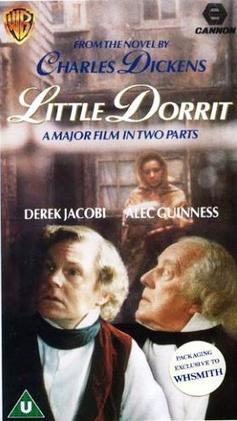
Little Dorrit is a 1987 film adaptation of the 1857 novel Little Dorrit by Charles Dickens. It was written and directed by Christine Edzard, and produced by John Brabourne and Richard B. Goodwin. The music by Giuseppe Verdi was arranged by Michael Sanvoisin.
Little Dorrit is a 1987 film adaptation of the 1857 novel Little Dorrit by Charles Dickens. It was written and directed by Christine Edzard, and produced by John Brabourne and Richard B. Goodwin. The music by Giuseppe Verdi was arranged by Michael Sanvoisin.
阅读详细介绍
Little Dorrit is a 1987 film adaptation of the 1857 novel Little Dorrit by Charles Dickens. It was written and directed by Christine Edzard, and produced by John Brabourne and Richard B. Goodwin. The music by Giuseppe Verdi was arranged by Michael Sanvoisin.
The film stars Derek Jacobi as Arthur Clennam, Alec Guinness as William Dorrit, and Sarah Pickering in the title role. A huge cast of seasoned British and Irish stage and film actors was assembled to play the dozens of roles, including Simon Dormandy, Joan Greenwood, Roshan Seth, Miriam Margolyes, Cyril Cusack and Max Wall. Pickering, in contrast, had never acted on screen; she was cast after writing to the production team claiming to 'be' Little Dorrit. It remains her only screen acting role.
Little Dorrit lasts nearly six hours and was released in two parts, of approximately three hours each. The first part was subtitled Nobody's Fault, an allusion to one of Dickens' proposed titles for the original novel, and the story developed from the perspective and experiences of the Arthur Clennam character. The second film, titled Little Dorrit's Story, took many of the same events and presented them through the eyes of the heroine. Together they represented overlapping chronicles.
Sands Films, the production company that made the film, is run by Christine Edzard, the screenwriter and director, and her husband Richard B. Goodwin.
Little Dorrit was listed in the BFI's "ten great British films directed by women" in 2014.
Plot
After returning to London after several years abroad, Arthur Clennam becomes involved in the problems of his mother's seamstress and those of her father in the Marshalsea debtors' prison.
Themes and interpretations
Little Dorrit continues Edzard's tradition of working beyond the artistic constraints that come with major commercial funding. The six hour length and two-part structure defy box-office norms and, unlike the pictorialism of more typical British period filmmaking, this is not a seductive version of Victorian England. Instead the film's streets are authentically "roaring" - full of people and objects
The director "wanted to avoid the exaggerative, the melodramatic and the sentimental". Some thought her omittance of the novel's melodramatic character – Rigaud – was a serious one which ran the risk of reducing Dickens' allegorical dialectic of good and evil to simply a satire with a love story. However, Edzard was able to reintroduce Rigaud's evil through the character of Merdle and in the way that the ruthlessness of the Circumlocution Office is represented.
In Edzard's "calmly feminist" film, the novel's character of financier Merdle is pushed into the background while the director uses, in an ironic reversal of Merdle's patriarchal role, his wife to speak for him. She allows only his influence to be felt through the "riotous lack of appreciation of the deleterious effects of capitalism throughout various strata of Victorian society."
Reception
Little Dorrit was critically acclaimed and was nominated for two Oscars: Actor in a Supporting Role (Alec Guinness), and Writing (Screenplay Based on Material from Another Medium) (Christine Edzard).
This was the first screen adaptation of one of Dickens's longest and most complex books for over 50 years and featured three hundred of Britain's best character actors.
Director Christine Edzard is known for her meticulous filmmaking often based on Victorian English sources, and her version of Little Dorrit has been recognised for its faithfulness to the original text and for the innovativeness of its narrative.
The film has 242 speaking roles and was made almost by hand at Edzard's and her husband producer Richard Goodwin's studio, Sands Films in London's docklands, where they have also made Stories from a Flying Trunk (1979), The Nightingale (1981), Biddy (1983), The Fool (1990), As You Like It (1991), Amahl and the Night Visitors (1996), The IMAX Nutcracker (1997), The Children's Midsummer Night's Dream (2001) and The Good Soldier Schwejk (2018).
Besides making films, the couple manufactured dolls houses and the sets that were built on site, where the hundreds of costumes were also sewn, were made using miniature models of houses combined with special effects to create the Victorian London background. The elaborate sets constructed included Marshalsea Prison, interiors of well to-do or neglected houses and the busy streets and dock areas of London. Designer Rostislav Doboujinsky worked on the film's sets, and on Mrs. Merdle's parrot.
The budget was only $9 million and the pink Sèvres china seen on Merdle's dinner-table, which would have been too expensive to rent or to buy, was made in the small pottery at the studios.
BFI's Screenonline described the filmmaking in detail: Filmed mainly in close and medium shot, its scenes tend to focus intently on one or two characters, the dark interiors and moody lighting evoking a sense of oppression. The theatricality and stylisation are quite deliberate, signalled by Edzard's choice of Verdi for the music soundtrack, full of tragic grandeur and operatic fatalism, but used sparingly, along with birdsong, ticking clocks, and faint sounds from outside.In the eerily quiet interior scenes a tiny movement or gesture, like dropping a shawl, can have a seismic effect. Occasionally, the long conversation pieces are broken, quite brilliantly, by sudden bursts of activity in the wider world - the print shops around St. Paul's, the bridge where Amy meets Arthur, the public areas of the Marshalsea - where a noisy, purposeful crowd will appear, bustling before the fixed camera. It's a simple, effective way of conjuring up the life of the Victorian city.
Alec Guinness' portrayal of William Dorrit is considered by some to be one of his best starring roles after the 1960s and, along with his role in the TV dramatisation of John LeCarre's Tinker, Tailor, Soldier, Spy, has been described as "effectively his screen monument".
It was the final film of actress Joan Greenwood, who died after a long and successful acting career in 1987, the year of the film's release.
The Region Two DVD was released in the UK on 27 October 2008.