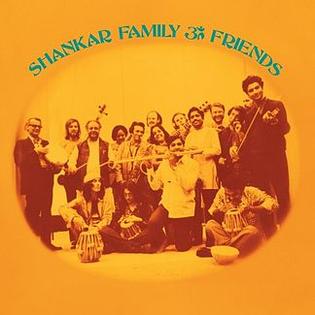
Shankar Family & Friends is an album by Indian musician Ravi Shankar, recorded primarily in Los Angeles during the spring of 1973, and released in late 1974. Produced by Shankar's friend George Harrison, it was one of the first releases on the ex-Beatle's Dark Horse label. The album was out of print for many years, and much sought after as a result, but it was remastered in 2010 and reissued as part of the Ravi Shankar–George Harrison box set Collaborations.
Shankar Family & Friends is an album by Indian musician Ravi Shankar, recorded primarily in Los Angeles during the spring of 1973, and released in late 1974. Produced by Shankar's friend George Harrison, it was one of the first releases on the ex-Beatle's Dark Horse label. The album was out of print for many years, and much sought after as a result, but it was remastered in 2010 and reissued as part of the Ravi Shankar–George Harrison box set Collaborations.
소개 자세히 읽기
Shankar Family & Friends (stylised as Shankar Family Friends on the album cover) is an album by Indian musician Ravi Shankar, recorded primarily in Los Angeles during the spring of 1973, and released in late 1974. Produced by Shankar's friend George Harrison, it was one of the first releases on the ex-Beatle's Dark Horse label. The album was out of print for many years, and much sought after as a result, but it was remastered in 2010 and reissued as part of the Ravi Shankar–George Harrison box set Collaborations.
The title Shankar Family & Friends refers to the group-participation approach to the music, from Shankar's sister-in-law Lakshmi and son Shubho to a host of "friends" from the Indian subcontinent, Europe and the United States. In a deliberate blend of "East-meets-West" musical styles, other performers include Indian-music pioneers Alla Rakha, Ashish Khan, Shivkumar Sharma and Hariprasad Chaurasia, and Western musicians such as Tom Scott, Emil Richards, Billy Preston, Ringo Starr and Jim Keltner. The album features the Harrison-arranged pop bhajan "I Am Missing You" and a jazz-funk instrumental, "Dispute & Violence", the latter a part of an intended ballet, titled Dream, Nightmare & Dawn.
Background and recording
Album content
Side one of the original LP begins with the Harrison-arranged, Spector-esque "I Am Missing You", a "toe-tapping" pop song about which Shankar would later recall: "I don't know how I did it, but one day I wrote an English song without thinking ... George heard it and liked it so much he wanted to do a version of his own." Released as a single, "I Am Missing You" features Lakshmi Shankar on vocals backed by a full Western rock band – Harrison, Hopkins, Scott, Voormann, Keltner, Preston and others – and a soaring, almost Ronette-like arrangement similar to those Harrison bestowed on his own "Don't Let Me Wait Too Long" and Starr's "Photograph" around this time.
The opening track is followed by four further Krishna bhajans, including a reprise of "I Am Missing You", and concluding with a gospel-inspired reading of the traditional folk song "Jaya Jagadish Haré". Side two (from the track "Overture" onwards) was written as a proposed ballet entitled Dream, Nightmare & Dawn, made up of what Harrison biographer Simon Leng describes as "adventurous ensemble compositions, improvised on the spot in two days". Shankar later conceded that such an approach was "a strange way of doing things", not to mention expensive. The ballet was never performed live in its entirety, however.
Although Harrison had served as Ravi Shankar's producer before – on the latter's 1971 Bangladesh relief EP Joi Bangla; the soundtrack for the Apple documentary film Raga; and a more recent live album with Ali Akbar Khan, recorded in New York – this was the first occasion that the two had collaborated on a studio album. Harrison would later refer to these and other projects with Shankar as one of his "little careers going on on the side", a series of rewarding collaborations that co-existed beside his solo career. This time, although Shankar Family & Friends did begin life as an Apple Records project, the results would not be issued on the Beatles' label, but on Harrison's own Dark Horse Records.
The bulk of the recording took place in Los Angeles during April 1973, shortly after Harrison had completed work on his album Living in the Material World and that of Nicky Hopkins, recorded concurrently in London. Arriving in Los Angeles in March, Harrison first attended Sunset Sound Studios, where former bandmate Ringo Starr's sessions for Ringo were getting under way. (It was at this point that Starr, Harrison, John Lennon, Billy Preston and Klaus Voormann recorded Lennon's track "I'm the Greatest" together, an event that immediately sparked rumours of a possible permanent reunion involving at least three of the four Beatles.) Starr, Preston, Voormann and Hopkins would all contribute to Shankar Family & Friends over the next couple of months.
Sessions began at A&M Studios, Los Angeles, on 1 April and continued into May, with a break towards the end of the first month. In addition to Starr, Preston et al., as producer, Harrison invited Tom Scott (on saxophones and flute), Emil Richards (marimbas), Jim Keltner (drums) and David Bromberg (guitar) along to participate. A jazz arranger and composer, Scott had previously worked with Harihar Rao, a former student of Shankar's and now an ethnomusicologist at UCLA. These sessions marked the first time that Harrison and Scott worked together, so beginning a loose partnership that would endure through much of the 1970s.
For the Indian contingent, Shankar chose a cast of similarly illustrious names: Alla Rakha and Kamala Chakravarty, both of whom had supported him at the Concert for Bangladesh; Ashish Khan, Shivkumar Sharma and Hariprasad Chaurasia, on sarod, santoor and bamboo flute, respectively, who had all taken part in Harrison's 1968 sessions for the Wonderwall soundtrack album (and by extension, for the Beatles track "The Inner Light"); and Lakshmi Shankar, L. Subramaniam and Harihar Rao, all of whom likewise went on to feature in the Music Festival from India venture the following year. While the majority of the recording was completed during that spring at A&M, further sessions appear to have been required through to early 1974, at Harrison's Friar Park studio.
The result across the fourteen tracks is a blend of traditional Indian music, jazz, funk, rock and Western pop – in Shankar's words, "The album contains almost every possible style that you can think of." The best-known songs are the single and "Dispute & Violence", on which Emil Richards and Tom Scott star. Both these tracks were performed on the 1974 North American tour undertaken by Harrison and Shankar, when Harrison would introduce "I Am Missing You" as "a love song to Krishna". Footage of a live version of "Dispute & Violence" from the tour was included as a bonus feature on the DVD release of Martin Scorsese's 2011 documentary Geor