
장소
Eastbourne College
영국의 초등학교
장소
영국의 초등학교
이 항목이 포함된 사건 파일에서 정보와 관계를 함께 살펴보세요.
이 항목이 포함된 사건 파일이 아직 없습니다.
이 항목으로 조사 시작하기아직 댓글이 없어요. 먼저 한마디 남겨 보세요.
관계가 언제 생기고 바뀌었는지 날짜순으로 모았습니다. 소식 글과 출처에 적힌 날짜를 기준으로 합니다.
Eastbourne College 동문 에디 이자드
영국의 초등학교
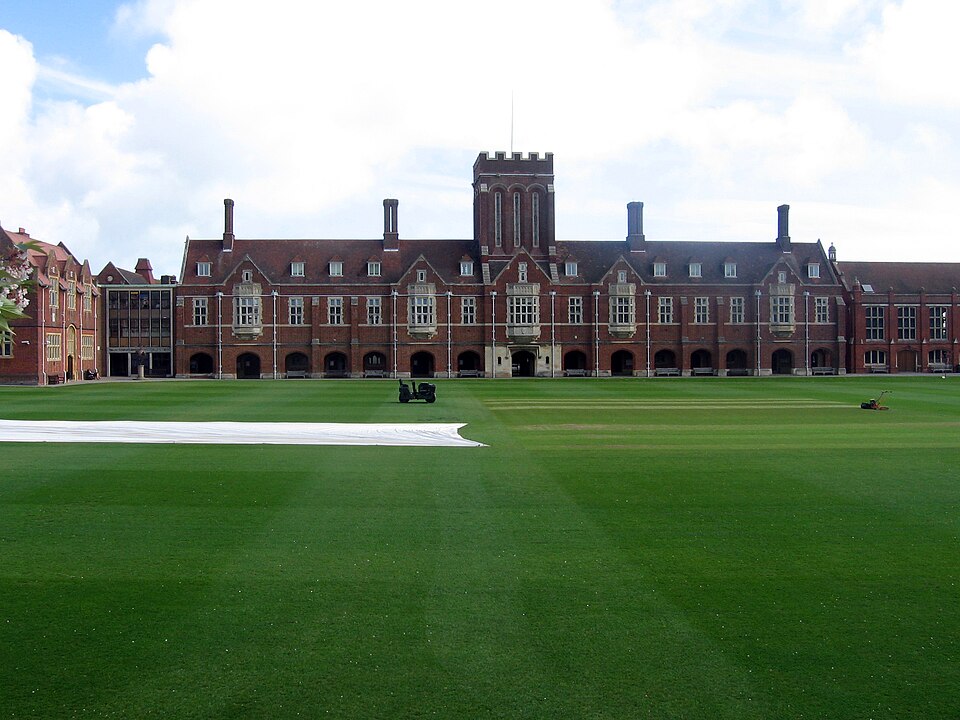
Eastbourne College is a co-educational fee-charging school in the English public school tradition, for boarding and day pupils aged 13–18, in the town of Eastbourne in East Sussex on the south coast of England. The college's headmaster is Tom Lawson.
The college was founded by William Cavendish, 7th Duke of Devonshire, and other prominent Eastbourne citizens in 1867.
The college is in the Lower Meads area of Eastbourne, a mainly residential area. Most of the school buildings are on a central campus area but many others are scattered in the immediate vicinity, such as the Beresford hockey and the links rugby pitches.
The motto, Ex Oriente Salus, is a play on "Eastbourne", meaning "The haven [the bourne] from the East". Salus also means health or salvation, the latter making an allusion to Christ, who came, from the English point of view, from the east.
Charles Hayman, an Eastbourne medical practitioner and member of the town's first council, together with other prominent local citizens, decided an independent school should be established and the support of William Cavendish, 7th Duke of Devonshire, was sought. He was supportive of the venture and provided 12 acres (5 hectares) of land for purchase at a modest price. This link with the Cavendish family is evidenced by the stag in the arms of the school.
From 1867 to 1869, it occupied Ellesmere Villa, now called Spencer Court; the location is now marked by a blue plaque. Architect Henry Currey was assigned by the duke to design a new school building, and College House, now School House, was built in 1870. The school chapel was constructed that same year.
During the 1880s, the school went through an impoverished period. Through the intervention of George Wallis, first mayor of Eastbourne and the work of new headmaster Charles Crowden, formerly of Cranbrook School, the school was saved from financial disaster.
The school's CCF corps was founded in 1896.
Sport is played at the many facilities around the college (including College Field which has been used for training by teams such as South Africa upon arrival in the UK and some internationals) and at various locations around the town acquired by the college. Former pupils who have achieved sporting success include rugby players Hugo Southwell (Scotland and London Wasps) and Mark Lock (Leeds Tykes), and cricket player Ed Giddins.
Each term at the college has a single primary sport:
There are also alternative sports, including football, cross country, swimming, golf, tennis, squash, rowing, sailing, rugby fives, fives, and rounders. The school owns a boat house nearby the campus.
On 17 October 2011, Gus Christie, chairman of the Glyndebourne Festival Opera, opened the Birley Centre. It was named after Michael Birley, former headmaster of Eastbourne College (1956–1970), and now has facilities such as a recording studio and a state of the art theatre space.
The Southern Railway made great use of steam locomotive names for publicity, and the carrying of pupils to boarding schools at the beginning and end of school terms was a significant traffic flow. Locomotives of the 'V' or "Schools" class, introduced in 1930, were hence named after prominent English public schools. The fifteenth locomotive, no. 914, was named Eastbourne after the college. Built at Eastleigh in October 1932, no. 914 remained in service until withdrawn by British Railways in July 1961.
출처: Eastbourne College (CC BY-SA)
확인된 구조화 정보, 사용자 의견, AI가 찾은 관계를 구분해 표시해요.
The college admitted its first girls in 1969 when the sixth form became coeducational, becoming one of the first HMC schools to admit girls. The college is now fully coeducational.
In 2005 the school was one of fifty of the country's leading private schools which were found guilty of running an illegal price-fixing cartel, exposed by The Times, which had allowed them to drive up fees for thousands of parents. Each school was required to pay a nominal penalty of £10,000 and all agreed to make ex-gratia payments totalling three million pounds into a trust designed to benefit pupils who attended the schools during the period in respect of which fee information was shared.