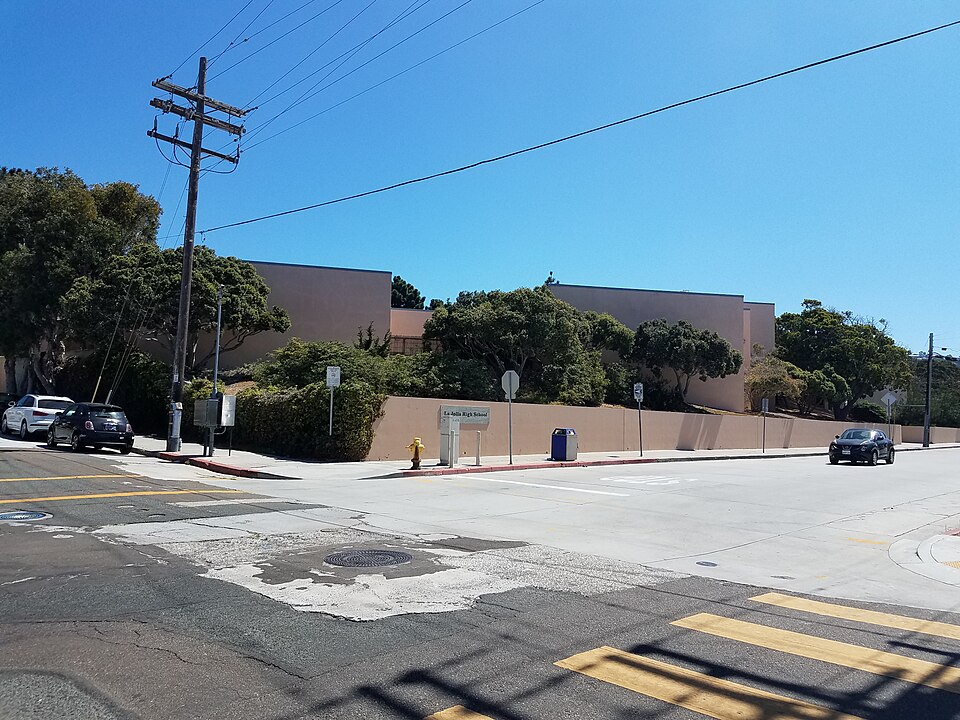
La Jolla High School (LJHS) is a public high school in La Jolla, a community of San Diego, California. Opened in 1922, LJHS is the second-oldest campus in San Diego Unified School District. It is accredited by the Western Association of Schools and Colleges (WASC).
La Jolla High School (LJHS) is a public high school in La Jolla, a community of San Diego, California. Opened in 1922, LJHS is the second-oldest campus in San Diego Unified School District. It is accredited by the Western Association of Schools and Colleges (WASC).
소개 자세히 읽기
La Jolla High School (LJHS) is a public high school in La Jolla, a community of San Diego, California. Opened in 1922, LJHS is the second-oldest campus in San Diego Unified School District. It is accredited by the Western Association of Schools and Colleges (WASC).
LJHS was named a California Distinguished School in 2003. It is recognized as an Advancement Via Individual Determination (AVID) School of Distinction. LJHS was the first public high school west of the Mississippi to earn a chapter in the Cum Laude Society.
PTSA
In 1997, former principal Dana Shelburne discontinued LJHS's controversial PTSA (then "PTA") Volunteer Hours program. The program, which was reportedly not put in writing until 1996, allowed PTA parents who volunteered over 75 hours to exercise specific control over their students' schedule and teachers. A PTA brochure said the program allowed parents to create a "dream schedule" for their child. The program was terminated following heavy criticism from parents whose students were enrolled in SDUSD's Voluntary Enrollment Exchange Program, a voluntary school busing program. Shelburne said that the program was shut down due to "the bookkeeping burden on the PTA and lack of benefit."
The Foundation
The Foundation is the fundraising organization for LJHS. Funds raised by the Foundation have been used to fund full-time faculty positions, security cameras, robotics class equipment, technology, textbooks and fiction books, teachers' professional development conference registration, academic league and team competition fees, athletic facility improvements, athletic trainer, and coaching fees among others. The LJHS Foundation fulfills a complementary, but distinct, role from the PTSA by raising funds for high-priority programs that are not fully funded by the SDUSD, as determined by the administration, site governance, and academic department chairs.
Site governance
The Site Governance team meets on the first Monday of each month. It consists of the following nineteen members: the principal; eight certificated staff representatives; one San Diego Education Association site representative; one classified representative; five parent representatives; one community representative; and two student representatives. Agenda items, which can be submitted by anyone, are turned in to the elected chair prior to the meeting. The role of the Governance Committee is to provide a forum for examination of issues relating to LJHS. The development, implementation, and evaluation of programs and policies of LJHS fall within the purview of the Governance Committee. The School Site Counsel meets after Site Governance, and some members are in both groups.
Demographics
In 2015, LJHS had about 1,500 students in grades 9-12, supported by 109 staff members (a principal, 2 vice principals, 67 credentialed teachers, 2 visiting community college professors, 4 counselors, a nurse, a psychologist, a librarian, a media tech, 6 custodial staff, a landscaper, and other support staff).
LJHS has two NBCTs (National Board Certified Teachers) in its English Department, and numerous AP (Advanced Placement) instructors in English, Computer Science, Social Science, and Science Departments who serve as Readers or Table Leaders for the annual AP Exams, which are designed by the College Board to measure student achievement in college-level classes and administered by the Educational Testing Service (ETS). All LJHS teachers have a valid credential for the subjects they teach, and SDUSD has certified the site as 100 percent No Child Left Behind (NCLB) compliant.
Caucasian students make up a little more than half of the student population, and Hispanic students comprise the largest minority population.
LJHS is made up of 61% residential students and 39% nonresidential. Of the approximately 1,500 students currently enrolled at LJHS, 24% are eligible for free or reduced lunch. Various students are enrolled in Voluntary Ethnic Enrollment Plan (VEEP), CHOICE, Program Improvement School Choice (PISC), NCLB, and special education programs. LJHS does not receive any Title I funds.
Discipline, dropout and graduation rates
LJHS's suspension rate is low, at about 3% for the 2021-2022 school year. The main reasons (about 50%) are due to minor disruptions in the classroom. The other 50% of suspensions include reasons such as fighting, alcohol/drug/tobacco possession and/or use, and stolen property. The dropout rate is 1%.
Students graduating with UC "a-g" credits increased from 70.7% to 79.4% in 2013–2014, the most recent year recorded by SDUSD. Class of 2016 students will be required to pass the "a-g" requirements for graduation.
Assessment and testing
The most recent testing data is available on the California Department of Education website. The CST Standards Assessment and Reporting system was phased out in the 2014–15 school year and replaced with the new California Assessment of Student Performance and Progress (CAASP). The CAASPs are summative assessments for all 11th graders in English Language Arts and Mathematics to measure their achievement in the Common Core State Standards (CCSS). On La Jolla's 2018 performance on the CA School Dashboard, LJHS 11th graders scored 78.6 above the standard for Math and English Language arts, a 21.8 point increase from 2017.
A more comprehensive breakdown of testing statistics related to English Language Learners, students receiving SpED services, socioeconomically disadvantaged students, and other subgroups can be found on the Mid-Cycle Review WASC document published on the LJHS website.
Academics
All LJHS classes have a hard cap of 36 students per class. However, certain AP courses and other classes are filled above capacity.
In 2015, the number of seminar-identified students in grades 9-12 was 234. The number of students enrolled in a seminar-identified class was 152. There are no seminar classes for 12th grade, as seniors are expected to take AP's or college-level classes such Political Science (offered through Mesa Community College) on the LJHS campus.
Each year, approximately 72% of LJHS students attend four-year u