
항목
디스토피아 영화
dystopian film
영화 장르
항목
dystopian film
영화 장르
이 항목이 포함된 사건 파일에서 정보와 관계를 함께 살펴보세요.
이 항목이 포함된 사건 파일이 아직 없습니다.
이 항목으로 조사 시작하기이 항목과 이어지는 작품이나 사람을 살펴보고 있어요.
디스토피아 영화
연결된 것을 찾고 있어요.
영화 장르
Dystopian is a subgenre of science fiction and political films that depicts imagined societies characterized by oppression, control, environmental degradation, and social or political instability. These films commonly explore themes of totalitarian control and the impact of political, social, or technological developments on individual autonomy.
Dystopian films are commonly characterized by the following features:
Dystopian films involve a society that is subjected to strict surveillance and control by a dominant authority. Scholars have noted that dystopian narratives across literature and film depict citizens as subject to forced labor, indoctrination, or exploitation under authoritarian systems.
Dystopian films depict multiple mechanisms of social control, including:
Dystopian films often depict advanced technology as a tool of surveillance and social control within highly mechanized societies. This theme is illustrated in dystopian films such as The Matrix (1999) by The Wachowskis, which depicts a society dominated by technological manipulation.
Bureaucratic control refers to the use of rigid administrative systems, hierarchical authority, and impersonal regulations as mechanisms of social control. Scholars such as Keith Booker have discussed bureaucratic control as a central feature of dystopian literature, a theme that is also commonly depicted in dystopian films such as Brazil (Gilliam 1985) and The Hunger Games (2012).
Dystopian narratives feature protagonists who resist oppressive social conditions and rebel against their oppressors. Such resistance may take the form of challenging the established order, exposing concealed truths, or seeking personal freedom within an oppressive society.
The development of dystopian film is commonly traced to dystopian literature of the late nineteenth and early twentieth centuries. Works such as We (1924), Brave New World (1932), and Nineteen Eighty-Four (1949), provided the thematic and philosophical groundwork that later filmmakers would translate to the screen.
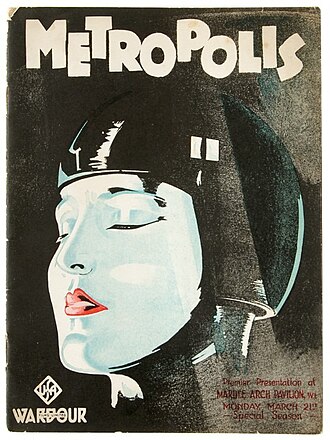
Cinematic dystopia emerged almost simultaneously with these literary developments. In the 1920s and 1930s, European filmmakers began to use visual spectacle to depict mechanized societies and the erosion of individuality. Fritz Lang's Metropolis (1927) is widely regarded as the seminal dystopian film, combining Expressionist aesthetics with social commentary on class hierarchy and industrial alienation, as discussed by film scholars such as Anton Kaes.
Commentators have noted that early works such as William Cameron Menzies's Things to Come (1936) expressed both optimism and anxiety about technology's capacity to rebuild or destroy civilization. These early examples established visual and thematic conventions that were subsequently incorporated into the film genre.
During the Cold War era, films frequently depicted authoritarian regimes, surveillance, and nuclear threats, themes commonly associated with Cold War–era concerns. Adaptations of dystopian literature, such as 1984 (1956) and Fahrenheit 451 (1966), gained widespread attention due to their distant yet realistic settings.
The 1980s and 1990s saw the emergence of cyberpunk and technologically oriented dystopias, associated with anxieties about corporate power, computers, and urban decay. Ridley Scott's Blade Runner (1982) combined film noir aesthetics with futuristic landscapes, depicting themes related to artificial intelligence, identity, and industrialization. Terry Gilliam's Brazil satirized bureaucratic and corporate control through absurdist imagery, while films such as RoboCop (1987) and The Matrix (1999) interrogated the relationship between humanity, technology, and autonomy.
Scholars and reference sources have identified recurring motifs in dystopian films from this period, including sharp divides between wealth and poverty, oppressive state or corporate control, alienation and dehumanization of individuals, and pervasive surveillance. These core elements established a foundation for subsequent dystopian storytelling, allowing filmmakers to explore contemporary social fears through imaginative futuristic scenarios.
In the 21st century, dystopian film has experienced renewed popularity, a trend commentators have linked to contemporary concerns such as climate change, social inequality, mass surveillance, global crises, and the increasing influence of digital technologies.
Films and series often depict near-future or alternate societies where the consequences of environmental degradation, economic disparity, or algorithmic governance are dramatized, illustrating individual and collective responses to oppressive social conditions. Notable examples include Children of Men (2006), which explores societal collapse and global infertility, and the Hunger Games series (2012–2015), which popularized dystopian narratives for younger audiences while highlighting themes of social stratification and authoritarian control.
Anthology series such as Black Mirror (2011) continue to examine the ethical and psychological implications of technology, reflecting current concerns about privacy, surveillance, and the dehumanizing potential of digital networks.
Dystopian fiction explores oppressive societies, typically characterized by profound human misery, poverty, oppression, and fear. Within this broad genre, several types of dystopia genres have emerged, each focusing on a distinct source of societal control, technological advancement, or environmental change.
Cyberpunk is defined by its "high-tech, low-life" aesthetic.
Focus: It centers on worlds where highly advanced technologies, such as cybernetics and artificial intelligence, coexist with profound social decay and poverty. Key themes include social stratification, alienation, blurred boundaries between human and machine, and critiques of corporate capitalism.
Governance: Governance is frequently dominated by massive, monolithic corporations megacorps that hold immense political and economic po
출처: Dystopian film (CC BY-SA)
확인된 구조화 정보, 사용자 의견, AI가 찾은 관계를 구분해 표시해요.
아직 댓글이 없어요. 먼저 한마디 남겨 보세요.