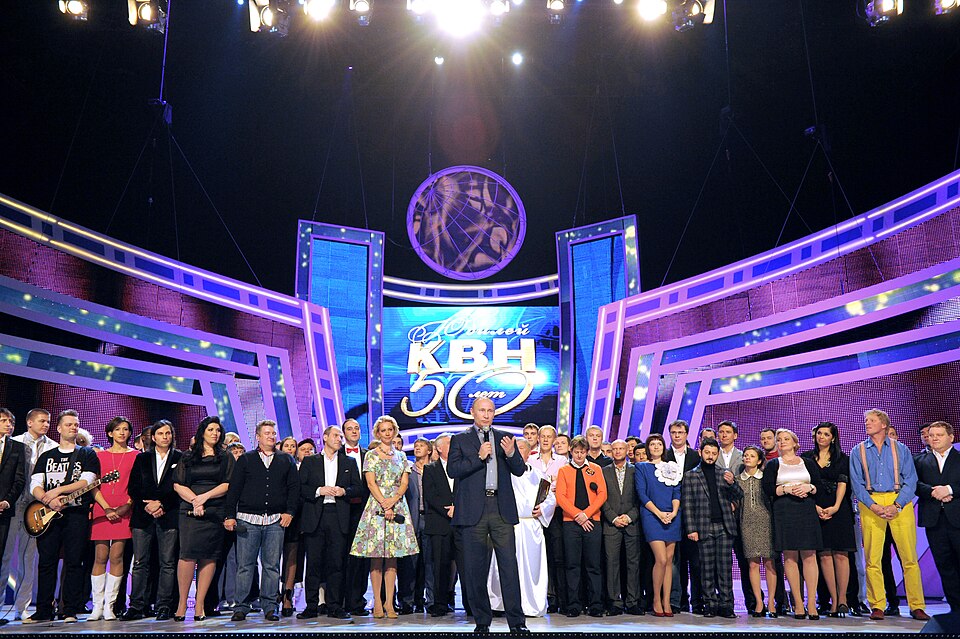
KVN is a Russian and formerly Soviet comedy television show and international competition in which teams compete by giving humorous answers and show prepared sketches. The show originated in the Soviet Union and is based on the earlier program An Evening of Funny Questions. The program was first aired on the Soviet First Channel on 8 November 1961.
KVN is a Russian and formerly Soviet comedy television show and international competition in which teams compete by giving humorous answers and show prepared sketches. The show originated in the Soviet Union and is based on the earlier program An Evening of Funny Questions. The program was first aired on the Soviet First Channel on 8 November 1961.
阅读详细介绍
KVN (Russian: КВН, an abbreviation of Клуб весёлых и находчивых, Klub vesyolykh i nakhodchivykh or Ka-Ve-En, "Club of the Funny and Inventive [people]") is a Russian and formerly Soviet comedy television show and international competition in which teams compete by giving humorous answers and show prepared sketches. The show originated in the Soviet Union and is based on the earlier program An Evening of Funny Questions (Russian: Вечер весёлых вопросов, romanized: Vecher vesyolykh voprosov). The program was first aired on the Soviet First Channel on 8 November 1961.
In 1972, Soviet censors, who found the students' impromptu jokes offensive and anti-Soviet, banned KVN. The show was revived in 1986 during the perestroika era, with Alexander Maslyakov as its host. It is one of the longest-running programs on Russian television; its anniversary on 8 November is celebrated by KVN players every year since its inception and was widely celebrated for the first time in 2001.
During the perestroika era (c. 1985-1991), KVN spread to Russian expatriate communities. In 1992, an Israeli team played against the Commonwealth of Independent States (CIS) team. The game became a success, and more international games followed: the CIS team visited Israel, Germany and the United States. In 1994, the first KVN World Festival was held in Israel; it featured four teams representing the United States, Israel, the CIS and Germany.
Leagues and competitions
Groups of KVN teams were organized into several leagues, in which they annually competed for the League Champion title. To organize the movement, the KVN Union created a structure of regional and multi-regional arrangements of Leagues. The Major League and the Premier League are regularly broadcast on Russian television station Channel One. Other leagues were broadcast on local channels. The winner of the Major League (Vysshaya Liga Russian: Высшая Лига) is declared the Champion of the Club. There are other KVN competitions outside the leagues: the KVN Festival (KiViN) is held in Sochi each January and attracts hundreds of teams from around the world: this is where teams are arranged into leagues for the season; the Musical Festival, which is called "Singing KiViN" (Golosyaschiy KiViN, Russian: Голосящий КиВиН), was held every July in Jūrmala, Latvia; and has been held in Svetlogorsk, Kaliningrad Oblast, Russia, since 2015. At the festival, teams compete to win prestigious prizes; the Summer Cup or Supercup is usually played in August every year, usually in Sochi, and only Major League champions are allowed to compete (with some exceptions: in 2003, when a team of famous KVN players competed, and in 2007, 2008 and 2010, when finalists were invited). A game called the Specproject (pronounced "Spetsproyekt") is held every November to celebrate KVN's anniversary. Many places, both inside and outside the CIS, have leagues independent from the KVN Union and hold their own competitions.
Format
KVN is a task-based team competition that is played in front of a live audience and a panel of judges. Typically, each team is asked to complete four or five themed assignments, such as:
Mandatory
Greeting (Privetstviye, Russian: Приветствие): witty introduction of the team, humorous greeting to the jury and spectators.
Analysis of the content of KVN releases for the presence of political censorship
The recognition of KVN as a political tool by the NATO StratCom Center for Strategic Communications became the reason for conducting a content analysis of KVN releases. Based on the results of a content analysis of political humor in four episodes of KVN from 23 October to 27 November 2016, in various formats, one with the participation of the President of the Russian Federation, the following conclusions were drawn:
The format and location of the game affect the nature of the content of political jokes.
Jokes containing foreign policy themes construct a
Warm-up (Razminka, Russian: Разминка) is usually the second contest; a rapid exchange of funny questions and improvised answers, sometimes played against the audience, jury and the host.
Musical Competition (Muzykalnyy Konkurs, Russian: Музыкальный конкурс): the competing teams perform musical sketches, sing, play musical instruments and dance. Sometimes an alternative, shorter version called One Song-Contest (Konkurs Odnoy Pesni, Russian: Конкурс одной песни) is played; players must use one melody throughout the competition.
Optional
STEM ("students' variety miniature theater") (Russian: СТЭМ): three performers from a team are allowed to be on stage simultaneously.
Captains' contest (Kapitanskiy Konkurs, Russian: Капитанский конкурс): individual competition between the team captains.
Homework (Domashneye Zadaniye, Russian: Домашнее задание): comedy sketches on a given topic; sometimes Musical Homework is played when there is no Musical Competition.
BRIZ (Bureau of Rationalization and Invention) (Russian: БРИЗ): teams present an invention, a brief historical survey, movies, photo-albums or any type of new idea. It is also called a literature contest because it mainly consists of textual jokes.
News Contest (Konkurs Novostey, Russian: Конкурс новостей): similar to the BRIZ but focuses on strange and funny news items.
Biathlon (Russian: Биатлон): a representative of each team "shoots" one or more jokes at the audience. The jury decides who leaves the "shooting range" until only two contestants remain and the jury chooses one winner who gets one point. In case of a draw the finalists receive 0.9 points each.
Freestyle (Russian: Фристайл): a more-modern and freer version of the Greeting, in which the teams have no genre restrictions.
Cinema Contest (Kinokonkurs, Russian: Киноконкурс) involves contestants making a movie, a music video, a clip consisting of different video and audio pieces, or dubbing a well-known movie.
A panel of celebrity judges evaluates performances on wit, humor, production values and audience reaction, and declares a winner by awarding points to the teams. In the Premier League, the jury usually consists of famous KVN players.